Sigma 362 anchor solution?

If the reason its hard work is because anchors are heavy then use a lighter anchor. Spade, Excel, Fortress, (which are available in aluminium form), or Viking and Odin (which are light through design - being based on high tensile steel, come to mind. If its hard work because anchors are an inconvenient shape - then maybe you are in the wrong pastime/sport :(..

We used an aluminium Spade and Excel - both are as good as the steel versions b ut are half the weight compared to their steel siblings.

Odin and Viking are currently out of stock but a new batch should be available soon.

Jonathan
 
Totally agree with Neeves here. I have a Sigma 362 and I too wondered about a windlass when I first got it. Then I realised that a) fitting such a thing would be a challenge in terms of space and effort (for me), and b) the real; problem was the heavy CQR anchor and the problems manhandling it out of the anchorlocker, and on to the roller. The solution, which has worked pretty well for over 20 years, was a lightweight 3rd generation anchor - in my case an aluminium Spade.

FWIW, I do my anchor handling (quite regularly - the boat is on the east coast) while standing in, or sitting on the edge of, the 362's anchor locker, that I can do once I've the anchor out, through the pulpit and hanging off the rollers (I put a bow fender out first if the water is a bit lumpy). From there, launching only requires gravity, tempered by preparation and manual control. Retrieval is straightforward too, a little bit of forward thrust from the motor will take any unwelcome weight/tension off the rode and standing in the anchor locker while pulling allows me to use body weight without straining limbs or joints (I'm not in the first flush of youth, or even middle-age, so I think about those things). If I get tired I just loop the road around the starboard mooring cleat. The most difficult bit about doing it all manually is breaking the anchor out of a firm set, but that generally only requires steady tension, the boat's natural movement and a little patience - and if your patience runs out there's always the motor.
 
Hi there ..I've just got a sigma 36 with a very big steel anchor, could you tell me what aluminium anchor you've got as well as how much chain and the size of it...I like your solution !!!
Thanks

John
 
Hi there ..I've just got a sigma 36 with a very big steel anchor, could you tell me what aluminium anchor you've got as well as how much chain and the size of it...I like your solution !!!
Thanks

John
It's an aluminium Spade anchor, the A100, on 25metres of 8mm chain and 30metres of 16mm (I think) anchorplait. Spade now say don't use an aluminium one as a primary anchor - there was no such advice when I bought mine but I think it might have been concerns about the shaft bending in certain circumstances that led to the warning. I bent mine once (trying to anchor on a patch of sand between rocks - I missed) so just got a new shaft. There's no doubt in my mind that an aluminium anchor is unlikely to last as long as a steel anchor, but this one is over 20 years old and, while showing its age, still seems to work as well as it always has.
 
The alternatives to an aluminium Spade would be an aluminium Excel, from Jimmy Green, or a Viking or Odin, from Viking Anchors.

The Spade A100 seems a bit overkill for a 36' yacht. We used an A80 or a No 4 Excel (in steel they both weigh around 15kg and in aluminium they weight around 8kg) We used either as a primary anchor on a 38' cat with the windage of a Bav 45. The Viking 10 or Odin 40 would be the comparable anchors from Viking, weighing in at around 10kg each.

Today I'd replace the aluminium anchors with an Odin 40.

The Viking and Odin seem underweight for a primary but they use HT steel and the fluke area of the A80/No 4 is the same as the Viking/Odin.

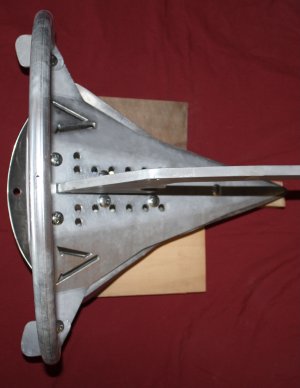
The Viking 10 and Odin 40 use the same sized fluke and this is the Viking 10 overlaid on a Spade S80 fluke.
IMG_4488.JPG

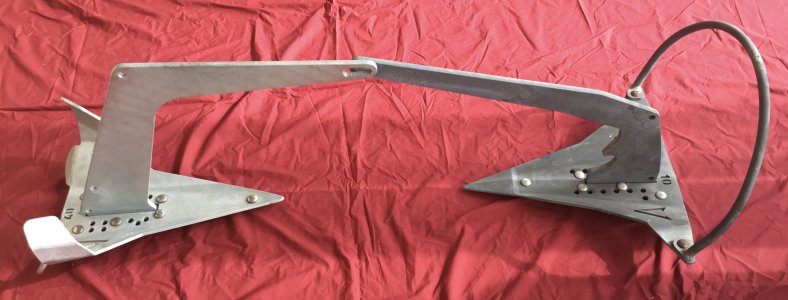
Spade and Excvel both rely on ballast, and a lot of it to engender setting. Viking relies on a roll bar. Ballast does not contribute to hold and neither does a roll bar, both are crutches to help the anchors to set. Odin does away with such devices and uses those fins which also contribute to anchor stability, acting as vertical flukes. Drop Odin on its side or upside dow on the seabed and apply a little tensions and the fins will self right the anchor to allow it to set. The fins are hydro dynamic acting like aircraft flaps, or the 'lift' of keeled yachts and the lift provided by foils on a foiling yacht (except Odin's fins can provide 'lift' using the seabed as well as the seawater).

Viking 10 opposite an Odin 40.

IMG_0838.JPG

Using foils (or fins) to provide lift is old technology - but not much seen in anchors :). But sand and mud are 'liquids' - being used to your advantage by Odin.

Jonathan
 
Last edited:
Top
