Should I rivet old holes in my boom?

Captain Crisp

Well-Known Member
Joined
1 Mar 2015
Messages
414
Visit site
My 50 Yr old boom has numerous holes from old fixings... someone told me it's a good idea to rivet them as it adds strength...
Opinion seems a bit divided though...
Any thoughts?
Thanks,
Crisp
 
If there was some form of corrosion protection that could be pushed into place & held there then along with the large head covering the hole it may provide some benefit towards that. However, one could no longer monitor corosion behind the head if one just stuck a rivet in the hole. In this case the rivet would be a disadvantage.
Does Duralec etc. provide corrosion resistance?
Structurally the rivet would do nothing.
 
If the hole is on the compression side, filling it with a rivet is sometimes said to make the spar a little less easy to break.
Probably marginal and only makes a difference if the hole is in the worst places.
 
If the hole is on the compression side, filling it with a rivet is sometimes said to make the spar a little less easy to break.
Probably marginal and only makes a difference if the hole is in the worst places.
If filling a hole with a rivit is a consideration with strength, then the boom is marginal, to say the least. If the cosmetics worry you, go ahead,
 
If the wind is making whistling noises in the holes, then fill them in either with rivets or filler. Otherwise just leave them alone.
 
Considering you are not supposed to drill any holes into a spar more than 15% of length away from the ends, I doubt filling a hole with a rivet makes any difference. If corrosion were an issue, then, by all means, fill it with a dab of epoxy, as has already been suggested. Besides, you might be unpleasantly surprised at the price of monel rivets.
 
Considering you are not supposed to drill any holes into a spar more than 15% of length away from the ends, I doubt filling a hole with a rivet makes any difference. If corrosion were an issue, then, by all means, fill it with a dab of epoxy, as has already been suggested. Besides, you might be unpleasantly surprised at the price of monel rivets.
Does the 15% rule apply to spreader attachments or tracks? ?
 
Does the 15% rule apply to spreader attachments or tracks? ?
Spreaders in conjunction with lower, intermediate shrouds divide a mast into individual panel lengths.
I doubt any aluminium mast will meet that rule, holes drilled for - deck light, steaming light, radar, radar reflector, lower shrouds & stays etc. If keel stepped, the gooseneck and winches would also be outside the allowed area.
Firstly, keel stepping creates the equivalent of a separate panel.
Re stays and shrouds see my previous comment.

What I have often wondered about are the many long slots cut into masts, often on the same side, for halyard exits. The only possible explanation is that these masts are substantially over engineered, which is not exactly a performance enhancing feature.
 
Spreaders in conjunction with lower, intermediate shrouds divide a mast into individual panel lengths.


Firstly, keel stepping creates the equivalent of a separate panel.
Re stays and shrouds see my previous comment.

What I have often wondered about are the many long slots cut into masts, often on the same side, for halyard exits. The only possible explanation is that these masts are substantially over engineered, which is not exactly a performance enhancing feature.
So the 15% "rule" is nonsense. Presumably we can take it that track fastenings at maybe 200mm centres, "divide the mast into individual panel lengths". My own masts have steps riveted on every 500mm. Are they doomed?
 
Considering you are not supposed to drill any holes into a spar more than 15% of length away from the ends, I doubt filling a hole with a rivet makes any difference. If corrosion were an issue, then, by all means, fill it with a dab of epoxy, as has already been suggested. Besides, you might be unpleasantly surprised at the price of monel rivets.
I cannot think of any engineering reason to restrict holes to precisely 15% though I accept that holes nearer middle give the greatest weakening of a bowing beam. However I suspect that most booms are so over engineered now ali is the preferred material that the effect of a tiny rivet hole is trivial. Some of the reefing cord loops riveted on my boom are certainly more like 30% from the mainsheet end
 
So the 15% "rule" is nonsense. Presumably we can take it that track fastenings at maybe 200mm centres, "divide the mast into individual panel lengths". My own masts have steps riveted on every 500mm. Are they doomed?
Considering that these figures are quoted in a number of heavy tomes on yacht and rig design, I do and have paid attention to them when designing or modifying rigs.
In this context I am left with occasional astonishment of what one can apparently get away with, such as three 6" long, albeit staggered, slits for halyard gates and these well within the max load zone.

Of course, at the end of the day everyone is free to drill as many holes and wherever they like in their spars - presumably one of the lesser-known benefits of living in a free society.
 
Considering that these figures are quoted in a number of heavy tomes on yacht and rig design, I do and have paid attention to them when designing or modifying rigs.
In this context I am left with occasional astonishment of what one can apparently get away with, such as three 6" long, albeit staggered, slits for halyard gates and these well within the max load zone.

Of course, at the end of the day everyone is free to drill as many holes and wherever they like in their spars - presumably one of the lesser-known benefits of living in a free society.
I guess that Selden, and others, haven't read your heavy tomes. ? Just for interest, have you experienced any cases of mast failure attributable solely to a reasonable spread of holes and slots? (We all know that masts will fail if their rigging fails).
 
I've got a couple of laser top sections broken at the rivet hole.
I've got a boom from a centre-main dinghy with a big crack in it from a hole on the bottom near where the sheet attaches.
Current dinghy has a xarbon boom with no holes drilled more than an inch from the ends.
The clew, sheet and kicker all work on webbing straps around the boom.

I think some masts with lots of slots cut in the lower end are double thickness in that area?
 
I guess that Selden, and others, haven't read your heavy tomes. ? Just for interest, have you experienced any cases of mast failure attributable solely to a reasonable spread of holes and slots? (We all know that masts will fail if their rigging fails).
I have seen two that failed at the spreaders and one at the height of the goose neck. Whether that was due to any weakening from perforating the tube I don't know, but I'm willing to keep an open mind. The rigging on these was still intact.
I had an aluminium mast fail on our little gaffer where it was sleeved and riveted in the middle.
 
I cannot think of any engineering reason to restrict holes to precisely 15% though I accept that holes nearer middle give the greatest weakening of a bowing beam. However I suspect that most booms are so over engineered now ali is the preferred material that the effect of a tiny rivet hole is trivial. Some of the reefing cord loops riveted on my boom are certainly more like 30% from the mainsheet end
You may be talking about a dinghy which is a different matter. However, I might query if booms on some modern AWBs are over engineered. I was looking at the boom on a Parker 31 & then at my own on a Hanse 31 & the difference does make me wonder how much I have in reserve. I was looking at the boom on a Halberg Rassey 35 & a Hanse 35 & one could see the difference immediately. So either the HR is so ridiculosly over engineered, or Hanse & similar mass production builders are using spars that are very near the limit.
That being said , one does not hear of many instances of broken booms. But that may be because the typical AWB does not dip the boom in the sea when on the run. I can recall a number of times when running down wind in my Stella, with its renowned Holman roll, I would dip boom, then spinnaker pole.
My current boat has a high topside & the boom rarely gets aywhere near the water. I normally am forced to reef long before conditions would force such conditions anyway.
I do worry a little, but then any responsible skipper keeps his eye on the rig & the strains that are being applied. unnecessarily. So if the Op has some extra holes that are corroding & are in position that could affect structural integrity, he should seek advice. Alternatively, treat the spar in question with respect.
 
I have seen two that failed at the spreaders and one at the height of the goose neck. Whether that was due to any weakening from perforating the tube I don't know, but I'm willing to keep an open mind. The rigging on these was still intact.

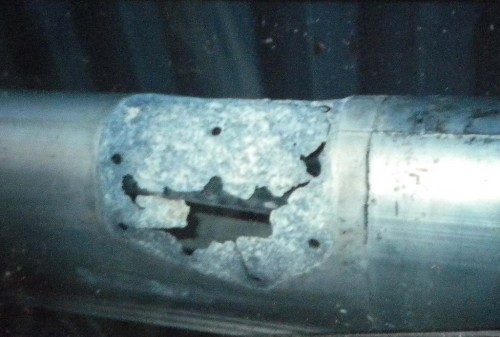
The usual reason for old masts to fail at fittings when the rigging doesn't is catastrophic galvanic corrosion of the mast hidden by the fitting.

michael-1430656647-Vera%20mast%201.JPG
 
Top