Should I have bilge pumps?

steve yates

Well-Known Member
Joined
16 Oct 2014
Messages
4,105
Location
Benfleet, Essex/Keswick, Cumbria
Visit site
I bought a plasticy whale hand pump thing, which doesn't look like it would be much use, with a rich loudly short hose on it, but that apart I have no pumps on my boat.
One Bradwell I looked at had a handle in the cockpit which operated a pump in the saloon, which I thought quite practical.
I presume I should have some means of getting seawater, back out of the boat should the waves decide to come in?
What do I need and where? I don't appear to have any bilges, what I can see so far under the floorboards looks like solid concrete, which I presume someone has laid down to add ballast?

I imagine I would want something to clear the cockpit in case of taking water over the side, and something to clear below in case it comes in through the companionway into the cabin?

What would be a good workable as I will usually be single Handing? By the way, it's just an 18 ft lifting Keeler in the Irish Sea.
Thanks
 
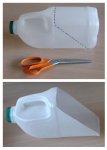
Depends on the type of boat. Cockpits normally have drains so don't need a pump. If yours doesn't then a bucket is probably more efficient than a pump in a small boat. Otherwise bilge pumps are mostly for removing water rather than for keeping a boat afloat as water pours in. So you just need whatever does the job. If you have electricity then a small 12v pump fitted permanently to the lowest part of the bilge. If not then a sponge and the bucket is probably best, or a cut off plastic milk bottle.
 
On one of the early Whitbread races it was reported by one boat that they found the best bailer to be a drowning man with a bread bin
Bearing in mind that boats such a Squibs etc do heal over & fill very quickly with water ( one of our club members just lost one). I would suggest the minimum to be a bucket.
In any event a small whale below deck with a handle near the helm for use in emergency a good option
Even on a fairly calm day something like the wash from a ferry can cause sudden drama
 
I carried a Whale dinghy pump like this

mg-y003679.jpg


on my last boat, a 21' Westerly, for 20 years. I never used it to pump anything out of the bilges - its main use was to empty the rigid dinghy after rain and very occasionally to pump out the fresh water tank after cleaning.

I now carry the same pump on the Hunter 490, where I use it to empty the cockpit, which only self-drains down to the last 3". The boat came with a small pump

IMG_4550.jpg


but I have never installed it, because I can't imagine it shifting as much water as would come in with a real emergency and for smaller amounts a bailer works fine.
 
In a word, absolutely!

Whale do an electric "super sub" in different sizes. Yellow, with an electronic sensor built in. All it needs is a 12v source. I'd also install a one-way valve in the outlet so any water it shifts from the bilge doesn't pour back in when the pump stops.

Install in the lowest part of the boat and pipe overboard.
 
The cockpit is self draining I believe, ( at least, it doesn't fill up with rain water)
That's the pump I bought Jumbleduck, the first one. The second one looks like what I saw in an earlier Bradwell I was looking at.. I do have electricity.
 
Dinghies only need a hand bailer, because they should have enough buoyancy to float even if completely flooded. Your boat may be small, but with ballast under the sole boards she sounds more like a little yacht. Yes, she needs a bilge pump.

I assume a small boat probably has a basic electrical system, if any at all. So you can't really rely on an electric pump to keep working when you need it, without flattening the battery.

There's an argument sometimes made that small boats need bigger bilge pumps than big boats, because the same amount of water coming in will sink them quicker. On the other hand, pumps do take up a surprising amount of space especially once you account for the plumbing, and there's no shame in recognising that smaller boat generally means smaller budget.

But in your position I'd get the biggest hand-operated diaphragm pump that I could, and fit it with the handle in the cockpit where I could reach it from the tiller. Probably a through-deck type with removable handle.

Patay are similar to Whale but lesser-known, so maybe cheaper.

Pete
 
+1 on my Pandora 700, there is a hole about 11/4 to drain cockpit, but I often wonder if large enough, thinking of drilling further hole in opposite corner?
 
>The usual recommendation is a minimum of one electric pump and one manual. That is what I installed on my 19 footer.

That's right for a boat that size the electric pump must have a float switch to trigger when there is water ingress. For larger boats we had 38 foot boat that was fitted to RORC standards whitch is two manual pumps and one float switch 12v electric pump. One of the hand pumps was in the cockpit and the other in the loo.
 
If you have a fixed pump, make sure there is a strum box or a strainer on the end, nothing worse than a blocked inlet pipe when you need to use it.

The bailer i used in dinghy sailing was an old petrol can that had lost its hose and was rather old, so cut it down like in the diagram for the milk bottle, very robust, nice handle and good volume. Mind you when a chum turned over his wayfarer and filled it to the gunnels short of using a dustbin to empty it... it ended up being towed to the shore and the bungs pulled out, too much chop to do anything else
 
Oh I have a bucket, which I think would be far more effective than the first hand pump Jumbleduck posted ( I have that too, but it's a two handed operation which could be an issue single handing, if the pump,is needed there are probably other problems to deal with too)
What about the fact that I appear to have no bilges? It's all concrete under the floor panel?
Should I have a pump on the floor level then?
In my head, a fixed hand lever like jumbleducks second picture is a potentially very useful safety feature to have.
BUT, should it be clearing water from the cabin below? Or from the cockpit?
It would seem to me that it should be clearing any water from below, and the cockpit drains clearing any in the cockpit,
But where does the outflow pipe go?
I do seem to have a sink outflow, could it be joined to that?
It seems to me that drilling holes in the hull of a boat going to sea is a bad idea?
Bear in mind I am a total novice so the obvious may not be to me :)
 
But where does the outflow pipe go?
I do seem to have a sink outflow, could it be joined to that?
Yes
It seems to me that drilling holes in the hull of a boat going to sea is a bad idea?
That's always been my view too - fewer the better.. :D

If the sink outlet is no good see if you can drain to the cockpit (where it can exit via the cockpit drains), or to an outlet above the water line, or even just have along outlet hose attached and put it over the side when using the pump...

Bear in mind I am a total novice so the obvious may not be to me :)
We all started somewhere, and most of it is still not obvious to me either!
 
I presume I should have some means of getting seawater, back out of the boat should the waves decide to come in?
What do I need and where? I don't appear to have any bilges, what I can see so far under the floorboards looks like solid concrete, which I presume someone has laid down to add ballast?
I'd be a bit concerned about having concrete in the bilge. In the old days it was a trick to stop up a leaky wooden boat that would fall apart a month after purchase. Whilst that's not likely to happen, I'd want to have A very good poke around outside and inside the area
 
The usual recommendation is a minimum of one electric pump and one manual. That is what I installed on my 19 footer.

Suspect an electric pump is most useful when the boat is unattended - provided there is enough battery power to be able to leave the battery connection to the pump permanently switched on, with a float switch to activate. But this sounds an impractical luxury in this case.
Bucket (plus spare) first and best for emergency, hand pump accessible from cockpit next would be my view for a boat of this size
 
Top