Short-handed downwind sail options

Presumably because you're having to run slightly by the lee, in order to keep the asymm full?

Partly, but also because the A-sail is not cut to be used on that point of sail, and when you ease it run very deep the clew lifts and the top 1/3 or so of the leech starts to want to go round the front of the luff. And like that the sail is just very unstable.

For you though, not really an issue, as you're in a dinghy and can just correct things with a quick flick of the tiller and/or a quick jerk on the sheet. But when being used like that on a cruiser you may find it very difficult unless you've got a pole on it or you're in very flat water. Definitely not an option for hours under autopilot, more a quick 5 minutes to get round that sandbank etc.

By contrast, when you pole out the tack of the A-sail you actually end up with quite a lot of sheet tension still, so the sail is a lot more stable.
 
I was going to mention the Parasail - the few people I;ve met who had one have raved about it but I believe they aren't cheap. Apparently the lift thing really works and having Jimmy Cornell use one is not a bad recommendation.

http://www.parasailor.co.uk/parasailor.html

It was the price that put me off initially, but once I actually bought one and used it, my pleasure in my craft was greatly increased when downwind sailing. As a single hander, I find it simple to tack, and easy to handle. My logo sows Snark + Parasail in the Solent.
 
For the sort of sailing I do I like the versatility of a removable inner fore-stay.
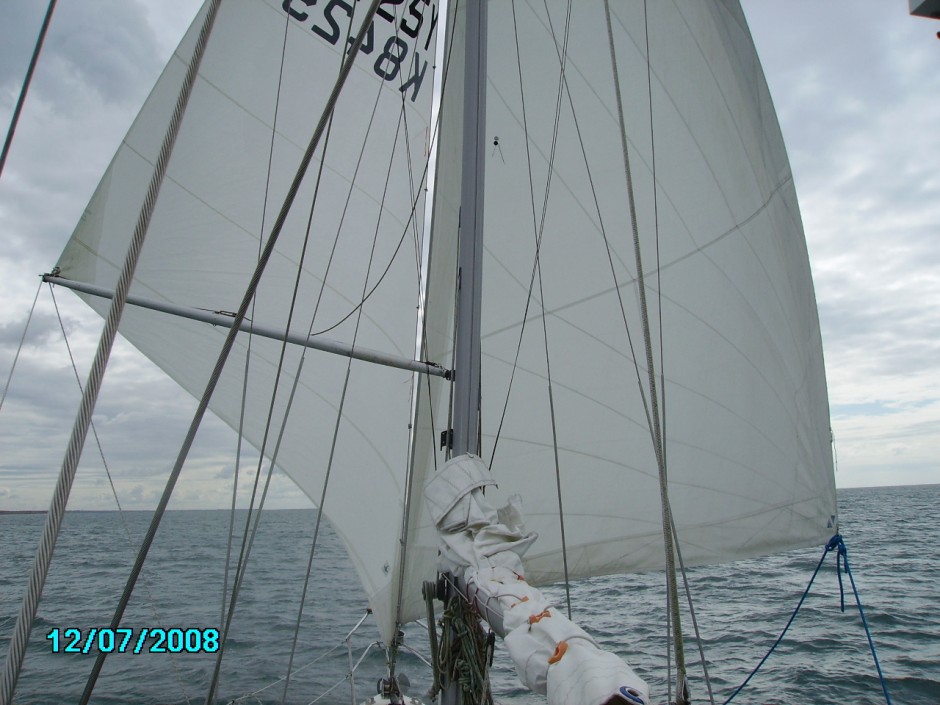
I can hank on a storm sail or a high cut Yankee and also run with the Genoa and Yankee, which I find very easy to control solo.

PICT0597-940x705.jpg
 
We also have a removable inner forestay, from which we fly a big old baggy lightweight hank on genoa. The main forestay is used for a blade jib on a roller.
So far we have done downwind stuff with the big genoa poled out and the main, wing on wing. But at some point I'm going to try replacing the blade jib with a second genoa, and fly that using the boom as a pole.
I don't know if this be more stable, less rolly, or any faster, but it will be fun to try...
 
We faced the issue of downwind sails on Dune (Jeanneau 389). In any wind much aft of the mast the performance was poor due to the sweep of the spreaders.
Solution was supposed to be a an asy on top down furler (always short handed).
After investigation we ended up with two sails. FFR and Maxi. Both use the same top down furler. Takes a couple of minutes to swap. Maxi has a tack line adjustable from cockpit.
FFR attaches halfway along bow roller, maxi at foremost attachment.
Both are used when ever the opportunity presents but probably use the FFR more than the Maxi
PYnwddZ.jpg


kN4cGgz.jpg


FFR
z7AeW2v.jpg


Maxi
2NCBsLv.jpg
 
Not to worry. The published version has 40,000 extra words over the free version. Enjoy!

Yes I did, I note we do not agree on snuffers though, I like the extra control and a better chance of keeping the sail (and cabin) dry.

I suspect 15 or 20 years ago I might have agreed with less advanced snuffers and age more on my side.
 
We faced the issue of downwind sails on Dune (Jeanneau 389). In any wind much aft of the mast the performance was poor due to the sweep of the spreaders.
Solution was supposed to be a an asy on top down furler (always short handed).
After investigation we ended up with two sails. FFR and Maxi. Both use the same top down furler. Takes a couple of minutes to swap. Maxi has a tack line adjustable from cockpit.
FFR attaches halfway along bow roller, maxi at foremost attachment.
Both are used when ever the opportunity presents but probably use the FFR more than the Maxi

Nice looking sails. Do you normally sail downwind without the main or was that just for the sake of the photos? Using the same top-down furler system I understand but does each sail have to have its own torsion rope? I am guessing that the torsion rope is a fair chunk of the price of the furler system.
 
Main moved just to get photo although it does two tenths of nothing when using Max. Each sail has own torsion rope. Luff of FFR is sown in to TR, Max is just attached at head and furler.
The FFR is a much thicker material than the max. More like a super size genoa.
When pic was taken we were making 3 knots in 4 knots true. With just standard sails we would have had the donk on.
 
We faced the issue of downwind sails on Dune (Jeanneau 389). In any wind much aft of the mast the performance was poor due to the sweep of the spreaders.
Solution was supposed to be a an asy on top down furler (always short handed).
After investigation we ended up with two sails. FFR and Maxi. Both use the same top down furler. Takes a couple of minutes to swap. Maxi has a tack line adjustable from cockpit.
FFR attaches halfway along bow roller, maxi at foremost attachment.
Both are used when ever the opportunity presents but probably use the FFR more than the Maxi
PYnwddZ.jpg


kN4cGgz.jpg


FFR
z7AeW2v.jpg


Maxi
2NCBsLv.jpg

I'm surprised that Maxi doesn't cover the range below 8 knots true windspeed at TWA's in the range 120 to at least 140.
It is a very straight luff and ought to be quite at home bringing the apparent forwards in that region?
The main is just centred for the photo? or because it's about to be dropped?
 
In my experience so far it does cover that range fine. We have sailed happily in those sort of conditions without issue although a gentle touch on the sheet is required.
Main was just centered for pic.
 
In my experience so far it does cover that range fine. We have sailed happily in those sort of conditions without issue although a gentle touch on the sheet is required.
Main was just centered for pic.

That's what I'd have thought. Where did the plot/diagram come from?
 
Do you normally sail downwind without the main or was that just for the sake of the photos?
I find the main to be a hindrance downwind. I reckon that having the centre of effort up at the nose gives more directional stability. I call it the 'shopping trolley' effect - if you pull said trolley with a length of cord tied to the front of the trolley it follows you obediently. If you pull said trolley with a length of cord tied near to the middle of the trolley it wanders all over the place.
 
I find the main to be a hindrance downwind. I reckon that having the centre of effort up at the nose gives more directional stability. I call it the 'shopping trolley' effect - if you pull said trolley with a length of cord tied to the front of the trolley it follows you obediently. If you pull said trolley with a length of cord tied near to the middle of the trolley it wanders all over the place.

Shopping trolleys don't have a keel or rudder though. Sorry to hear your boat handles like a shopping trolley! :)
 
Since I got a furling code zero and retractable pole for my Sadler 32 I've found I use it all the time, it's easy to set up in advance and pack away afterwards, I can set it, trim it and retrieve All without leaving the cockpit. I don't sail dead down wind as a rule, but I've flown it without the mainsail when I had to.

My genoa is 135% and the code zero can be used from 5-16 knots apparent, from 40-45° to all the way round. Any more than 14 knots and it's genoa time.
 
My guess is that most of the respondents on this thread wont be sailing masthead rig boats with large genoas like your Contessa 32. I am not though my Starlight has a masthead rig and is a lot nearer to the Contessa than a modern Bav/ Hanse etc.

My boat like yours isnt fast enough to benefit from tacking dead downwind so when racing we use a symetrical spinnaker. I am no longer capable of running down the deck like a mountain goat so when single handed I dont consider using the spinny. Seems to me in congested waters to be un- seamanlike. And despite a really good pilot I am not happy leaving the helm to get down a spinnaker single handed in a decent breeze. I might add that in my expeience a snuffer adds more string to tangle than effort it saves.

Instead I have found it easier if a little bit slower simply to pole out the genoa and if necessary strap down the main when goosewinged. In fact we sometimes do this in races with short downwind legs because the speed loss isnt great at all and the genoa can be furled most of the way without disconnecting the pole. When cruising I often drop the main altogether for an easy and not much slower life.

Have a chat with Pete Saunders of Saunders sails. A real nice guy who makes most of the sails used by the Contessa one design fleet. He will give good advice
 
Since I got a furling code zero and retractable pole for my Sadler 32 I've found I use it all the time, it's easy to set up in advance and pack away afterwards, I can set it, trim it and retrieve All without leaving the cockpit. I don't sail dead down wind as a rule, but I've flown it without the mainsail when I had to.

My genoa is 135% and the code zero can be used from 5-16 knots apparent, from 40-45° to all the way round. Any more than 14 knots and it's genoa time.
Pole in this context means short bowsprit? Not angled to windward or anything?
 
Top