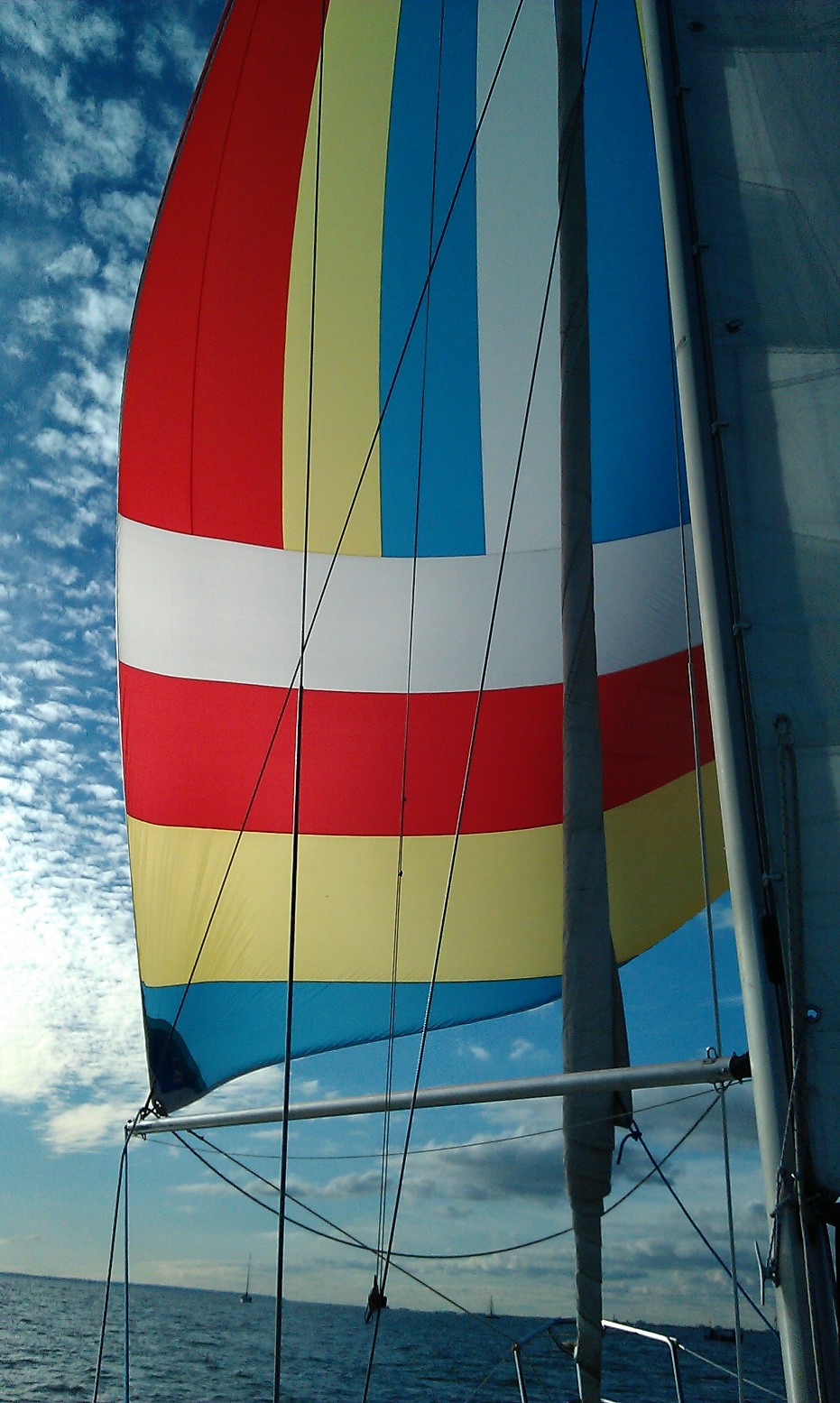
Short-handed downwind sail options

I'm thinking about a downwind sail option for my contessa 32 - but don't want to bother with a symmetric spinnaker.

I wonder if people have used asymmetric spinnakers with snuffers or furling code zeros on these type of old boats ? Or whether you need to have a bowsprit/extensive modification of the pulpit ? And I'm not sure how much extra benefit over the rather large genoa ?

Grateful for any advice.. :)

Sounds to me like what you really need is for someone who knows how to fly a kite short handed to come out sailing with you and show you how to get the best of your current kit before you go spending money.
 
My old boats had symetric spinakers and after a bit if fiddling I found them fairly self stabilising for down wind. My present boat has asymetric cruising shute and its a lot less stable though it will go slightly further abeam. Whats more its harder to get down as I cant afford a shute furling system. Now if you can afford a furler that changes everything.

An alternative to spinakers is off course a no 2 genoa run as a stay sail in addition to your main genoa. Theoretically self stabilising but in practice still needs a whisker pole , and its all done from the foredeck not hanging over the pulpit. Just drop it on the deck when you dont need it
 
Fascinating stuff.

It seems symmetric spinnakers are preferable, within 30° of dead downwind. But does anybody know if there's a good reason not to pole an asymmetric out opposite the mainsail, for a dead run? I think I've asked quite a few times, but I only had rather oblique replies.
 
Fascinating stuff.
But does anybody know if there's a good reason not to pole an asymmetric out opposite the mainsail, for a dead run? I think I've asked quite a few times, but I only had rather oblique replies.

There is no reason not to. In fact you don't really need the pole. I have several times zig-zagged downwind just gybing the main and leaving the cruising chute flying. It's not much different from goose-winging the genoa.
 
Fascinating stuff.

It seems symmetric spinnakers are preferable, within 30° of dead downwind. But does anybody know if there's a good reason not to pole an asymmetric out opposite the mainsail, for a dead run? I think I've asked quite a few times, but I only had rather oblique replies.

It works (see my post on page 1) and is reasonable in a blow and being smaller easier to manage but not as good on a run as a symmetric in most conditions.
 
There is no reason not to. In fact you don't really need the pole.

Excellent. Just what I hoped to hear. I can also hear my old symmetric spinnaker sighing and retreating further under the bed as I type.

I still really admire singlehanders who can manage a symmetric spinnaker, but for me, life's a bit short to spend it learning how.
 
I have a parasail on my nic 26. I regularly use it and often sail single handed. It's relatively easy to set and collapse as it has a snuffer. Even with the lines rigged, it's not a hugely quick job, but well within the scope of a single person. A distinct plus point is that you can use it on a broad reach so once up it gives you a lot of options. It also lifts the bows which steadies the boat so it doesn't roll as much. I wasted a lot of good years pondering the purchase when I could have been using it. I do have a smaller spinnaker on the boat but it was always a headache setting and controlling it single handed.

I was going to mention the Parasail - the few people I;ve met who had one have raved about it but I believe they aren't cheap. Apparently the lift thing really works and having Jimmy Cornell use one is not a bad recommendation.

http://www.parasailor.co.uk/parasailor.html
 
I considered that set up, but it is really rather limited for coastal cruising. Fine for sailing dead downwind such as long tradewind passages, but is not a substitute for a cruising chute, even though they claim it can be used as a genoa. It is also expensive compared with a cruising chute. Over twice the price of a straight cruising chute with snuffer or 40% more than one on a furler.
I take your point with cost. However I got the impression this was far more versatile than that. More like having an asy + a sym kite in one, with the genoa/code zero function built in as an additional benefit. I can see how something like this would work for me in my sailing grounds. It'll be interesting to hear what they're actually like, once some real world independent reviews come out.
 
It works (see my post on page 1) and is reasonable in a blow and being smaller easier to manage but not as good on a run as a symmetric in most conditions.

I also think that actually very few cruisers set their cruising chutes until the wind is well aft of the beam, so the benefits of the Asymmetric - that it's better in the 90-120 TWA - are not actually really being used. If that is the case, and you are only really looking for a downwind sail, then for cruising I actually think the Symmetric is a better bet, as it's a lot more stable at deep angles.

Yes you can pole the tack of an A-Sail out, but that makes gybing a right faff. And if you're going to pole the clew out then you'll need a monster pole....
 
We very occasionally flew the cruising chute from the pole end on our previous boat - see below.

We used one of the genoa sheets as a guy to pull the pole back as the tack line was eased. But it is a lot of work and - as Flaming says - gybing it would have been a nightmare. Both the old boat and the current one have masthead rigs but we found the chute gave a significant advantage over the genoa in light winds. You have to sail the angles and learn to gybe it but that is fun and more comfortable than running dead downwind.

I understand that a symmetric spinnaker could well be better. But for two people on a lively 39 footer it seems like a lot of gear to handle. So if and when we get a downwind sail for this boat I think it will be and asymmetric on a top-down furling system. But they are seriously expensive!

IMAG0350A.jpg
 
Fascinating stuff.

It seems symmetric spinnakers are preferable, within 30° of dead downwind. But does anybody know if there's a good reason not to pole an asymmetric out opposite the mainsail, for a dead run? I think I've asked quite a few times, but I only had rather oblique replies.

Poling out an asy in any significant breeze might be putting strains on the leech that it's simply not designed for.
Also on many cruising boats, with a masthead rig and a big genoa, it probably isn't presenting that much more area to the wind than poling out the genoa.

The reason you don't get definitive answers is that there isn't a definitive question.
Boats are diverse, people are diverse, what they are trying to do is diverse.

There are basically two modes of downwind cruiser sailing.
1 is 'being blown along' not far off dead downwind. the main is largely stalled, the apparent wind remains aft of the beam. This is windjammer sailing, it works well when the true wind is say 12 knots and your boat has a hull speed of 6 knots.
2 is 'apparent wind sailing' this is where you are using the boat speed to move the apparent wind forwards. The main and kite are both working with reasonable flow across both sides. This works well when the boat's potential speed is a big fraction of the true windspeed. This can get you real progress when there's too little wind for dead running to be a good idea.

The trade wind sailing windjammer merchants have a different objective to the apparent wind operators. They are answering a different question.
 
We very occasionally flew the cruising chute from the pole end on our previous boat - see below.

We used one of the genoa sheets as a guy to pull the pole back as the tack line was eased. But it is a lot of work and - as Flaming says - gybing it would have been a nightmare. Both the old boat and the current one have masthead rigs but we found the chute gave a significant advantage over the genoa in light winds. You have to sail the angles and learn to gybe it but that is fun and more comfortable than running dead downwind.

I understand that a symmetric spinnaker could well be better. But for two people on a lively 39 footer it seems like a lot of gear to handle. So if and when we get a downwind sail for this boat I think it will be and asymmetric on a top-down furling system. But they are seriously expensive!

IMAG0350A.jpg

If I was using that on a powerful boat around 40ft, two up, I'd gybe it quite easily.
Snuff the kite. Make tea. Put cross on chart. Swap all the kite strings over. Swap the pole. Gybe the main. Unsnuff the kite. Drink tea.
It's not a ten second process, but it's not a nightmare. It's a very reasonable thing to be doing out in the channel on a ten hour passage. Soon gets silly when there are lots of boats around and you're only on a 40 minute leg.
 
I take your point with cost. However I got the impression this was far more versatile than that. More like having an asy + a sym kite in one, with the genoa/code zero function built in as an additional benefit. I can see how something like this would work for me in my sailing grounds. It'll be interesting to hear what they're actually like, once some real world independent reviews come out.

That is the claim. but not really convinced - which is why I did not go down that route. The "genoa" facility is rather over egged as it both requires the two sails to be aligned and velcroed together and it ends up a heavy (double thickness) sail which cannot be tacked without furling. It won't be effective over such a wide range of angles as a cruising chute, nor as good in light airs.

Remember it was designed for downwind ocean crossings as a more easily handled alternative to a spinnaker and a bit more sophisticated than the common twin headsail rigs where two jibs are flown, either on a foil or one on a foil and one flying free.

If your sailing requires a lot of straight, or nearly straight downwind work it has merit. If you use one of the common furlers you can use the same gear to fly an assymetric of some sort. Then the additional cost of two light genoas (which is what they are) is not so daunting as an extra type of sail. However for mixed coastal work, single handed and only wanting one sail, a cruising chute seems a better bet.
 
If I was using that on a powerful boat around 40ft, two up, I'd gybe it quite easily.
Snuff the kite. Make tea. Put cross on chart. Swap all the kite strings over. Swap the pole. Gybe the main. Unsnuff the kite. Drink tea.
It's not a ten second process, but it's not a nightmare. It's a very reasonable thing to be doing out in the channel on a ten hour passage. Soon gets silly when there are lots of boats around and you're only on a 40 minute leg.

Fair point. And your other about the two modes of sailing. If it was too windy for the chute and the leg was long enough we just poled out the genoa and ran dead downwind.
 
I wonder if my question has been misunderstood? DJE's photo appears to show the asymm's tack poled out...I definitely mean to leave the tack on the bowsprit dead downwind, with the clew poled out. Treating the spinnaker pole as a spinnaker pole, was never in my plan. I meant, might the asymm need the pole as a 'jib stick' to keep it from collapsing?

Poling out an asy in any significant breeze might be putting strains on the leech that it's simply not designed for.

...you don't get definitive answers [because] there isn't a definitive question...Boats are diverse, people are diverse, what they are trying to do is diverse.

That's very true; and most that you say, I knew. My query was whether a clewed-out, goose-winged asymmetric doesn't stay full enough to be beneficial on a dead run.

Good point about potential weakness of the leech when the wind is entering the sail from behind, although my use will preclude conditions that are likely to be damaging.

My asymm is the same size as my main and genoa combined, and of course at dinghy-level, I'll aim to use it for beam-reaching thrills. What I didn't know, was whether the same sail might be largely unsuitable for idle running in light breezes, and restricted to a relatively narrow range of 'broadside' angles. That seems not to be the case.

And with only an 8ft alloy spinn pole to hold the clew out (assuming pessimistically that it doesn't stay filled without support), I doubt it will be too troublesome to gybe.

The appeal of the asymmetric for me, is mainly escaping from having to handle the pole (with its own rigging), and the twinned sheets and guys. The fact that the shape of the assym also brings benefit (for light hulls) from apparent wind, is actually secondary. I may change my tune after a beam-reaching blast. But if the asymmetric shape was so rotten beyond about 140° that one seriously needed a symmetric kite as well, I doubt the asymm would have developed a following from cruising sailors, among whom I count myself.

Assuming that for sailing a straight route rather than downwind diagonals, I can set the asymm like a big full-bellied goose-winging genoa, I'll still be very glad not to face the symmetric spinnaker's relative complexity. I won't count poling out the clew with the spinn-pole, as part of that same kerfuffle.

The fact that I'm deep in a self-inflicted bobstayed-bowsprit project, more complex than any symm spinnaker, doesn't dispel my enthusiasm for the simplicity principle. :D
 
Last edited:
I wonder if my question has been misunderstood? DJE's photo appears to show the asymm's tack poled out...I definitely mean to leave the tack on the bowsprit dead downwind, with the clew poled out. Treating the spinnaker pole as a spinnaker pole, was never in my plan. I meant, might the asymm need the pole as 'jib stick' to keep it from collapsing?


That's very true; and most that you say, I knew. My query was whether a clewed-out, goose-winged asymmetric doesn't stay full enough to be beneficial on a dead run.

Good point about potential weakness of the leech when the wind is entering the sail from behind, although my use will preclude conditions that are likely to be damaging.

My asymm is the same size as my main and genoa combined, and of course at dinghy-level, I'll aim to use it for beam-reaching thrills. What I didn't know, was whether the same sail might be largely unsuitable for idle running in light breezes, and restricted to a relatively narrow range of 'broadside' angles. That seems not to be the case.

And with only an 8ft alloy spinn pole to hold the clew out (assuming pessimistically that it doesn't stay filled without support), I doubt it will be too troublesome to gybe.

The appeal of the asymmetric for me, is mainly escaping from having to handle the pole (with its own rigging), and the twinned sheets and guys. The fact that the shape of the assym also brings benefit (for light hulls) from apparent wind, is actually secondary. I may change my tune after a beam-reaching blast. But if the asymmetric shape was so rotten beyond about 140° that one seriously needed a symmetric kite as well, I doubt the asymm would have developed a following from cruising sailors, among whom I count myself.

Assuming that for sailing a straight route rather than downwind diagonals, I can set the asymm like a big full-bellied goose-winging genoa, I'll still be very glad not to face the symmetric spinnaker's relative complexity. I won't count poling out the clew with the spinn-pole, as part of that same kerfuffle.

The fact that I'm deep in a self-inflicted bobstayed-bowsprit project, more complex than any symm spinnaker, doesn't dispel my enthusiasm for the simplicity principle. :D

In 'light breezes' I would say your Osprey ought to be doing something like 6 knots of boat speed in 6 knots of true breeze, steering perhaps 30 degrees above DDW.
Or you could pole it out, and run DDW at 3 or 4 knots in 2 or 3 knots of apparent.

The latter option actually has its moments, e.g. running out of Langstone Harbour against the flood, tucked into the shallows on the Hayling side.

The point about abusing the cloth is more relevant on 10 tonne cruiser with a kite made of 1 oz cloth than on a 100kg dinghy with a kite of 0.6 oz cloth.
 
It's not a ten second process, but it's not a nightmare. It's a very reasonable thing to be doing out in the channel on a ten hour passage. Soon gets silly when there are lots of boats around and you're only on a 40 minute leg.

I would echo this for single-handed symmetrical chutes, though a 40 minute leg is probably worthwhile but not with a lot of boats around (or a lee shore). Take your time! If you are used to fully crewed hoists and drops right on the mark then put it out of your head. Set everything up methodically, check it again, check your surroundings, and only then hoist.
 
I wonder if my question has been misunderstood? DJE's photo appears to show the asymm's tack poled out...I definitely mean to leave the tack on the bowsprit dead downwind, with the clew poled out. Treating the spinnaker pole as a spinnaker pole, was never in my plan. I meant, might the asymm need the pole as a 'jib stick' to keep it from collapsing?

As someone else has said you would need a very long pole to make that work. But on the boat in the photo we did occasionally goose-wing the chute in very light winds to run dead downwind. Once in a race up Southampton I remember where we wanted to avoid a lot of slow passes across the shipping channel. It works without a pole but it takes a bit of nerve and some careful steering.
 
Top