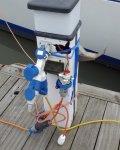
Shorepower - some people need protection against themselves..

OK, it's not best practice. But exactly what makes it unsafe, assuming there's continuity in the earth, neutral and live and they're wired correctly?
If it's rain ingress, then the RCD will deal with that.
(This is an honest question seeking enlightenment)
 
Is it me or is there an increasingly assumed stance that RCDs wil protect against all evils of and idiots with electricity.

An RCD is a protective device to improve electical safety in the case of an inadvertent electric shock whereby the supply live is shorted to earth through a person, typically where the live conductor becomes damaged or perhaps a loose connections or faulty equipment allows a connection to a metallic casing, wet surface, etc , but it is not safety in itself, and they are certainly never foolproof, as correct wiring in the first place is vital, especially where conductive seawater is around. Most people they protect have no clue as to how they may have actually 'protected' them, and this likely includes a good number of 'sparkys'. Most are set for 30mA residual current, which in certain circumstances is above the lethal level anyway.

You wouldn't see me poking a knife or fork into a toaster RCD or not !

The problem with electricity is that it is perfectly safe until you forget it is dangerous.

Too many people using electricity in dangerous situations just don't know it is dangerous.
 
It's a gender-bender surely? The orange shorepower terminates in a socket so a plug-to-plug is needed to go into the socket on the shorepower outlet. It's not exactly brilliant but it's a very long way from the worst around. Not even lying in the water.
 
It's a gender-bender surely? The orange shorepower terminates in a socket so a plug-to-plug is needed to go into the socket on the shorepower outlet. It's not exactly brilliant but it's a very long way from the worst around. Not even lying in the water.

I thought about that but I don't believe that is so.

power.jpg


The first thing I realised is that the cap is hinged on the short section terminating with the 13A plug That will therefore be the in line socket.

On closer examination I also realised that it is a plug on the orange lead because the skirt which shields the pins fits inside the skirt around the socket.

Although on even close examination it looks as though that connection is made of there components.

Two plugs with a coupler between them ??? Is there such a fitting that will connect two plugs together?
 
Last edited:
I don't see what all the fuss is about, it will work fine, there's nothing dangerous about it at all, assuming the wires are connected properly. The domestic socket might be affected by heavy rain (or it might not), it's not the end of the world is it?
 
it still does not justify the lash up with a 13A domestic plug and socket in the middle

Well, no ...
Adapter wise
I have a 30A plug connected to a 16A socket
A Euro Plug connected to a 16A socket
A 16A plug connected to a 13amp socket board (3)
A 13A Plug connected to a 16A socket

So I can get around most situations without needing to re-cable - I don't have a polarity reverser though ...

But I can see the temptation to use the 30A to 13A then 13A to 16A if .... and only if ... it's a temporary solution (ie overnight stop) and you're aware of the risk and it's not likely to be a torrential downpour ... but then I'd not have a 30A to 13A lead to start with ...
 
I don't see what all the fuss is about, it will work fine, there's nothing dangerous about it at all, assuming the wires are connected properly. The domestic socket might be affected by heavy rain (or it might not), it's not the end of the world is it?

The danger is that the domestic socket will get wet and if the outside of the plug or socket is wet too then it could be live - if it hasn't tripped the RCD then if anyone touches that it'll give them a shock.
It doesn't take a huge amount of rain to create that situation - and if you look at the way the plug/socket is hanging you'll see that the water could drain from the earth connection but still have water around the live - either shorting out the connection or creating the dangerous live outer casing situation I just described.

It's not dangerous if you're aware of the danger - ie remove the power source before you touch the dodgy connection - but in a public area you should assume that everyone will think it's safe.

Even 16A-16A connections aren't foolproof, but they take a lot more abuse than the 13amp connection.
 
Although the adapters present a danger in wet weather (and they are actually superfluous in this situation - orange cable plug into socket on box) this looks totally safe compared to last year's horror: A home-made plug to plug adapter being sold on eBay! I hope it was never sold and the owner took the advice to destroy it. Most dangerous electrical device I've ever seen.
 
Is it me or is there an increasingly assumed stance that RCDs wil protect against all evils of and idiots with electricity.

An RCD is a protective device to improve electical safety in the case of an inadvertent electric shock whereby the supply live is shorted to earth through a person, typically where the live conductor becomes damaged or perhaps a loose connections or faulty equipment allows a connection to a metallic casing, wet surface, etc , but it is not safety in itself, and they are certainly never foolproof, as correct wiring in the first place is vital, especially where conductive seawater is around. Most people they protect have no clue as to how they may have actually 'protected' them, and this likely includes a good number of 'sparkys'. Most are set for 30mA residual current, which in certain circumstances is above the lethal level anyway.

You wouldn't see me poking a knife or fork into a toaster RCD or not !

The problem with electricity is that it is perfectly safe until you forget it is dangerous.

Too many people using electricity in dangerous situations just don't know it is dangerous.

I think you're overlooking that many houses - yes, including mine - only have a 2 wire mains supply with no supplied earth. Of course you put in a local earth rod but that is not going to provide human safety in many circumstances by itself. So RCD devices are absolutely crucial to safety and are regarded as acceptable for this under, and indeed are required by, the wiring standards. They are not just something extra.

This is not meant to excuse practises such as shown in the photo, just a different perspective.
 
I don't see what all the fuss is about, it will work fine, there's nothing dangerous about it at all, assuming the wires are connected properly. The domestic socket might be affected by heavy rain (or it might not), it's not the end of the world is it?

Agreed. It looks like a perfectly reasonable way of overcoming a short term problem (16A plug into 30A socket) with a collection of adaptors. Not sensible long term, but fine as a quick fix.
 
Anything you can do we can do better .....

My local arts centre has a café with free wifi, supplied by a repeater mounted high on the wall. The repeater is powered by a wall wart mains adaptor plugged in to a socket about 2' above ground level. At some point somebody had obviously knocked it off the wall, breaking its prongs, so as a fix the prongs from a standard 13A plug - but not the plug - had been inserted into the socket and wires run from the exposed screw terminals on these to the remains of the wall wart. Yup, 240V mains completely exposed.

As an added bonus, the socket, pins and danger were immediately beside - as in 6" away from - a bookcase full of books for children to read while in the café.
 
Here we go -

In 2004 I covered an event for BBC TV called Festival in the desert, which took place 65Km North of Timbukto (our spelling) in the Sahara desert. The generator had been dropped on site a year previously and along with the rest of the site had to be dug out of the blown sand.

The distribution board for this 500KW set was a piece of plywood, about 3ft square with 6 inch nails hammered in. The connections were bare wires wrapped around each interconnected line of nails forming a bus bar. It just sat there in the sand, near the stage.

However the more interesting observation was of a young guitarist. Often at these events, due to old kit, poor maintenance etc., an audio hum arises from some sort of earth loop between the audio side of the kit and the power supply - in this case there was no earth, it being surrounded by very dry sand, the genny left floating.

In order to get rid of this hum, the young guy had connected a piece of wire to the pickups on the guitar and tightly wrapped the other end around his finger, effectively grounding the whole festival through himself as he played.

He got away with it and there was no hum!!
 
Top