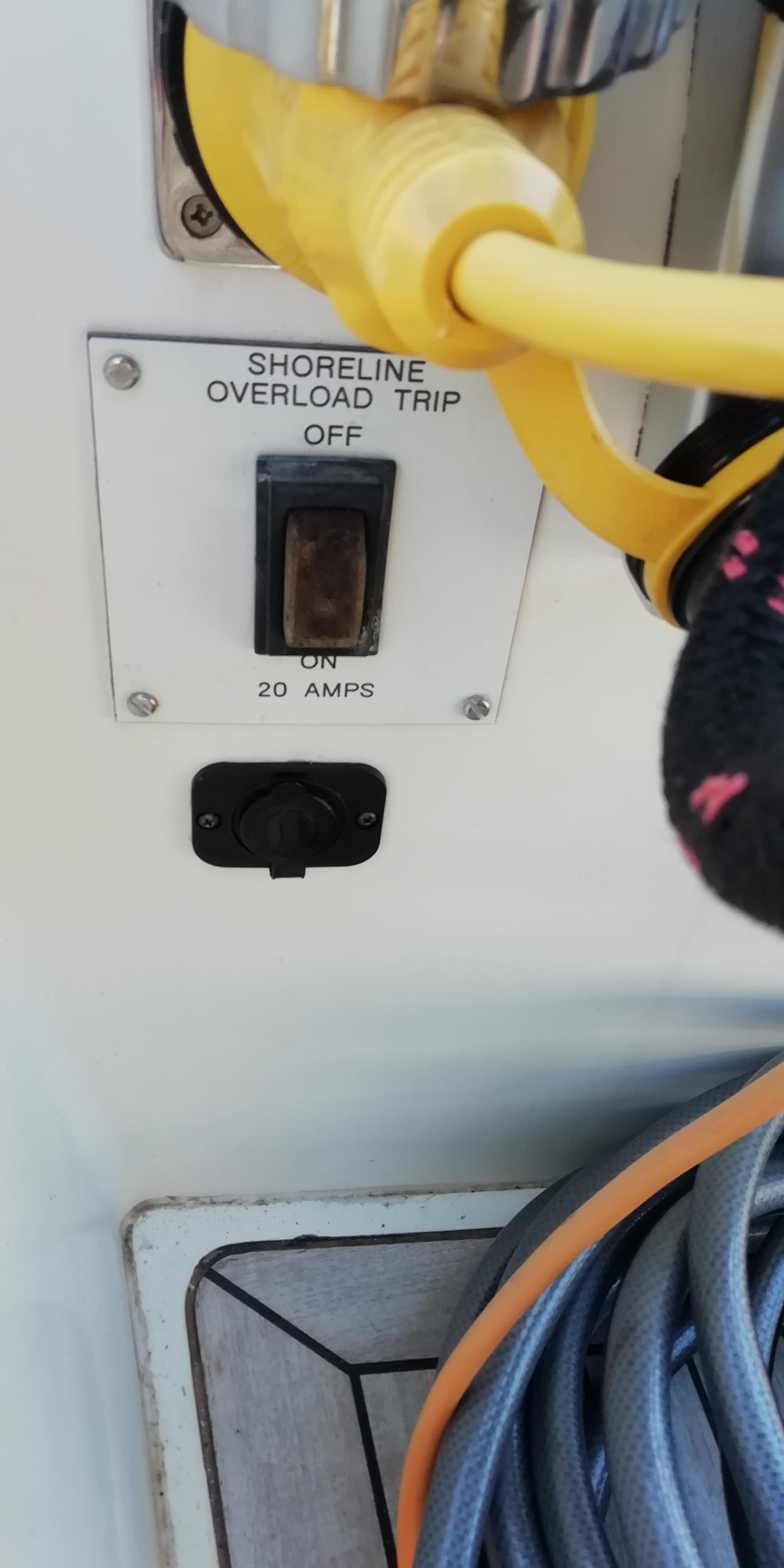
Shore Power Setup

... Regulations require that a breaker that trips if the polarity is reversed (relay trip breaker) must be fitted to boats. This gives protection in cases where incorrectly wired shore power leads are used.

....
Y adaptors where ever they are are just asking for trouble as a permanent fixture.
My dog pees on them , because he can smell other dogs urine - territory marking not bladder issues .
They don,t look particularly weather proof either if you closely inspect the glands where water can run down and in .
Buts that just a side show which will lead to the shore box clicking off not a fire .

can you point me to the regulations that say that polarity switch (reversing neutral and phase) in a monophase AC installation is not allowed ? / dangerous ?
I know that brits make a point of this, but here in B its a non issue afaik.
in none of the professional installations we make in my co, there ever was a question about this.


I agree with your point / concerns about a permanent Y fixture, but must admid that its a convenient solution that we use very frequently with our shore power adapters,...
even now, there is a Y adapter from one Marechal to two blue CEE32A female connectors permanently on the dock. (one blue cee is used for my dock wifi camera)
all are taped with orange waterproove tape...
 
Nope, the first breaker is on the stern adjacent to the shorepower socket. The second breaker is on the panel. The reverse polarity detector is separate as far as I know.

Photo:

IMG_20181012_160419.jpg


Fellow Fairline owners might be interested to know what a whole replacement unit can be purchased for around £35 (I was only interested in the sun damaged switch but at that price it made sense to get a whole unit which is on my desk awaiting fitment).
 
P, am I right in understanding that it's a cigarette lighter socket, under that breaker?
If so, I'm a bit surprised to see such cheap thingie fitted on a FL, let alone (I suppose) externally!
In your boots, I'd get rid of it altogether.
Or if you actually use/need it, like for an inflating pump or whatever, I would at least replace it with a waterproof one.
I half remember to have seen one IP67 rated, meant for external installations in vans or motorcycles.
 
P, am I right in understanding that it's a cigarette lighter socket, under that breaker?
If so, I'm a bit surprised to see such cheap thingie fitted on a FL, let alone (I suppose) externally!
In your boots, I'd get rid of it altogether.
Or if you actually use/need it, like for an inflating pump or whatever, I would at least replace it with a waterproof one.
I half remember to have seen one IP67 rated, meant for external installations in vans or motorcycles.

Fear not P, it's a proper water resistant trolling socket (now smothered with vaseline).

I recently replaced the old and broken one with a new one for dinghy inflating. Like this:

http://www.marinco.com/en/12vcps2

Pete
 
Fairenuff.
I would have never guessed that it's Marinco stuff, based on the previous pic! :encouragement:
 
It's a good question if it was me I would be stuck has I only have a 16amp lead , but if this happens where I boat I would make a small box with a 16amp breaker in feeding a 16amp socket and the breaker would be supplied via 32amp plug and 4mm cable not 2.5 as I have never seen 2.5 rated st 32amp but I take the med is more relaxed ,but just say something went wrong and you was not wired right ,I hope not
I do not imagine the cable ratings I published. I do use such tables for my day job.

However, you seem to be getting carried away with the notion that because the female receptacle is rated at 16a it cannot be fed safely from a 32a source. This is nonsense.

Most electrical supplies gradually reduce away from their source and are protected along the way.

We run 0.75mm2 cables from 250amp MCCBs to 1 amp MCBs. If I understand your concern you would want me to use cables capable of 250amps into the 1 amp MCB. The real world does not work like that.

So there is a 32a supply receptacle female socket, which links to a 32a male plug, on to (I say with suitable reference tables supporting my figures) a 2.5mm2 cable, into a 16a female flying socket, which in turn connects to a boat's inlet receptacle male, in turn feeding through a 16a rated MCCB / MCB (and presumably an RCD).

This is perfectly normal.
 
I do not imagine the cable ratings I published. I do use such tables for my day job.

However, you seem to be getting carried away with the notion that because the female receptacle is rated at 16a it cannot be fed safely from a 32a source. This is nonsense. I don’t want to keep on ,but what table in the 18th edition do you get your current carry capacity from , if you are right I will give £10 to RNLI, I HOPE you are right and I can make more money on my day job

Most electrical supplies gradually reduce away from their source and are protected along the way.

We run 0.75mm2 cables from 250amp MCCBs to 1 amp MCBs. If I understand your concern you would want me to use cables capable of 250amps into the 1 amp MCB. The real world does not work like that.

So there is a 32a supply receptacle female socket, which links to a 32a male plug, on to (I say with suitable reference tables supporting my figures) a 2.5mm2 cable, into a 16a female flying socket, which in turn connects to a boat's inlet receptacle male, in turn feeding through a 16a rated MCCB / MCB (and presumably an RCD).

This is perfectly normal.
 
Just to chip in with my own ramblings.

On my Trader, I have a single American 'twist and lock' style socket in a locker on the transom. Not sure what it's called but I'm sure someone can tell me? I have a 2.5mm lead with a blue 16A plug on the other end to plug into a marina 16A supply. However, my berth only offers a 32A supply, so I made a short adaptor lead with a 16A on one end and a 32A plug on the other that then connects my lead to the shore supply.

I've been thinking about this lately and have concluded the 'boat' side of the system must be set up for a 32A supply, as we are totally electric with separate hob, oven, microwave etc. as well as three air con units and the pump etc. and I assume a previous owner set up the cable with a 16A plug, perhaps as that was all he could get in his berth?

Anyway, I was planning on changing my cable to 4mm and simply fitting a 32A plug to it and having an adaptor that will go down to 16A if that's all I can get in another marina.

So far, no one's mentioned genny's and their potential to supply significant amounts of current. We have a 12kv unit, which, if my maths is correct, will pump out up to somewhere in the region of 50-55 amps.

As far as I'm aware, the shore power side of the system and the genny supply meet up at the main AC selector switch and then goes through an RCD of some sort which I think is rated at 80A but I'd need to check that. The supply then feeds into the main AC distribution panel and then fed off to each circuit protected by it's own circuit breaker.

Does this sound about right d'you think?

Andy
 
@Andy Cox
Yup sounds right ,
May as well keep the 16 A lead / plug to use when visiting 16 A marinas .
Just get a new 32 A lead and plugs to skip the adapter at your home berth .The dog piss / wet argument.:)

As at the mo the 16 A lead could as I keep saying “ get warm “ :) sucking up to 32 A down it .

But 1st check if your trader is a 50 A American import ? Sounds like it is with those screw cap plugs ?
 
Well Thanks for all the comments I have read them all, I think I may actually get some professional help with this as reading all this not really confident to do myself. Great help though
 
Thanks Portofino

The boat was originally specced for the Caribbean and ran at 110V. When it was imported to the UK all the 110 kit was changed over to 240 except the air con units which had step down transformers fitted to run them. I think there is still a couple of 110 sockets in the engine room.

Keeping the 16A lead is a good idea - as you say, adaptors, dog piss, rain etc........not great.

I'll have to see if I can talk the marina into swapping the 16A Metermaid for a 32.

Cheers
Andy
 
Just to chip in with my own ramblings.

On my Trader, I have a single American 'twist and lock' style socket in a locker on the transom. Not sure what it's called but I'm sure someone can tell me? I have a 2.5mm lead with a blue 16A plug on the other end to plug into a marina 16A supply. However, my berth only offers a 32A supply, so I made a short adaptor lead with a 16A on one end and a 32A plug on the other that then connects my lead to the shore supply.

I've been thinking about this lately and have concluded the 'boat' side of the system must be set up for a 32A supply, as we are totally electric with separate hob, oven, microwave etc. as well as three air con units and the pump etc. and I assume a previous owner set up the cable with a 16A plug, perhaps as that was all he could get in his berth?

Anyway, I was planning on changing my cable to 4mm and simply fitting a 32A plug to it and having an adaptor that will go down to 16A if that's all I can get in another marina.

So far, no one's mentioned genny's and their potential to supply significant amounts of current. We have a 12kv unit, which, if my maths is correct, will pump out up to somewhere in the region of 50-55 amps.

As far as I'm aware, the shore power side of the system and the genny supply meet up at the main AC selector switch and then goes through an RCD of some sort which I think is rated at 80A but I'd need to check that. The supply then feeds into the main AC distribution panel and then fed off to each circuit protected by it's own circuit breaker.

Does this sound about right d'you think?

Andy

Doesn't sound at all right to me! If you have an 80amp breaker and a boat capable of drawing 64amps or so then surely it's not safe to connect it using a 16amp leads / plugs?
 
But surely if connected to a 16A supply, then the shoreside 16A breaker will pop as soon as you start drawing too much on the boat. So if the oven is on for instance and then I put the kettle on whilst SWMBO fires up her supercharged hair drier then the power will simply go off as the marina breaker pops.

Neither would it matter if you are using a 16A 2.5mm cable or a 4mm 32A cable.

I'm not sure what is unsafe about that?
Andy
 
But surely if connected to a 16A supply, then the shoreside 16A breaker will pop as soon as you start drawing too much on the boat. So if the oven is on for instance and then I put the kettle on whilst SWMBO fires up her supercharged hair drier then the power will simply go off as the marina breaker pops.

Neither would it matter if you are using a 16A 2.5mm cable or a 4mm 32A cable.

I'm not sure what is unsafe about that?
Andy

But you really don't want to be reliant upon the marina to protect your boat from an overload. You'd be reliant upon them having a correctly rated breaker that's working. Maybe I'm being over cautious.
 
I take your point, however during my deliberations on this very point over the last few weeks, I have carried out a basic test by running all the air con in reverse cycle, the water heater, 50A battery charger and had the oven on, drawing somewhere around 30A from memory and then felt the shore power cable. There was absolutely no noticeable warmth in the cable or any of the connectors.

Even so, I'm still going to upgrade the cable to 4mm with a 32A plug on it, but keep the 2.5mm with the 16mm plug.
Andy
 
Andy when your rcd says 80 amp it is capable to switch 80 amp load it only switches off on a earth leak fault
 
Last edited by a moderator:
Thanks for that Seastoke. I checked it today and it's actually 63amp.

I hear what you say about it only switching in an earth fault condition. Is there a combined breaker / RCD unit available that will protect from overload as well as an earth fault?

So going backwards a bit, what is the best way to provide overload protection to both the shore power supply and the generator supply in the type of installation I assume I have?

Andy
 
Thanks for that Seastoke. I checked it today and it's actually 63amp.

I hear what you say about it only switching in an earth fault condition. Is there a combined breaker / RCD unit available that will protect from overload as well as an earth fault?
Is it a 32 amp you want ,CUDIS,CPN 32Amp,DP2 ,module 6KA TYPE C 30MA ,RCBO Available at CEF
So going backwards a bit, what is the best way to provide overload protection to both the shore power supply and the generator supply in the type of installation I assume I have?

Andy
 
OK,. thanks for that, but I need to maintain the 63A rating as this is downstream of the main AC selector switch and is providing protection for the 12Kv genny as well as well as the 32a shore supply.

Is there a 63a option, or there abouts?
 
Top