Shore power earth

Lots of info here which is way above my feeble brain. An isolation transformer can be had for less that £50 and I'll incorporate one in the future, the logistics of getting one to the boat in Spain are difficult in the short term. Is there any way to figure out if the marina socket earth is functional? It's quite a modern installation so it may be good enough.
 
Electrical installations in Spain should be constructed to a similar set of regulations to our own - they are based on the same CENELEC harmonised document which in turn is based on an IEC (worldwide) document. The particular section for marinas is based on IEC 60364-7-709.

I cannot recommend any method for you to test the earthing system effectively. Testing can cause the supply to shut down.

You could just ask the marina to confirm compliance with local standards.
 
Lots of info here which is way above my feeble brain. An isolation transformer can be had for less that £50 and I'll incorporate one in the future, the logistics of getting one to the boat in Spain are difficult in the short term. Is there any way to figure out if the marina socket earth is functional? It's quite a modern installation so it may be good enough.

Can be done with a neon from live to earth. A second from neutral to earth will also help confirm neutral live polarisation is correct.

A socket tester that plugs into a 13 amp socket probably the most sensible way to go.
Only a few £s from any DIY store..

https://www.google.co.uk/search?q=s...=X&ei=3jkFVdGmM4T5UMHagOAC&sqi=2&ved=0CFEQsAQ


Neither is a foolproof way of confirming a good low resistance earth connection though


Probably best not to leave either type on/ plugged in if you have a galvanic isolator as the current flow to earth will propbably overide its function and render it uselss a preventing corrosion
 
Lots of info here which is way above my feeble brain. An isolation transformer can be had for less that £50 and I'll incorporate one in the future, the logistics of getting one to the boat in Spain are difficult in the short term. Is there any way to figure out if the marina socket earth is functional? It's quite a modern installation so it may be good enough.

You can buy polarity testers which plug into you AC circuit. They have a series of LEDs which will light up,to confirm either all is well (live and neutral correct way round, earth present) or that there is a fault of some sort (live and neutral inverted, earth absent). One of those will confirm if there's an earth present on your berth supply. That's my simple minded solution. No doubt someone will be along shortly to rubbish it :ambivalence:
 
If your boat is wired in accordance with ISO 13297 it should all be properly earthed .... but you cannot rely entirely on the marina wiring to be correct and up to scratch. The best you can do to check is probably to invest in a socket tester eg http://www.diy.com/departments/bq-230v-socket-tester/178677_BQ.prd

You will have noticed from GEB's input that an RCD is an extremely unreliable bit of kit. I dont know what you do about that apart from having it tested professionally every time you intend using it . Even then like your car brakes and an MOT, it could fail immediately after being tested.


If your boat is wired and the earth bonded as required by the current standards and you intend having the shorepower connected for prolonged periods a galvanic isolator is next to essential to avoid corrosion problems caused by the earth connection.

Thanks VicS. The good news is that Khamsin was professionally rewired (totally) last year. Further good news is that I don't intend to be using shore power all that much, and thirdly I have a socket tester - somewhere in the junk-yard that on the house plans is quaintly termed "garage"!

Less good news is the warning(s) about RCDs.

Thank goodness I have just invested in some beefy solar panels.

Fair winds to you all, and safe home.

RW
 
Lots of info here which is way above my feeble brain. An isolation transformer can be had for less that £50 and I'll incorporate one in the future, the logistics of getting one to the boat in Spain are difficult in the short term. Is there any way to figure out if the marina socket earth is functional? It's quite a modern installation so it may be good enough.

Be careful. Many transformers do not isolate but have the neutrals of primary and secondry connected together.
 
Be careful. Many transformers do not isolate but have the neutrals of primary and secondry connected together.
Which is why back in #3 I said "isolation transformer"

Fit an isolation transformer to isolate you boat completely from the dodgy Spanish electricity system

Ground one side of the secondary winding to an internal "earth "system thereby creating your own neutral. Don't worry about connecting it to the planet's surface.

Fit an RCD in the normal way
 
I'd agree with many of VicS points - especially about shoreside installations which are not earthed - it's amazing how many I find with the wrong polarity so I always check that automatically.
I found Spanish and French elecrical systems pretty good, all earthed and all correct polarity (until you got to DiY marinas). Many in those two countries used the European 10 amp two-pin system which does incorporate an earth in the body of the plug. Croatia and N Italy complied but from Naples S quite a few "sports". Lots and lots in the E Med. (Don't know about Turkey).
I always believed that you needed a return to earth to trip an RCD and the one in the boat has tripped thrice in 20 years.
My daughter once shared a post with the "UK's leading specialist in galvanic corrosion" and suggested it appeared to be one of the higher forms of arcana, with more contradictory postulates than any other speciality across which she had come.
For that reason I've tended to discount the theories of all the "experts" in the subject - though I did find a gold-plated ground-plate "ate" anodes and a 316 stock.
But that's a whole different ball-game, RF ground theory.
 
You need to keep the reliability issue in perspective. RCDs can and do fail – usually due to what the industry often calls 'stiction' (the mechanism operates slower than required due to the ingress of pollutants or mechanical sticking).

This can only be identified by timing its operation. The device on your boat should trip within 0.04 seconds when a test current of 150mA is applied – any slower and it would failed to provide adequate protection.

The test button allows you to 'exercise' the RCD and in shore based installations the recommendation is test every 3 months – you might want to increase this on a boat.

In a properly constructed installation there will now be an additional RCD in the supply pillar which is in series with your boat RCD. This provides a square law improvement in reliability (4 times better). Biegelmeier used 4. :cool:


Edit - I put the wrong test current in. A 30 mA test current should cause operation in 0.3 seconds but a test at 5 times this also has to be applied 150 mA - operate within 0.04 seconds
 
Last edited:
Be careful. Many transformers do not isolate but have the neutrals of primary and secondry connected together.
Which is why back in #3 I said "isolation transformer"

Fit an isolation transformer to isolate you boat completely from the dodgy Spanish electricity system

Ground one side of the secondary winding to an internal "earth "system thereby creating your own neutral. Don't worry about connecting it to the planet's surface.

Fit an RCD in the normal way
 
This is wrong. The leakage is though you to any object, even to a carpet or the floor. An rcd will trip if you touch the live wire in, say, a ceiling rose even though you're maybe on a wooden legged chair and not touching anything connected to the earth circuit. It detects an imbalance between live and neutral.

This is about the third or fourth time this has been discussed on this forum.

The situation you discuss is a land based setup where at the substation one side of the output windings to the transformer is connected to a ground plain. The connection is then termed the neutral and feed to the electrical distribution network as 3 wired live, neutral and earth. I ignore the 3 phase element where the residence has only single phase supply.

At your residence the live and neutral pass through the RCD and the earth is fed straight through and may also be connected to a ground spike (steel water pipe) at your residence.

In your example or you touching live wirt of a 2 wire ceiling rose the imbalance current would pass through you to ground/earth spike and then back to the earth/neutral connection at the substation. If the ceiling light was on when you touched the live wire there may be say 0.5 amp in the live wire and lets say 20mA through you and down through the earth leaving 0.498 Amps in the neutral. Now by Kirchhoff's current law "then algebraic sum of currents at a point must be zero.

http://en.wikipedia.org/wiki/Kirchhoff's_circuit_laws

Now on a boat with an isolation transformer the transformer is in effect the same as the transformer at a substation except no voltage reduction i.e. 1 to 1 transformer.
 
The mains wires coming to my rather isolated (UK) house are just live and neutral, but the house has earth in the system. does that mean that the electritican made his own earth? In which case, are there just two wires going all the way back to Long Drax or wherever the electricity comes from? If so, what is the earth wire attached to?
 
The mains wires coming to my rather isolated (UK) house are just live and neutral, but the house has earth in the system. does that mean that the electritican made his own earth? In which case, are there just two wires going all the way back to Long Drax or wherever the electricity comes from? If so, what is the earth wire attached to?

An earthing spike or an underground metal water pipe http://www.toolstation.com/shop/Electrical/d190/Electrical+Accessories/sd2620/Earthing/p25281

the neural will be earthed at the substation

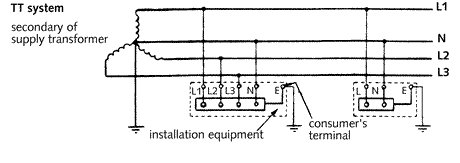
I beleive this is what is called a TT system

5.4b.gif
 
Last edited:
The situation you discuss is a land based setup where at the substation one side of the output windings to the transformer is connected to a ground plain.

Yes but, as most boats (like ours) don't have isolation transformers so they are an extension of the land based supply, just the same as a detached garage is.

Moving around different countries and marinas/yards I've lost count of the number of reversed polarity connections, some don't have earth and in one case, shore power where a neighbouring boat on a different post to ours measured 90 volts on the shore earth connection!
 
It is indeed a T.T system and the consumer must supply their own connection to the general mass of earth. This will often be via a rod electrode, a plate or similar.

The use of water pipes and gas pipes is not permitted however, they will be bonded (connected to) the earthing system at the main earth terminal (MET)
 
Yes but, as most boats (like ours) don't have isolation transformers so they are an extension of the land based supply, just the same as a detached garage is.

Moving around different countries and marinas/yards I've lost count of the number of reversed polarity connections, some don't have earth and in one case, shore power where a neighbouring boat on a different post to ours measured 90 volts on the shore earth connection!

Many countries use double pole switching for isolation and control and as such are not really worried about polarity. Their regulations will require correct polarity but it is often ignored as, for them, there is no real risk.
 
It is indeed a T.T system and the consumer must supply their own connection to the general mass of earth. This will often be via a rod electrode, a plate or similar.

The use of water pipes and gas pipes is not permitted however, they will be bonded (connected to) the earthing system at the main earth terminal (MET)

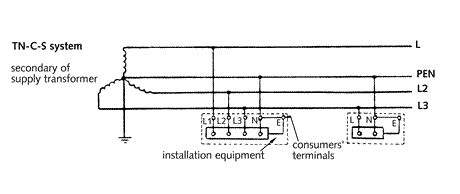
My house earth used to be connected to the neutral. ( TN-C-S ?????)

5.6b.gif


shortly after a new meter was installed an engineer came to inspect the meter installation and at that time changed the earth connection to the cable sheath. I've often wondered why it was not connected to the cable sheath in the first place.
 
Last edited:
My house earth used to be connected to the neutral. ( TN-C-S ?????)

5.6b.gif


shortly after a new meter was installed an engineer came to inspect the meter installation and at that time changed the earth connection to the cable sheath. I've often wondered why it was not connected to the cable sheath in the first place.

Connection to the cable sheath is usually an example of a TN-S system. It was common place but is now rapidly disappearing due to the fact that lead sheathed cables are no longer used.

These cables have an outer covering that tends to rot over time and the lead sheath is then in contact with the earth over a large area. This is a good thing as it creates a reliable earth connection.

These cables are no longer available (lead - H&S etc, etc)

The most common system in the UK now (and much of Northern Europe and North America) is TN-C-S. This uses the supply neutral to connect to the earthed neutral point of the supply transformer.

TN-C-S is not permitted on the supplies to boats or caravans (it is actually illegal by statute).

I would be surprised if your supply was converted from TN-C-S to TN-S – you might want to check with your supplier.
 
It is indeed a T.T system and the consumer must supply their own connection to the general mass of earth. This will often be via a rod electrode, a plate or similar.

The use of water pipes and gas pipes is not permitted however, they will be bonded (connected to) the earthing system at the main earth terminal (MET)

When I moved into my 1960 built house it had a TT supply and the old style ELCB (now not permitted; they worked - if at all, mine didn't - by direct measurement of the earth current, not imbalance between L and N.) The earth for it was the copper water piping, normal practice in those days I think, no earth rod. Now I have an earth rod (and an RCD), and all the copper piping is bonded along with the earth rod to the MET. My electrician mate who certificated it for me couldn't believe how low the earth path resistance was. I put it down to the 200ft or so of copper pipe laid directly in the earth from the roadside for my water supply; I think in reality the earth rod is bonded to it, not vice versa!

The serious point is that you can't regard an earth rod as being equivalent to a supply earth. In general its resistance will be much higher and you can't rely on it to clear a fault condition. Your safety is much more critically dependent on the RCD. I test mine with the button regularly, and I've had 2 failures in about 10 years, a worrying lack of reliability. If you have a TT supply, do check your RCD regularly! That goes for the boat system too.
 
Connection to the cable sheath is usually an example of a TN-S system.

I would be surprised if your supply was converted from TN-C-S to TN-S – you might want to check with your supplier.

I watched the man do it !

Here it is as it is now

DSCF1407.jpg
 
Top