Shore power circuit breaker size

Parmesan

New Member
Joined
7 Feb 2024
Messages
11
Visit site
In checking the electrics on my yacht, I have found that the shore power RCD/distribution box (installed by the previous owner) has a 63A circuit breaker. This seems very large, given that it is a small yacht with only a couple of 13A sockets (which I only use for a kettle or fan heater or laptop) and a battery charger.

Is this a reason for having such a large circuit breaker (for instance, when using shore power overseas) or would it be better/safer to install a smaller one? If so, what would be more appropriate? Should it be 16A or be slightly larger to provide a buffer?

Thanks
 
In checking the electrics on my yacht, I have found that the shore power RCD/distribution box (installed by the previous owner) has a 63A circuit breaker. This seems very large, given that it is a small yacht with only a couple of 13A sockets (which I only use for a kettle or fan heater or laptop) and a battery charger.

Is this a reason for having such a large circuit breaker (for instance, when using shore power overseas) or would it be better/safer to install a smaller one? If so, what would be more appropriate? Should it be 16A or be slightly larger to provide a buffer?

Thanks
What exactly do you have installed ?

Should be a RCD and some MCBs or a RCBO, at least.
 
Are you sure that this is the only breaker and that you don't have a 63A RCD and another breaker of lower rating?
I would expect to find a 16A or 20A breaker at the most for a shore line on your boat with such a low current demand.
Ensure that you do have an RCD or an RCBO to protect you, very important.
If you replace this I suggest a double pole 16A RCBO which will also protect you from reversed polarity, (very common on mariners)
 
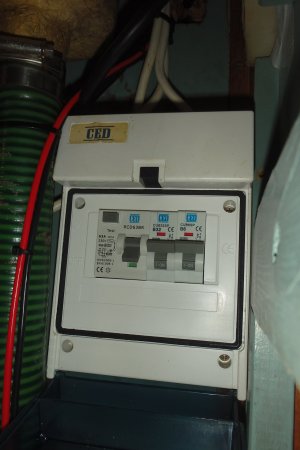
Here is a photo of what is installed at the moment: RCD63BR, CUB32SP, CUB6SP (all CED). Investigating this as planning to install a galvanic isolator.
 

Attachments

  • P3226397.JPG
    P3226397.JPG
    226.6 KB · Views: 21
Here is a photo of what is installed at the moment: RCD63BR, CUB32SP, CUB6SP (all CED). Investigating this as planning to install a galvanic isolator.
RCD is 63A, which is fine. I would swap the 32A MCB for a 16A one.

You only need to install a galvanic isolator if the shore power Earth is connected to the water, via the anode etc.
 
This is a garage consumer unit with 63A 2 pole RCD ( its not a miniature circuit breaker ) a 32A breaker which is still bigger than you need, and a 6A breaker which would normally be for the garage lights.
You could simply replace the 32A breaker with a lower current ( 16a? ) you would still have protection against reversed polarity of the mains on the marina socket.
 
This is a garage consumer unit with 63A 2 pole RCD ( its not a miniature circuit breaker ) a 32A breaker which is still bigger than you need, and a 6A breaker which would normally be for the garage lights.
You could simply replace the 32A breaker with a lower current ( 16a? ) you would still have protection against reversed polarity of the mains on the marina socket.
How ? There is nothing in that consumer unit to protect against reverse polarity.
 
Personally, assuming the OP is taking shore supply from standard marina units with 16 amp (Blue) plugs and sockets, I would replace the 63 amp RCD with a 16amp RCBO Type "A" for the RCD bit and "B" tripping curve, example here. also replace the 32 amp MCB with a 16 amp B curve MCB. He may need a couple of blanks if using "Compact" units.
 
Breakers and fuses are there to protect the cable, not the device.

16A commando plug leads? Fit a 16A breaker. No point leaving 63A circuit protection and trying to run 3 kettles, a calorifier and fan heater through a 16A cable/connector.
 
Breakers and fuses are there to protect the cable, not the device.

16A commando plug leads? Fit a 16A breaker. No point leaving 63A circuit protection and trying to run 3 kettles, a calorifier and fan heater through a 16A cable/connector.
They are there to protect the CIRCUIT and EQIPMENT therein. They are designed to operate in the event of a fault within that system. Not just the cable! The cables are sized to carry the current required for the equipment and the fuses and breakers sized to operate under overload or short circuit conditions within circuit. So yes they do protect the cable. However it is incorrect to say that they are there solely for cable protection.
 
Last edited:
How can a 16A breaker protect, say, a TV that draws less than 1A and decides to destroy it's own circuit board?
You don't just use a 16 amp breaker,Simples! There may be other things on that whole circuit, called tottal connected load. Thats why you have 3amp fuses in plug tops 🤣 :p
 
Last edited:
You don't just use a 16 amp breaker,Simples! There may be other things on that whole circuit, called tottal connected load. Thats why you have 3amp fuses in plug tops 🤣 :p
Absolutely, so, in your example, how is the 16A breaker protecting the equipment? All I see is it protecting the cable between the breaker and the 3A fuse.
 
Coming off the boat for a minute, all of this power is coming through a cable which is plugged into a supply point, which will have its own protection. Regardless of anything on the boat, all of the shore power facilities that I have used have been restricted to a current of 16 amps and are further protected by an RCCB. Having a 63A breaker on board is of no use at all. It doesn't protect anything.
 
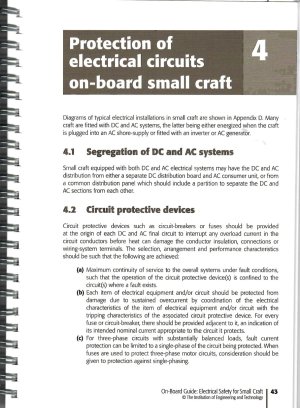
Reference - Electrical Safety Guide for Small Craft - IET Guide.

Circuit protective devices such as circuit-breakers or fuses should be provided at the origin of each DC and AC final circuit to interrupt any overload current in the circuit conductors before heat can damage the conductor insulation, connections or wiring system terminals ...

No mention of equipment protection and these sort of statements only perpetuate the (common) misunderstanding.


page1.jpg
 
Coming off the boat for a minute, all of this power is coming through a cable which is plugged into a supply point, which will have its own protection. Regardless of anything on the boat, all of the shore power facilities that I have used have been restricted to a current of 16 amps and are further protected by an RCCB. Having a 63A breaker on board is of no use at all. It doesn't protect anything.
It does serve a purpose, it's the potentially life saving 30ma RCCD. Doesn't matter it's current limit is 63A, it's main purpose is to trip if there is residual current leaking to earth (ie faulty heating element or someone touching a live cable).

This forum sometimes reveals some poor understanding of things electrical.
 
Top