John100156
Well-Known Member
Excellent well done, i'll throw in free postage too then!

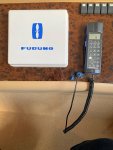
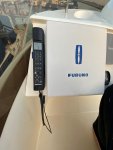


Yep - I have two handheld Standard Horizon DSCs - great little sets.Just got back to UK, I just missed you this visit.
No, no DSC unit - I have a box of RPi's though, so would like to chat to you about AIS when we are next out together. I will probably keep the 8400 until it plays-up, then would go for the SH GX2100E or latest equivalent thereof at a later date, I will buy the hand held SH VHF with DSC (which I also had on the F43) for now.
I'm in Madrid end-of-March on business, but not sure if I can get down to the boat thereafter, we're next out in April, when I will run her down to Las Fuentes to do a fuel check, then hoping to trip over to Mallorca for three weeks in June, in convoy with Keith and Lyn. Best laid plans and all that.


Old sockets to be sent to 'DavidJ' of this parish when I get back to UK on Monday.....!
Have I mentioned what a really nice bloke you are.
Really neat installation of yours and best of luck with SH project......looks a bit beyond my pay grade.
Oh yes! I’ve done the needful with the RNLI
MikeI've not actually made one of these using an RPi yet but I use the software all the time and I used the hardware on the AIS station.
So, this is what I would do:-
I bought my dAISy Hat from here:-
dAISy HAT
I was told by a friend we both know not to bother with the pre-amp that they offer as an extra.
But I did buy the little plastic box that mounts the RPi and the dAISy Hat in a nice little box.
You will need a good VHF antenna set for the AIS frequency - a good marine VHF antenna is about the best you can do on your boat.
The coax will feed directly from the antenna to the dAISy Hat's antenna input.
You could use a VHF antenna splitter and share your existing antenna with the 8400 but that might cost as much as a separate antenna.
Then, I would power up the RPi and install Raspbian (Linux) onto the RPi.
The dAISy Hat outputs serial data into the RPi so virtually any software can read the AIS NMEA 0183 sentences sent from the dAISy Hat.
Now to the actual software.
I use Kplex which is an NMEA multiplexer written in software.
Open source free to use - See here Kplex: An NMEA-0183 Multiplexer
It runs under Linux but IIRC there is a RPi version for exactly this purpose.
You set Kplex up to receive any number of NMEA channels (even at different baud rates or different devices).
You can then set Kplex to output to as many devices as you like - again any baud rate or channel.
Now to the clever bit - Kplex also outputs (or inputs for that matter) to TCP or UDP (over a LAN)
Raspberry Pis Version 3 and above (more recent) incorporate internal WiFi.
So, using Kplex on an RPi 3 or greater you can send NMEA data over WiFi.
Two ways of doing this - either make the RPi a WiFi access point or get the RPi to connect to a "Ships WiFi Router" - @John100156 - Like the Buffalo router that you used before.
So, now you have NMEA data on WiFi (either as an access point or on a Wireless LAN)
You now need a program/device that will pick that data up and use it.
I'm not an iPerson but I run OpenCPN on Android and this works nicely - AIS on my Android Tablet for example.
I know all this works because my ships PC (running Linux) is set up to stream AIS continually across WiFi.
A little project that I have in mind for this summer is to get Navionics working again since the recent licence changes - it should be possible to get the Navionics App to read AIS over WiFi using Kplex. You would need to know the port number that they use and then just get Kplex to transmit using that port number - I think that they tend to use port number 10110.
As I say, it SHOULD be possible to get the Navionics App displaying AIS from a Raspberry Pi but it DOES work with OpenCPN on the Android.
So - over to you - iPeople.
EDIT
Of course, instead of a tablet/phone, a standard PC/Laptop running OpenCPN would pick up the AIS Raspberry Pi feed - and again, I KNOW this works.
Already in envelope and will be posted on Monday....!

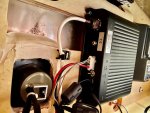
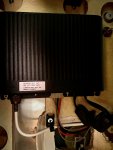
yes that's exactly what i need. how the colors are occupied so that I can solder it on.This is part of what John generously sent me over two years ago. Sadly reminds me it’s been that long since I’ve seen my boat. I’m happy to check the colors against pin position if that’s what you need. Please confirm
I’ll do it tomorrow but I’m sure you have your head around it but it’s the socket I’m doing so the plug will be the mirror imagefrom 1 to 6. with the notch down and 6 in the middle.