Keith 66
Well-Known Member
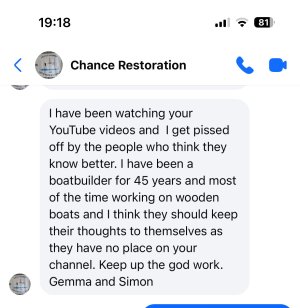
I commented on the original thread early on, Anyone giving good sensible advice back then was branded "A nay sayer" as if our experience & knowledge was worthless. I stopped following the project years ago.
I must say im surprised they have got as far as they have & take my hat off to them for their perseverance at least.
I am not convinced about the usage of short bits of wood & modern goops & epoxies though. The very nature of DD boats means rot has ample avenues to travel a long way & i dont see how they can escape this. But its the kind of project where the job has become its own show paid for by online content from you tube or wherever.
Im the same age as Jstar & unlike him didnt do an apprenticeship. Many of the guys in the WBTA didnt do one either.
I well remember the day the WBTA was formed, Some of the old boys argued that there should be differing grades of membership with Ordinary members & "Fellows" (Who had done a recognised apprenticeship) above them.
One lad got up who had just won the boatbuilders award for the finest boat at the show. He said "I havent done an apprenticeship & you are telling me that i cannot be as good as you?" That killed the two tier membership on the spot!
I do not believe that the trade is not training enough people far from it. Look at how many students went through the C&G route at Falmouth, IBTC, Lyme regis et all, Now you have the Pioneer trust churning out boatbuilders.
Everyone wants to do the lovely traditional work but the brutal truth is it is limited to a few local areas around the country, You cant eat karma & it dont pay the bills. Most boatbuilders down here went off to work on the tools on building sites, Fitting kitchens etc Decent money!
Most of the few who kept going like me had a good woman behind them earning steady money in a public sector job!
I must say im surprised they have got as far as they have & take my hat off to them for their perseverance at least.
I am not convinced about the usage of short bits of wood & modern goops & epoxies though. The very nature of DD boats means rot has ample avenues to travel a long way & i dont see how they can escape this. But its the kind of project where the job has become its own show paid for by online content from you tube or wherever.
Im the same age as Jstar & unlike him didnt do an apprenticeship. Many of the guys in the WBTA didnt do one either.
I well remember the day the WBTA was formed, Some of the old boys argued that there should be differing grades of membership with Ordinary members & "Fellows" (Who had done a recognised apprenticeship) above them.
One lad got up who had just won the boatbuilders award for the finest boat at the show. He said "I havent done an apprenticeship & you are telling me that i cannot be as good as you?" That killed the two tier membership on the spot!
I do not believe that the trade is not training enough people far from it. Look at how many students went through the C&G route at Falmouth, IBTC, Lyme regis et all, Now you have the Pioneer trust churning out boatbuilders.
Everyone wants to do the lovely traditional work but the brutal truth is it is limited to a few local areas around the country, You cant eat karma & it dont pay the bills. Most boatbuilders down here went off to work on the tools on building sites, Fitting kitchens etc Decent money!
Most of the few who kept going like me had a good woman behind them earning steady money in a public sector job!