Shiny propeller

oldbilbo

...
Joined
17 Jan 2012
Messages
9,973
Location
West country
Visit site
I've worked on the prop which came attached to the born-again Cutlass 27 here, and eventually removed the layers of hard wormcasts and old antifoul which had coated it..... Perhaps I was too enthusiastic with the flapwheel, but when the native bronze started to emerge, I suppose I ought to have quit while ahead. The result was that the blade faces were clearly scratched.

I've now worked on them with a couple of polishing wheels with two grades of 'soap' - grey and brown - with minor improvement. The friction causes the weebly 200amp, 150mm bench grinder to stall, so I cannot apply much pressure. The question I have is whether to continue with this, or quit while ahead thinking I already have most of the improvement I'm going to get.


IMG_3406.jpg


There are certainly 'ruggiosities' which can just be felt, but I'm wondering whether they matter.... and also whether a couple of coats of Diamond Hard Polyurethane varnish won't improve the situation.

What does the team think?
 
Unless you are going to show it in an art gallery, it hardly matters, since it will have coated itself within a few weeks anyway. Mine was glistening at the end of April last year and moderately encrusted by mid-June in spite of a coating of lanolin.
 
I do not see the point of polishing to that extent.
I clean mine with Disclean, a brick cleaner obtained from a builders merchant . It only takes 15-20 mins & comes up a dull finish
When launching i smear with grease
As an aside i have a Brunton Auto prop. Bruntons advise against antifoulling a propellor
They say that in the course of a season chips of antifoul come off & exposes small areas of the metal
Any electrolitic action concentrates on this area causing imbalance
If not antifouled any stray electrolosis goes evenly over the whole area
The fact that a chip may be a small area does not mean less current. It means the whole current that would go to the prop goes to the isolated area
Before anyone gives me an earbashing for that i do not have a clue. I am only passing on Brunton's advice. Whether they are correct or not - i do not know
What i do know is that changing from the standard fixed Volvo prop to a bronze Brunton means that i now have to buy 2 anodes each year instead of a single one every 3 years. So there must be some stray current somewhere being picked up by the change of metal
 
that "chip=more local corrosion" only holds good if the antifouling is an electrical insulator (dielectrical) . If an AF contains copper.....


Any application of a conformal coating, such as grease, lanolin, Grossman's chili paste, eye of newt or toe of frog, needs to cope with the localised pressures of water flow, cavitation, or the abrasive cement glands of barnacles and other parasitic arthropods. That's a very tough ask, and no wonder that Bilbo's subject of therapeutic polishing may well be returning to his workbench in a year's time for more TLC.
 
I cannot say that I have had any success with the 'polishing + no antifoul' theory. Until a couple of years ago I have always antifouled my prop with whatever I was doing the hull with, sometimes hard scrubbable, sometimes eroding. It comes off the blades quite quickly, mostly stays on the hub. A scrub underwater a couple of times in the season mostly takes care of the fouling. Two years ago I tried the polishing method - disatrous results. More fouling than I can ever recall. Last year I tried some Italian specialist stuff that needed a primer. I had some Hammerite non-ferrous primer, which I applied first, then four coats of the A/F. This chipped off quite early on but amazingly the Hammerite primer revealed beneath did not foul.
 
I cannot say that I have had any success with the 'polishing + no antifoul' theory. Until a couple of years ago I have always antifouled my prop with whatever I was doing the hull with, sometimes hard scrubbable, sometimes eroding. It comes off the blades quite quickly, mostly stays on the hub. A scrub underwater a couple of times in the season mostly takes care of the fouling. Two years ago I tried the polishing method - disatrous results. More fouling than I can ever recall. Last year I tried some Italian specialist stuff that needed a primer. I had some Hammerite non-ferrous primer, which I applied first, then four coats of the A/F. This chipped off quite early on but amazingly the Hammerite primer revealed beneath did not foul.

+1 for the hammerite
 
I cannot say that I have had any success with the 'polishing + no antifoul' theory. Until a couple of years ago I have always antifouled my prop with whatever I was doing the hull with, sometimes hard scrubbable, sometimes eroding. It comes off the blades quite quickly, mostly stays on the hub. A scrub underwater a couple of times in the season mostly takes care of the fouling. Two years ago I tried the polishing method - disatrous results. More fouling than I can ever recall. Last year I tried some Italian specialist stuff that needed a primer. I had some Hammerite non-ferrous primer, which I applied first, then four coats of the A/F. This chipped off quite early on but amazingly the Hammerite primer revealed beneath did not foul.

+1
Hammerite special metal primer stuck to my old bronze prop amazingly well for years. I put whatever antifouling I was using on top each year. The antifoul on the outer 2/3 of the prop disappeared but fouling remained light
New boat has had very shiney flex o fold 3 blader for 2 seasons. It shines better than new - on delivery it had a surface roughness of around Ra1.6 but after polishing on a buffer wheel it was around Ra0.6 - I thought a smooth surface would not be as easy for barnies and would have less surface area in contact with water. Prop anode largely dissolves in 1 season but have managed to re- shine over winter with some elbow graese, a kindling stick and brasso. Will paint blades and hub when I cannot get a shine or get fed up of bothering
 
good to know that Halo carries a nano-scale profilometer in his tool box on board. Every conscientious skipper should have one, and its use should be taught at the RYA competent crew level..


So very helpful at the bar when one is discussing the amplitude, count, spacing and slope ratios. :)
 
IMAG0100.jpgIMAG0128.jpgIMAG0179.jpg all i do is polish mine and i dont put any thing on it. mine stays in for over 12 months i dont know but dont think thats excessive do you ? thanks dilly
 
My two-penneth ............
I polish the prop each year (well, to be fair, the crew polish the prop each year) but not to the mirror finish shown.
Usually stop at about 400 grit paper
I then smear with teflon grease.
The first year I did this I expected it to spin / wash off.
But it does seem to be effective and last all season even if the baot isn't in regular use.
M
 
Not a lot of consensus yet.... :(

I'll need to do the job fairly soon ( I hope!! ) but I have a wide selection of unguents, potions and Patent Preparations to consider. However, no-one has yet mentioned the Diamond Hard Polyurethane varnish from B&Q, some of which I have in a part-used tin. Hmmmm. Maybe there's a 'comparative test' here we could try out for the 'new broom' at PBO.... ;)
 
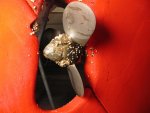
Tried to post earlier but couldn't get Photobucket to behave. This taken before pressure washing after about four months in the water in the Aegean Sea. No scrubbing afloat during this period. Previously there would have been quite major accumulations of tube worm after this time. Hammerite primer beneath four coats of expensive Italian prop antifoul.
IMG_2766.jpg
 
I cannot say that I have had any success with the 'polishing + no antifoul' theory. Until a couple of years ago I have always antifouled my prop with whatever I was doing the hull with, sometimes hard scrubbable, sometimes eroding. It comes off the blades quite quickly, mostly stays on the hub. A scrub underwater a couple of times in the season mostly takes care of the fouling. Two years ago I tried the polishing method - disatrous results. More fouling than I can ever recall. Last year I tried some Italian specialist stuff that needed a primer. I had some Hammerite non-ferrous primer, which I applied first, then four coats of the A/F. This chipped off quite early on but amazingly the Hammerite primer revealed beneath did not foul.
Also tried polished shiny plus lanolin once - never again. Now use two coats of zinc-rich primer then two coats of AF, seems to last through the year with minimal fouling, and little discernible drop in speed under engine through the year. This is on a sailing boat though - fast powerboats need polished props or the fuel ££££s go from ultra-high to astronomical.

Boat next to me on hard has polished and applied cow udder cream this year as an experiment.
 
Last edited:
I made an experiment a couple of years back: Polished the blades of my feathering to a very nice finish with the help of a dremel tool, but left the hub un-polished. In the autumn the prop came out like this:

http://www.ybw.com/forums/images/attach/jpg.gif

My conclusion was that polishing was a very good thing, so next spring did so to the entire prop. But the result was disappointing, both blades and hub came out equally fouled with barnacles. Might have been a bad year for fouling.
Since then I have polished, but not to the same finish (takes too much time) and relied on mid season scrubbing with mask and snorkel instead.
 

Attachments

  • prop.jpg
    prop.jpg
    67.5 KB · Views: 0
Cow Udder cream. swear by it - basically a big tub of lanolin for £10. redo the prop every time I see it - every 2 months or so ? slap it on my chops as well to stay young (before I rub it over the prop -not after !)

no issues. I Look 10 years younger.................
 
Top