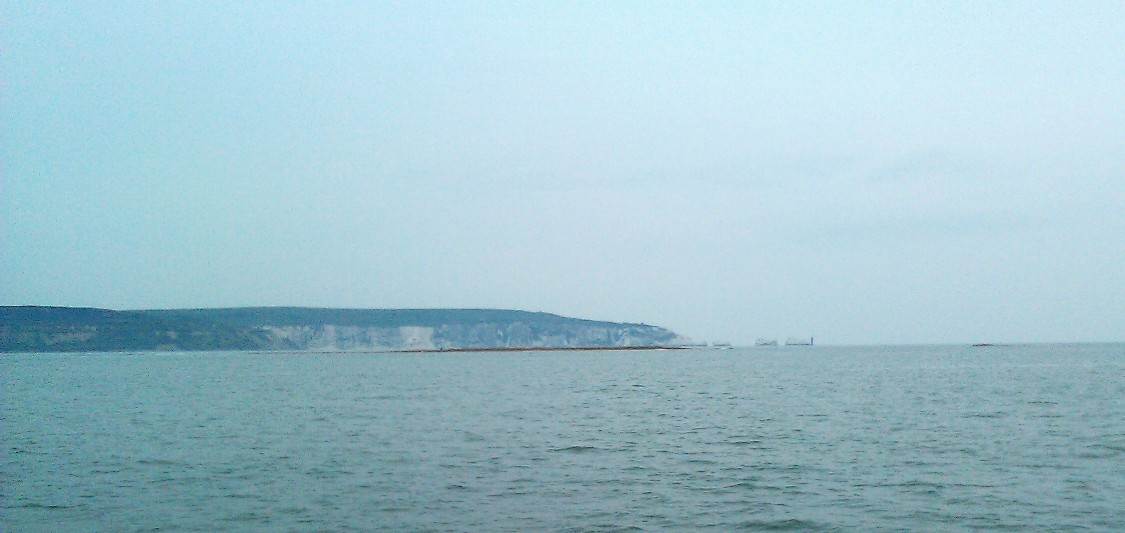
Shingles Bank

doris

Well-Known Member
Joined
19 Jun 2001
Messages
2,265
Location
London
Visit site
Went round the back of the Shingles a few days ago. We were 2 hours before low water and bang on neaps. Quite amazing how much of the bank was showing. At low water springs it must dry a good 2metres plus now. Deffo not one to get wrong!!
 
We came across there last Sunday an hour or two before low water neaps. On our normal approach due East to NE Shingles buoy there was a minimum of 5 metres of water. But about half a mile South of our track this was showing:-

Shingles2.jpg
 
We came across there last Sunday an hour or two before low water neaps. On our normal approach due East to NE Shingles buoy there was a minimum of 5 metres of water. But about half a mile South of our track this was showing:-

Shingles2.jpg

I'm going to ask SWMBO, why she allowed you in my living room to take that photo! :mad:
 
20 years ago, no more than that 25?, there was an all tide island for some months.
Some wag put a 'for sale' sign on it, and I'm told, a concrete mixer for a short while.
I remember seeing the for sale sign coming back from a JOG race.
 
I read a book wrecks of the Isle of Wight which described how a 3/4 hundred foot ship of some sort was driven aground there during a gale during which time no one could get out to it & after four days I think it was no trace of the vessel remained.Worth remembering as you pass over that area encase a bit of it re-emerges!:eek:
 
Used to be a great place to catch bass if you motored along the edge as the high tide was turning. Don't know about now though.
 
On just about every Fastnet Race one, two, or several of the 'participants' under sail fail to understand that the fast-ebbing tidestream in the Needles Channel squirts sideways ACROSS the Shingles Bank, fail to make suitable allowance for this predictable 'set', and fail to avoid being carried onto the bank. They find themselves, at best, needing to start the engine to get off.... which should disqualify them from further participation and cause their early retirement.....

There are several crews known/seen to have been so stuck who nevertheless continue and pitch up at the end-of-race parties at Plymouth 'as if butter wouldn't melt in the mouth'.
 
On just about every Fastnet Race one, two, or several of the 'participants' under sail fail to understand that the fast-ebbing tidestream in the Needles Channel squirts sideways ACROSS the Shingles Bank, fail to make suitable allowance for this predictable 'set', and fail to avoid being carried onto the bank. They find themselves, at best, needing to start the engine to get off.... which should disqualify them from further participation and cause their early retirement.....

There are several crews known/seen to have been so stuck who nevertheless continue and pitch up at the end-of-race parties at Plymouth 'as if butter wouldn't melt in the mouth'.


We completed the RORC Myth of Malham race over the weekend and we got caught in just that situation! Fortunately we only grazed the bank and quickly managed to tack into some clearer water, but I was surprised just how strong the ebb was over the bank (the direction surprised me not the strength; it was after all a high spring tide).
 
Yeah, and bloody spooky it is too at night.
I prefer goose rock, the Bridge n all but when you gotta beat out on an ebb...
 
We completed the RORC Myth of Malham race over the weekend and we got caught in just that situation! Fortunately we only grazed the bank and quickly managed to tack into some clearer water, but I was surprised just how strong the ebb was over the bank (the direction surprised me not the strength; it was after all a high spring tide).

An old and grizzled race navigator - and also a nav instructor on Shackletons and Nimrods who did much of the examining of candidates for Services skippers' tickets in the 70s - pointed out to me that the gulch that is the Needles Channel, bounded on one side by Wight and on t'other by the Shingles Bank, ends in a rock wall we call 'The Bridge'. Not only does this significant obstruction to the easy flow of the ebb kick up big standing waves and overfalls at times, it also creates a pressure-bulge in the ebbing tidestream which has to go somewhere..... sideways. He used that to teach me, a budding 'offshore' navigator, to perceive the tide stream in 3 dimensions and consider the effects of underwater obstructions and ridges. For example, in a light airs race, and if there's just sufficient water, a half-knot advantage may be gleaned from sailing close along the northern edge of The Shambles bank off Portland. That might just be enough, in a dying ebb, to get around Portland Bill and away west.

He also taught me - in the 70s - that race was not about straight-line speed, but about very crafty tidal strategy to keep gaining places at every headland. Oh, and he also taught me Adlard Coles' race-winning trick of deep-water kedging..... and also to read the old books by the very crafty old beggars like AC and John Illingworth.
 
Bilbo I love reading posts like this.
Plenty of food there for nourishing my ever limited set 'ways' of seeing things , ta muchly.

An old and grizzled race navigator - and also a nav instructor on Shackletons and Nimrods who did much of the examining of candidates for Services skippers' tickets in the 70s - pointed out to me that the gulch that is the Needles Channel, bounded on one side by Wight and on t'other by the Shingles Bank, ends in a rock wall we call 'The Bridge'. Not only does this significant obstruction to the easy flow of the ebb kick up big standing waves and overfalls at times, it also creates a pressure-bulge in the ebbing tidestream which has to go somewhere..... sideways. He used that to teach me, a budding 'offshore' navigator, to perceive the tide stream in 3 dimensions and consider the effects of underwater obstructions and ridges. For example, in a light airs race, and if there's just sufficient water, a half-knot advantage may be gleaned from sailing close along the northern edge of The Shambles bank off Portland. That might just be enough, in a dying ebb, to get around Portland Bill and away west.

He also taught me - in the 70s - that race was not about straight-line speed, but about very crafty tidal strategy to keep gaining places at every headland. Oh, and he also taught me Adlard Coles' race-winning trick of deep-water kedging..... and also to read the old books by the very crafty old beggars like AC and John Illingworth.
 
Bilbo I love reading posts like this. Plenty of food there for nourishing my ever limited set 'ways' of seeing things , ta muchly.

Appreciated. It's very much about 'handing on the torch' lit by others. As for crafty Adlard Coles' ploy of deep water kedging, we used that twice on the 2003 Fastnet, which helped us to a Class Win. Crucially, we 'went equipped' to do that, while bigger, faster boats in class didn't/couldn't and lost miles when the Channel flood stream took them far to the east.... Sometimes it's not about boat speed.
 
Top