Shall I galvanize my bilge keel?

Don't think it's been mentioned here but you could clean them back to bare metal and use a zinc-rich 2-pack epoxy primer. 2-3 coats, followed by 2-3 of a standard epoxy primer then antifoul. The zinc primer can be a commercial/industrial product.
 
Ignore him, no matter how "experienced" he is. There is no need for anodes on sheet steel plates. Anodes are only required where you have two metals with different potential in contact in seawater - the most typical is yellow metal props and stainless shafts. You do not have this situation having only one metal (steel). Any corrosion you get will be good old fashioned rust and you cannot stop that other than isolating it from water by coating it in zinc (galvanising) or other coating such as paint or an epoxy based coating as suggested.
The middle keel is cast iron.
 
If you have the plate(s) grit blasted then whatever protective coating you are going to apply you need to do as soon as possible, preferably as a continuous process, complete the blasting, coat. It depends on the weather but corrosion will commence immediately on cleaned metal. Galvanisers clean the steel with acid and then immediately galvanise, if you have the grit blasting conducted by a subcontractor the galvaniser will tell you to advise him of timing and then he can schedule the item in as soon as he receives it. But don't leave it for a few days, a couple of hours is going to be acceptable. I assume its not a fancy steel and if it were me I'd grit blast and then just prior, like 10 minutes before 'painting' if that is the route - I'd clean with acid. The grit blast should provide the 'key' for any paint.

Galvanising if done properly is a metallurgical process - the zinc forms Zn/Fe alloys at the interface that are metallurgically bonded to the underlying steel (like welding). They are much stronger than anything you can achieve with paint (but its a hassle to have galvanising conducted - hence the fall back to 'paint'.). But if paint were totally successful - the Forth Rail Bridge, or Sydney Harbour Bridge would not need a team of painters with a lifetime's work and your cars would not be scrapped because they have rusted through.

The weak part of steel plate are the corners, they chip easily (this is true for galvanising as paint). If they are not already rounded it might be worth taking an angle grinder to them

If it is financially sound, for you, and you can find a convenient galvaniser - that's the route I would follow. I might then apply an epoxy coating and then AF - along the lines mentioned by Tranona (I believe in belt and braces - then hopefully it will all last as long as you keep her). I'd also be careful where you sail - the galvanised coating, and any paint, can be damaged.

Jonathan
 
The middle keel is cast iron.
Same process applies, although cast iron is more difficult to deal with as there are often impurities in the casting that leave pits and over the years you inevitably get rust. Most people clean back as far as they can and use conventional primers plus AF and just patch each year. as you can see with my photo you can get blasted to a finish that should take epoxy, but it is expensive. Blasting, epoxy and Coppercoat cost me around £600 doing all the coating except for the first sealing coat myself.

What boat is it?
 
Same process applies, although cast iron is more difficult to deal with as there are often impurities in the casting that leave pits and over the years you inevitably get rust. Most people clean back as far as they can and use conventional primers plus AF and just patch each year. as you can see with my photo you can get blasted to a finish that should take epoxy, but it is expensive. Blasting, epoxy and Coppercoat cost me around £600 doing all the coating except for the first sealing coat myself.

What boat is it?
Its a Halcyon 23. It lives most of the year on a trailer and then goes into a drying harbour which is both muddy and rocky, so the bottom edges of all three keels get heavy abrasion.

A previous owner welded steel "skids" to the bottom edges of the outermost 2 keels which I believe was to prevent them sinking into sand or mud. These have turned out to be a weak point corrosion-wise. I have in mind to do away with he skids and simply bolt an length of angle to the bottom edge of the keel. This steel angle of say 38mm wide would resist sinking into mud like the skid but would be sacrificial -can be unbolted and replaced whenever living the the fin unaffected by abrasion.

Thanks
 
If you have the plate(s) grit blasted then whatever protective coating you are going to apply you need to do as soon as possible, preferably as a continuous process, complete the blasting, coat. It depends on the weather but corrosion will commence immediately on cleaned metal. Galvanisers clean the steel with acid and then immediately galvanise, if you have the grit blasting conducted by a subcontractor the galvaniser will tell you to advise him of timing and then he can schedule the item in as soon as he receives it. But don't leave it for a few days, a couple of hours is going to be acceptable. I assume its not a fancy steel and if it were me I'd grit blast and then just prior, like 10 minutes before 'painting' if that is the route - I'd clean with acid. The grit blast should provide the 'key' for any paint.

Galvanising if done properly is a metallurgical process - the zinc forms Zn/Fe alloys at the interface that are metallurgically bonded to the underlying steel (like welding). They are much stronger than anything you can achieve with paint (but its a hassle to have galvanising conducted - hence the fall back to 'paint'.). But if paint were totally successful - the Forth Rail Bridge, or Sydney Harbour Bridge would not need a team of painters with a lifetime's work and your cars would not be scrapped because they have rusted through.

The weak part of steel plate are the corners, they chip easily (this is true for galvanising as paint). If they are not already rounded it might be worth taking an angle grinder to them

If it is financially sound, for you, and you can find a convenient galvaniser - that's the route I would follow. I might then apply an epoxy coating and then AF - along the lines mentioned by Tranona (I believe in belt and braces - then hopefully it will all last as long as you keep her). I'd also be careful where you sail - the galvanised coating, and any paint, can be damaged.

Jonathan
Thanks very much. This is very helpful. Please see my reply to Tranona adjacent which also applies to your comment to some extent.
 
Its a Halcyon 23. It lives most of the year on a trailer and then goes into a drying harbour which is both muddy and rocky, so the bottom edges of all three keels get heavy abrasion.

A previous owner welded steel "skids" to the bottom edges of the outermost 2 keels which I believe was to prevent them sinking into sand or mud. These have turned out to be a weak point corrosion-wise. I have in mind to do away with he skids and simply bolt an length of angle to the bottom edge of the keel. This steel angle of say 38mm wide would resist sinking into mud like the skid but would be sacrificial -can be unbolted and replaced whenever living the the fin unaffected by abrasion.

Thanks
That is the same arrangement as on my Eventide keels, and pretty standard for the time. I never had a drying mooring although did dry out from time to time. I have seen various mods to try to protect the bottoms of the plates from damage varying from building aerofoil sections around the steel plates to bolting sacrificial wooden runners to the bottom. Not keen on bolting steel to steel as all the holes just introduce points where corrosion can start. I think if I wanted to solve the problem long term I would still blast and epoxy the keels and attach sacrificial wooden runners to the bottom with Sikaflex. My first boat was a Seawych with moulded bilge keels and the bottoms were very vulnerable to abrasion and the usual mod was to glue on sacrificial GRP moulded shoes. You can't do much about the bottom of the central keel unless you can get it up high enough to blast it and epoxy. However if you just blast what you can and epoxy you should find that the inevitable rust does not creep upwards under the epoxy.
 
You are not being ignored - but answered with foresight.

See post 16.

Though most welders ca do marvellous things
A wooden shoe shaped to fit the contour of the hull will solve that problem.
I fabricated bilge plates for my Eventide and got a carpenter friend to shape the wood. We had the job done in a day.
 
That is the same arrangement as on my Eventide keels, and pretty standard for the time. I never had a drying mooring although did dry out from time to time. I have seen various mods to try to protect the bottoms of the plates from damage varying from building aerofoil sections around the steel plates to bolting sacrificial wooden runners to the bottom. Not keen on bolting steel to steel as all the holes just introduce points where corrosion can start. I think if I wanted to solve the problem long term I would still blast and epoxy the keels and attach sacrificial wooden runners to the bottom with Sikaflex. My first boat was a Seawych with moulded bilge keels and the bottoms were very vulnerable to abrasion and the usual mod was to glue on sacrificial GRP moulded shoes. You can't do much about the bottom of the central keel unless you can get it up high enough to blast it and epoxy. However if you just blast what you can and epoxy you should find that the inevitable rust does not creep upwards under the epoxy.
If the rust doesn't creep up between steel and epoxy maybe I can accept that the bottom edge of skids will be sacrificial. My main concern is losing the main sheet part of the keel - and then having to fork out for the tricky job for the fabricator having to form the flange at the top which must follow the contours of the Hull.
 
A wooden shoe shaped to fit the contour of the hull will solve that problem.
I fabricated bilge plates for my Eventide and got a carpenter friend to shape the wood. We had the job done in a day.


Its a fundamental flaw of offering advice that OP's do not provide enough detail and we scratch around with ideas - that can be totally wrong. A few pictures (does not everyone not have a camera in their phone now (except me :) - not quite true but I prefer a real camera) would offer the detail that is missing and make it possible to offer focussed and accurate comment and advise.

But I'm not going to change the world, or the YBW world, so - rant over.

We can continue to muddle along. As long as OP's are happy - why should I worry.

If I were the OP and if the flange attached (welded?) to plate is that critical I'd be documenting the flange NOW, your wooden model would suffice - but I'd document photographically. Moreover because I don't think bending steel is that complex - I'd make a spare flange. It seems a good time ..... now?

Jonathan
 
Its a fundamental flaw of offering advice that OP's do not provide enough detail and we scratch around with ideas - that can be totally wrong. A few pictures (does not everyone not have a camera in their phone now (except me :) - not quite true but I prefer a real camera) would offer the detail that is missing and make it possible to offer focussed and accurate comment and advise.
But I'm not going to change the world, or the YBW world, so - rant over.

We can continue to muddle along. As long as OP's are happy - why should I worry.

If I were the OP and if the flange attached (welded?) to plate is that critical I'd be documenting the flange NOW, your wooden model would suffice - but I'd document photographically. Moreover because I don't think bending steel is that complex - I'd make a spare flange. It seems a good time ..... now?

Jonathan
The op could even cut off the steel flange off the old bilge plate and weld the new plate to it if he wanted. But a steel plate, a length of straight angle iron welded or bolted on and a wooden flange straight on the bottom edge and shaped on the top.
 
I Needed to Google that. Had heard of it but wasn't really sure what it was.
Quite interesting.

Hot Zinc Spray vs. Hot Dip Galvanizing – Bradleys Metal Finishers

I had a 13mm steel galvanised bow roller which started rusting around 32 years old.
The hot zinc spray in the link suggested 20 yrs.
Within one year a submerged galvanised 10mm chain has gone completely rusty
When they talk about " prestige" in relation to something as mundane as galvanising, your PR bullpoo detector ought to have gone off!
I ran a business that had a hot dip galvanising plant on site and which was used for the thousands of tonnes of steel fabrications we made. We didnt have distortion problems but it must be said that our fabrications were typically 5mm thick - if your keel is 2mm thick then it might be a different issue. We had no issues with dross - the bath surface should be cleaned before dipping and withdrawal. The big benefit of hot dipping is that the zinc and iron at the interface form a sort of alloy so you cant peel the zinc off as you sometimes can with surface coating. And the thickness of the zinc is way more than you are likely to get with a coating process. Yes the PR BS is right about dipping needing a hole for hot dipping as you have to suspend the item in the molten zinc.

If you go for coating you need to check how the item is cleaned before coating. We dipped in acid cleaners to get rid of any scale or rust but even then had to be careful about previous paints and markings.

The galvanised chain is very likely to have been electroplated with a thin coat like all the chinese shackles to buy. I had my own chain and anchor hot dipped - the former was a difficult job because individual links tended to glue together as the zinc solidified so I had to have someone hitting the dangling chain with the dross rake whilst it solidified and even then the gypsy didnt like it.

Having said all this, you might have difficulty getting a hot dip plant to do the job - getting spraying done is likely to be easier.

Last comment. Getting any paint to stick to non ferrous isnt easy. Hot spraying might well be better in that respect. Mind you, if you manage an impervious paint coat ( will it withstand the first drying out / grounding?) you dont need the zinc.
 
The galvanised chain is very likely to have been electroplated with a thin coat like all the chinese shackles to buy. I had my own chain and anchor hot dipped - the former was a difficult job because individual links tended to glue together as the zinc solidified so I had to have someone hitting the dangling chain with the dross rake whilst it solidified and even then the gypsy didnt like it.

To clarify.

Many Chinese shackles are HDG coated, as are Crosby, Peerless, and Van Beest. In fact I believe Peerless, the US's biggest chain maker, shackles are made in China, as are those from CMP in their Titan range.

Many galvanisers hot dip galvanise chain, its a common process (that's how, nearly, every metre of chain is processed that leisure sailors use). Much chain now on chandlers shelves is made in China. There are no recent complaints of poor quality of Chinese chain, the galvanising seems acceptable, the chain is of an acceptable quality (and Vyv has shown the strength of G30 Chinese chain is near G40 quality, though that survey is dated).

There are other processes, Thermal Diffusion Galvanising. TDG is specified for the 'Studs' used to support wind farm towers, spring clips used to secure train rails to concrete sleepers, nails for nail guns, tie down chains for military vehicles on landing craft and some anchor chains etc. Google 'Armorgalv' (which is one of a few licensed process) or, 'Sheradizing' or 'TDG' for more details. Our 6mm high tensile chain is Armorgalv coated as are 3 more rodes and another rode to be made in the next couple of months.

Plasma spraying is also used to coat metals.

With HDG chain - the stuff we buy in chandlers never suffers from problems passing through a gypsy - because galvanisers who regularly galvanise chain either use a shaker or spinner (maybe both?) to ensure the links are evenly coated and do not stick to each other. Bacause many galvanisers don't have shakers/spinners - they are reluctant to accept chain.

Jonathan
 
not convinced about galvanising anything underwater. Wont it turn the whole damn thing into a bloody great anode???
No - and in the case of bilge plates it is then coated with antifouling so for the most part water never gets near it. The OPs concern, quite correctly is about damage to the bottom flange from drying out on abrasive seabeds such as his harbour.
 
If the rust doesn't creep up between steel and epoxy maybe I can accept that the bottom edge of skids will be sacrificial. My main concern is losing the main sheet part of the keel - and then having to fork out for the tricky job for the fabricator having to form the flange at the top which must follow the contours of the Hull.
See post#13. Don't know the condition of your keels, but assume they were originally 6-8mm (1/4 - 3/8"). I f so highly unlikely to corrode to the point that they are unsafe. Fabrication of the top flange is nowhere near as difficult as you imagine for a good fabricator, particularly if he has a pattern of the old one to work to. The ones on my Eventide were made originally from drawings and fitted perfectly on the second boat which was built from the same drawings!
 
See post#13. Don't know the condition of your keels, but assume they were originally 6-8mm (1/4 - 3/8"). I f so highly unlikely to corrode to the point that they are unsafe. Fabrication of the top flange is nowhere near as difficult as you imagine for a good fabricator, particularly if he has a pattern of the old one to work to. The ones on my Eventide were made originally from drawings and fitted perfectly on the second boat which was built from the same drawings!
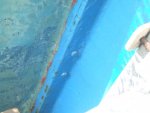
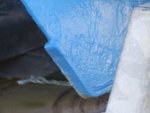
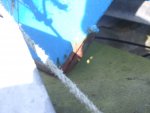
I had no idea this would turn out to be such a long and detailed thread! Here are some pics.
DSCF2042.JPGDSCF2043.JPGDSCF2044.JPG
 
Top