Shaft goes through prop

schmidp

Member
Joined
20 Jan 2021
Messages
23
Visit site
Hello,

I am trying to get the old steel steel boat I bought last summer working and I have trouble with my reverse gearbox slipping, so the guys in the marina suggested that maybe the propeller is loose, so I dived down (still a bit cold at 16C) and took a short video of the prop.

Apparently no-one here has seen a system like this before were the shaft moves through the propeller. What is that kind called? So I could look for some drawings online to understand it better.
How is the prop fixed to the shaft? Can't be a screw as the prop stays and the shaft moves and there does not seem to be a nut at the end.

I did not have the boat out of the water yet as I want to get the gearbox and engine working properly before I get on with the cleanup up the hull.

Screenshot 2021-05-11 at 07.42.10.jpg

The shaft is 25mm btw, now that I look at the picture, does a 2 blade propeller like this seem big enough for a 5t 9m steel boat?
 
It looks like a variable pitch propeller
what make of engine is it
is there a gearbox?
propeller size is dependent on engine hp
 
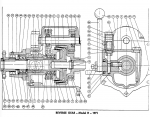
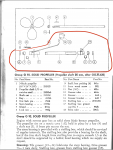
From the engine manual it looks like I have the assembly circled in red, but then the previous owner obviously seems to have changed something regarding the shaft and propeller.

Screenshot 2021-05-11 at 08.13.34.png
 
It looks like a variable pitch propeller
what make of engine is it
is there a gearbox?
propeller size is dependent on engine hp

It's a fixed propeller and the gearbox is only a simple forward/reverse gearbox with one lever with f/n/r positions.

The engine is 10HP SABB GG.
 
Looks a bit like a feathering prop given the way the blades are flat near the hub. If no thrust in reverse then the blades may not be getting past their neutral position due to an issue in the hub. Either that or the key has broken and forward drive pushes it on the taper enough to grip whilst reverse doesn't. Also the gearbox cones in reverse may be slipping due to wear or cable adjustment. You don't say what gearbox it is or say exactly how the issue manifests itself.
 
Isn't that a feathering prop? Try twisting the blades.

Is it possible the previous owner fitted a feathering prop and fixed the blades turning it into a fixed propeller?
But I will dive down in a bit and try to move the blades.
 
Looks a bit like a feathering prop given the way the blades are flat near the hub. If no thrust in reverse then the blades may not be getting past their neutral position due to an issue in the hub. Either that or the key has broken and forward drive pushes it on the taper enough to grip whilst reverse doesn't. Also the gearbox cones in reverse may be slipping due to wear or cable adjustment. You don't say what gearbox it is or say exactly how the issue manifests itself.

Hi,

the gearbox is a SABB reverse gearbox, I was posting about it in this thread as well: Rebuilding a 1968 Sabb model GG

I bought the boat without a working engine and after having the cylinder head repaired from a crack I was trying to get the boat out of the marina.
To my disappointment I was only able to generate thrust when I was going forward and not in reverse.

The gearbox has lever on the side which basically moves a clutch astern or ahead (reverse, forward). The lever way should be the same between forward and reverse, but it is much more towards the rear, so something is worn.

I currently believe that:

a) the engine was not properly aligned (sure of that it was 5mm to the right and the shaft bend when the flanges were connected)
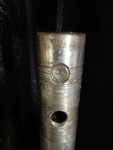
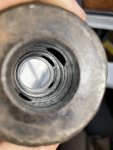
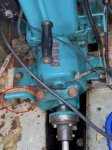
b) the flange going on the propshaft is not centering (see pictures)
c) the gearbox might have wear in bearings or for some reason the operating lever mechanism because of the misalignment.

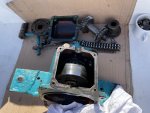
I now have the gearbox apart trying to find out why the lever has so much play.


IMG_0266.jpegIMG_0264.jpegIMG_0248.jpeg


Screenshot 2021-05-03 at 21.38.58.pngScreenshot 2021-05-03 at 21.38.36.png
 
I'm afraid that I don't understand what "the shaft moves through the propeller" means?

The video seems to show a shaft which goes through the central boss of the propeller and comes out through the other side. The shaft turns when you turn the propeller because the prop is fixed onto the shaft, usually with a key.

Richard
 
I'm afraid that I don't understand what "the shaft moves through the propeller" means?

The video seems to show a shaft which goes through the central boss of the propeller and comes out through the other side. The shaft turns when you turn the propeller because the prop is fixed onto the shaft, usually with a key.

Richard

Have a look at the video again. The shaft protruding through the prop varies in length as it turns.
 
Have a look at the video again. The shaft protruding through the prop varies in length as it turns.


It might be varying in length but IT IS turning. You have a variable pitch propeller and the reversing is accomplished by a sliding inner shaft . Inside the boat you will find the mechanism which selects the right position for the ahead and astern position of the blades. Make sure this mechanism is connected up and slides its full travel when you select ahead and astern.
 
It’s been a while but that looks awfully like the variable pitch /feathering 2blade arrangement I had on a boat with Sabb 10.
The remote greaser is important , the shaft through the propellor boss is lubricated thus , as are the swivelling propellor blades
I wouldn’t worry too much about some play in the gearbox parts until you have learnt and used the engine for a few hours
All I remember is that it was much easier to find astern from ahead by reducing revs to idle and gently pushing on the gear lever , you could ‘ feel’ the parts sliding and setting up some reverse thrust ..
And it was all much easier if you gave that greaser a turn or two to keep everything loose and lubricated !
My engine pushed an 8t 12metres sailing boat forwards acceptably ( firmly but slowly ).
Reverse was quite weak because of the design not because of any slippage inside the gearbox .
Great simple engine which relies on a grease gun to lubricate the upper bearings inside the cylinder head iirc..
The exhaust /water injection elbow design was prone to corrosion and likes a regular decoking..
I think there were 2designs , one curvy the other like a square or oblong .
The heat when running seemed to be all at the top of the engine and in the exhaust elbow bits
That is what I remember !
No flexible joint is possible with a variable pitch /feathering propellor and gearbox arrangement , it must be solidly rigidly connected
 
It might be varying in length but IT IS turning. You have a variable pitch propeller and the reversing is accomplished by a sliding inner shaft . Inside the boat you will find the mechanism which selects the right position for the ahead and astern position of the blades. Make sure this mechanism is connected up and slides its full travel when you select ahead and astern.

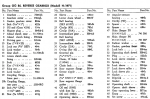
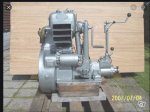
Thats the thing, I definitely do not have a mechanism to change the blades. So there are two types of gear boxes for my engine:

  1. "fully feathering propeller" gearbox
  2. "reverse gear" gearbox
I attached pictures of the fully feathering one and mine (the reverse gear one).

So basically what I have here is a gearbox that was meant for a fixed propeller and a variable pitch propeller that has been turned into a fixed propeller by probably welding the blades...

Well I hope if I get the reverse clutch working I can get by for a few season with this strange setup :-/
Anyway thanks for your insights I will report back though if the blades are moveable, but I am not highly confident in my assumption.


Screenshot 2021-05-11 at 13.42.50.jpgScreenshot 2021-05-11 at 13.40.50.jpg
 
Last edited:
Ah , I wrote just before you posted photos of your hybrid set up !
Ah well

still helpful in understanding more how it should behave! thanks!
I have a new rectangular exhaust/silencer btw after the old round one broke off shortly before I bought the boat.
was 700 euros new. a month later a found one for 120 on ebay :cry:
 
I would check that the variable pitch blades are firmly locked in position otherwise they may go to zero pitch when rotation is reversed.
 
Top