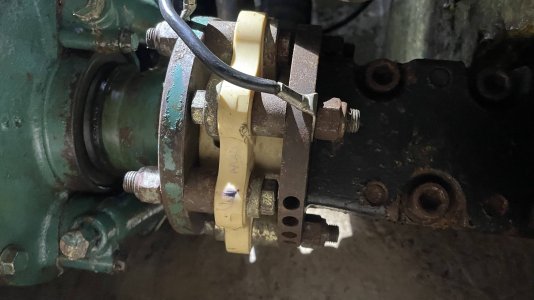
Thanks Tranona, I dod read that but my coupling doesn't seem to have any cone shaped bolts to measure against. I may be wrong but they appear to be normal headed bolts and, if so, I am not sure they are accurate enough.Follow the instructions here randdmarine.com/wp-content/uploads/2024/10/RandD-Flexible-Shaft-Couplings-09-22.pdf
Select any bolt and follow the instructions. The gap should remain essentially the same as the shaft is rotated. If you are still not confident about the alignment you can do the same set of measurements with each of the other bolts.Thanks Tranona, I dod read that but my coupling doesn't seem to have any cone shaped bolts to measure against. I may be wrong but they appear to be normal headed bolts and, if so, I am not sure they are accurate enough.
The red is only to give you one bolt head to use. You can use any bolt head. The important thing is that the gap should be the same at all 4 points when you rotate the shaft.Thanks Tranona, I dod read that but my coupling doesn't seem to have any cone shaped bolts to measure against. I may be wrong but they appear to be normal headed bolts and, if so, I am not sure they are accurate enough.
But it won't tell you if the shaft is correctly lined up in the stern tube.The red is only to give you one bolt head to use. You can use any bolt head. The important thing is that the gap should be the same at all 4 points when you rotate the shaft.
No, but that was not the question. You can only do that by disconnecting the coupling completely then centring the shaft in the tube followed by bringing the engine in line (assuming the shaft floats in the tube with no bearing or solid mounted stuffing box). If the shaft is not central it is more likely to result in noises from hitting the tube or excessive cutless wear rather than vibrations.But it won't tell you if the shaft is correctly lined up in the stern tube.