Sextants.. How precise do you need to be?

Most of the time when I last calculated position with a sextant, there was no GPS as we didnt have it. So nobody really knew how accurate anyone's particular position was.

In the world of Navigating Officers, the 2nd Officers position was the most accurate, the 3rd Officers was next most accurate, and the Cadets' positions were not really considered as they were just practising.

As a cadet, I used to wonder why my position wasn't given any weight as, assuming there wasnt a mistake in the way I had done the calculation, there was no way of knowing where we actually were, so no way of knowing whose position was closest. I didnt argue the toss... gained nothing by it, and would probably have offended my seniors :(
 
When I used to take the daily positions with a sextant, I would normally get within 2Nm of the GPS position using a commercial metal sextant. It was very much down to the optics and construction of the sextant and how good you were plotting the sight lines.

However, back then it was early days for GPS and it used to have quite an error itself depending where you were and who America was at war with so neither position may have been accurate.
 
Nothing wrong with a plastic sextant. The changes of temperature tend to affect the arc more than a more expensive metal sextant but you always check the index error every time the sextant comes out of the box to allow for that. As others have said, the accuracy is as much down to the skill of the user, especially when navigating from a yacht, and within 4 miles is a pretty good result for anybody. However astro navigation is well worth pursuing as an extremely satisfying "hobby". Sun sights tend to be the starting point and for these an Ebco is fine. However the best results come at twilight (morning and evening stars) and then the better optics in more-expensive sextants come into their own. I am a big fan of my Astra IIIb with a whole-horizon mirror. See what is around at Beaulieu in April, or try e bay. There is currently a GLH sextant on offer at £220 which looks pretty reasonable; avoid the old vernier models and replicas.
 
Deep into a YM Ocean course and have broken out my cheapo Ebbco (Special, mind you!!) to give sun sights a go in the real world. I'm taking sights within 4'-10' of predicted altitude at my GPS position. Is this good enough? All the paper exercises have index errors less than 2' so is 4' or more too imprecise?
Do I need to fork out for a metal instrument to get through the YMO? I'm not interested in owning a thing of beauty.

When I qualified (a long time ago - Cert No 256) there was no way of knowing how accurate your fix was - unless you could take bearings on shore. If you found your destination that was good enough. When Decca became available I found with an Ebco special I could get a position reliably to 2nm in calm weather but only if I took about 6 shots in quick succession and averaged the lot. I also found I had to check the index error error every time I used the thing. For passages (as opposed to practice) I have a Zeiss (now Freiberger) whole horizen sextant and was quite upset if I couldn't get a position line within 2nm in calm weather with a single sight. However, that was when I used the things regularly. I tried last year with the Ebco and was 6 miles out - there is nothing like practice.

Purists get quite snotty about whole horizen mirrors. In essence they make routine sun shots easier but may make star shots more difficult as faint stars become fainter still. In my case I only selected bright stars so I was quite pleased not to be distracted by faint ones.

As far as I can see the present test only asks you to show your sight reductions, you don't have to prove how accurate they were. Despite the lack of GPS there was more of a giveaway in the old days as you had to provide the workings of a five star fix and the size of the cocked hat gave a good indication of how accurate you sights had been. The secret was to plot them on a fairly small scale. The only complaint from the examiner was that I had taken rather a long time between sights. I was just glad to get them done before the horizen disappeared!
 
Plastic sextants aren't all bad. The Ebbco was never intended as more than a practice instrument, but a Davis Mark 15 got me across the Atlantic in the distant days before GPS. I found the problem with it was not that it was initially less accurate than a 'proper' sextant, but that it wore fast, so that inaccuracies, particularly backlash, eventually became too severe. It was certainly capable of star sights, though my skill at reducing them was less so!
 
Thanks for the further info and suggestions which are reassurring. More practice seems to be the key - especially from a deck rather than a seaside carpark!
 
OK. Thanks for replies so far. Maths isn't my forte so can I ask if a 4' error in observed altitude translates into a 4 mile error in position, or is there some exponential buried in the sums which will send things really awry?

Chichester used to practice taking sights while he was running along the ground.
 
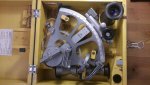
I am consistently within 3NM precision with my Russian sextant:

cho-t.jpg

Real world precision to achieve should allow you to get close enough to your destination to be able to see it, e.g. a tall island you can spot from 20NM away is very easy to find then.
 
Top