Sextant prices

Bubble sextants

I know of at least two airline captains who take bubble sextants onto the flight deck to practice the ancient art.

Astro also seems to have a particular fascination for physicists, as any member of Navlist will confirm. I know of one who has a small collection of A-12 bubble sextants and is a whiz at overhauling them.

Much more on sextants of all types
 
Not VHF, transmissions on medium wave AM. Receivers varied from cheap Seafix ( http://www.jerkasmarknad.com/seafix.jpg ) to expensive Lokata ( http://bar-antenna.com/rdf/LOKATA_1A.jpg ).

No, I don't mean RDF beacons which were just CW transmitters which transmitted a continuous carrier periodically interrupted by an identifier in morse. There were both marine beacons, often located at lighthouses, and aero beacons located to specifically assist aircraft. You simply swung a directional antenna (a ferrite rod in the case of the SeaFix and Locatta) to locate a null in the direction of the signal. I still have a SeaFix in working order, though all it is good for now is Radio4 LW.

The VHF radio lighthouse system (maybe there is a more official name) used 2 differently located/phased transmissions. As described before, you simply listened on an ordinary VHF radio to the appropriate channel. After a pause, you would hear a series of beeps which you counted. Tables published in the almanacs enabled you to determine your bearing from a specified position. I guess in concept it was similar to Consul.

The system was only in service for a few years before being overtaken by 'affordable' yacht DECCA systems.

Surprisingly I can find no mention on Google, but have only skimmed.

Vic
 
Last edited:
Yes, a great read.

Chichester used a marine sextant and the sea horizon on his solo flights from NZ to Norfolk and Lord Howe Islands. He flew down to just above sea level to calibrate his altimeter, then went up to 1000 feet to take sights, using the appropriate correction for dip at that height. All this in the cramped, open cockpit of a Gypsy Moth.

Chichester did work on bubble sextants during WW2 and I believe personally assembled some Mark IX versions for the RAF.

Just picture it! Flying along, solo and a long way out of sight of any land, open cockpit, Irwin-type leather-and-wool flying jacket, leather helmet, marine sextant and watch in one hand, chart, notepad and pencil in the other, holding onto the circular slide rule used for reducing the sight(s) with the teeth and eyebrows, and the aircraft's 'stick' held firmly between the knees....

....And only one island ( Lord Howe ) to find and land beside. Or 'Good night, Francis C!'

They made them of hardier stuff in those days!

:cool:
 
My two sextant heros have to be Frank Worsley on board Shackltons 23 foot whaler The James Caird working out his position by candle light wedged under the canvas sheet that was its deck whilst crossing the Southern Ocean to South Georgia!-no concise sight reduction tables just tables of logs cosecants etc.
The second Nansen -not a seasoned marine navigator whilst out on the Arctic ice heading for the North Pole-he remarks on one occasion it took him all day in his tent at little below minus 15! to get the maths right.He also had on one occasion to do a GMT calculation as they had forgot to wind their watches which is I believe possible but very complicated.
 
Just picture it! Flying along, solo...

....And only one island ( Lord Howe ) to find and land beside. Or 'Good night, Francis C!'

They made them of hardier stuff in those days!

:cool:

Getting it wrong meant almost certain death in the sea - the probable fate in 1937 of Amelia Earhart and her navigator Fred Noonan, whilst trying to find Howland Island in the Pacific. LOTS on this in Navlist. :)

Back down at sea level, got to agree with ffill's reference to Frank Worsely and the James Caird.
 
Back to prices...

A 1960 vintage C Plath sextant described as being in "good" condition sold on UK ebay yesterday evening for £410 plus £30 p&p. There were 19 bids.
 
Sextant Restoration

Does anybody here know where I can get a sextant restored? It's from about 1930 and was my Grandfather's - he used it to navigate while on the Russian convoys during the war.
I was pointed in the direction of compass adjusters near Southampton but cannot make contact. Does anybody know anywhere else? I'd like it to look good but also to allow me to take the odd sight on a clear night!
Thanks
 
sextant restoration

Thanks Thwister Ken - they're who I tried to contact but who aren't answering calls or emails. Thanks Parsifal, I'll give them a try.
 
I've recently done (and passed) the RYA Ocean certificate. Thoroughly enjoyed it but have yet to buy a sextant of my own (I need to buy another boat first!). Good sextants aren't cheap although they're frequently available on ebay and usually come from ships scrapped in India. I wonder whether they are carried on modern merchant and RN ships. One drawback with their use is that there is considerable expense involved in keeping the necessary books up to date.
 
One drawback with their use is that there is considerable expense involved in keeping the necessary books up to date.

'If you think knowledge is expensive, try ignorance.'
Bok, McIntyre

:)


Or you could consider the economic alternative that is Reed's Astro Navigation Tables ( used to be called 'Reed's Heavenly Bodies' before the big girls' blouses got on to it ). Read the recommendations on the rear cover....


:)
 
Last edited:
Merchant ships and Naval vessels still carry sextants.

Another vote for Reed's, just don't buy a sextant that looks anything like the one on the cover.
:eek:

(Must write to Reeds about that)

There are also downloadable almanacs available from several sources on t'internet and the US government publishes Bowditch, HO 249/AP3270 (The Air navigation tables) and much else for free download here. Click on Publications.
 
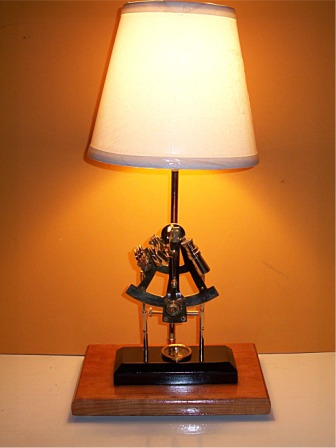
Here you go...

Sextant_TableLamp_BR4851A-L.jpg


Yours for $69.95; just de-lamp it and you're in business.
 
Top