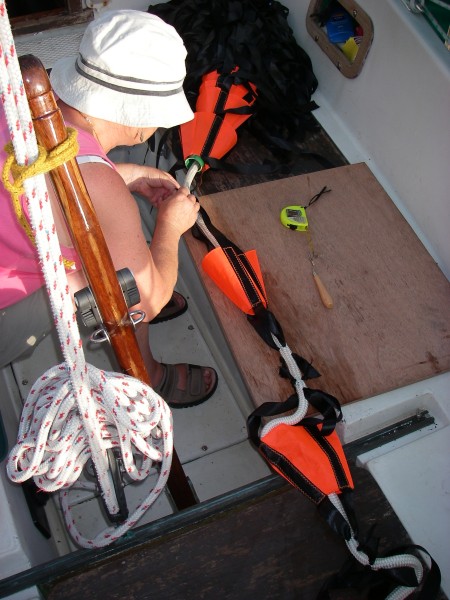
series drogue video's

bryan

New Member
Joined
6 Mar 2005
Messages
15
Visit site
series drogue video\'s

Dear All,
My Son and I have been to Noosa in Queensland, Robin filmed the tests with the Volunteer Coast Guard we conducted with them, evaluating the performance of the series drogue. To you blokes that say this forum should not be about promoting web sites, I have two words for you, "cricket".
regards
Bryan
www.seriesdrogue.com
 
Re: series drogue video\'s

Whats the point in demonstrating a drogue in a flat calm? Go out in a F10 and do it you antipodean pussy!
 
Re: series drogue video\'s

any so-called sailor who steps inside the bight of piece of kit being deployed overboard needs either good insurance or his head examining.

Pretty poor safety and risk delivery.
 
Re: series drogue video\'s

Not too impressed by the video but the CG study was interesting ( the bits I could understand!!) so my 2' diam drogue will be next to US and if I dont trail it at the right distance completly usless. I need about 150 small drogues and a lot of dedicated heavy cordage and very strong cleats??
(32' heavy motor sailor).
What do you carry??
 
Re: series drogue video\'s

My understanding is that the series drogue was designed to resist pitchpoling or broaching in the event of a breaking wave strike (following1979 Fastnet race for those long enough in the tooth to remember).

Towing behind a motor boat in calm conditions does not demonstrate anything useful, but then I gave up watching part way through after too many tasteful shots of the deck.

Jordan Series drogue has some more info: http://www.jordanseriesdrogue.com/D_1.htm

Would seriously consider making a series drogue for ocean sailing. I carry three liferaft drogues in series for my coastal / offshore pasages but have never had need of them - now far too timid (or wiser?) having experienced F9 off Fair Isle in my first 26ft cat when we sheered both rudders while surfing with the cockpit full of water from the previous breaking wave.
 
Re: series drogue video\'s

Thanks for your kind words. The Coast guard at Noosa have to tow about 50 boats a year across a nasty bar into the Noosa river from the Pacific. In surf the towed vessel often overtakes the towing vessel which is dangerous. The Coast Guard believe the series drogue trailed behind the towed vessel would provide directional stability and slow it down.
regards
Bryan
 
Re: series drogue video\'s

Ignore them Bryan - they're being grumpy. probably because it's nice and warm down there but cold and pis*ing it down again here.
 
Re: series drogue video\'s

I thought at times that they were going to get the lines caught round their feet! Not a very good way to launch or recover a drogue, I would have thought?
 
Re: series drogue video\'s

This has long been an interesting report and an interesting device. It has been suggested it would be quite sensible or even prudent for me to carry a small drogue and rig on my current boat (given that it's small, slow and open and I live inside a sometimes difficult harbour bar). My solution so far has been to not be out in my boat in anything where a drogue would be necessary and would be, should plan a fail, not to even attempt to get in unaided.

RNLI all-weather lifeboats typically carry their own conventional drogue and a smaller 'casualty drogue' that can be passed to another vessel to be towed or escorted. They are often used not for particularly heavy seas but for the sort of dangerous bar crossing (or harbour entrance and close-in or surf situation) you describe. The big drogues may not come out that often but the casualty ones get used quite frequently when towing, particularly if the tow is a small yacht or is without steering.

The series drogue in the videos looks a superb heavyweight piece of kit and may actually do a better job than a single conventional drogue but it looks a complete pain to store, deploy and recover in the video... and this from a CG vessel in calm water with several blokes and a big open aft deck.

I'd not be keen doing it on my own, nor from my tiny cockpit and aft deck, nor in a big sea... but I do think I could manage a small conventional drogue on a fixed line and bridle.

As for towing in others, I can't see that it would be practical to attempt to pass a series drogue like that shown in the video across to a small yacht in a big sea and ask them to flake it out (where?) then deploy it from their stern. If it makes sense in the Noosa case, it must be flat seas outside and one hell of a bar on the way in...
 
Re: series drogue video\'s

We built a series drogue with rope off Ebay and 90 cones Bryan sent us at a very reasonable price, but fortunately have not had the occasion to deploy it yet. Total cost for our boat was under £250.

Our drogue is appprox. 75 m length including the bride, with 90 cones (Albin Vega 27). Lots of research convinced us that this was THE bit of emergency kit to have offshore in a small boat, and nothing since has changd my mind. It fits, neatly flaked, into a relatively small bag with the bridle at the top, all ready to quickly haul out of the locker and deploy with relative ease from the safety of the cockpit - much safer and easier than deploying a parachute anchor or even a single drogue. Drag is small when you first start paying it out as well, so if you screw it up it can be recovered and redeployed before it all goes horribly wrong.

I am not convinced our stern cleats would stand a breaking wave strike - which can essentially result in a force on one leg of the bridle of over 50% of the weight of the boat - so we have some big shackles on the bridle loops which mean we can take lines from there to the main winches which will share the load and would take over in the event of total cleat failure.

We haven't towed it in calm weather because we can see that it will work and have read the reports. I don't however see the point in taking the p*ss out of Bryan's video just because it is not blowing a gale - drag is drag, and he is a manufacturer so has to have some advertising material.

In terms of cost, space and proven performance the series drogue has surely got to be the most effective piece of 'survival storm' gear you can have on the boat.

seriesdrogue.jpg

Making our series drogue
 
Re: series drogue video\'s

Not sure that I took the p*ss out of either the video or the product... but I was trying to provoke some discussion of drogues because I've some experience of using them, have an interest in carrying one and wouldn't mind some input.

FWIW I don't think the video as presented does the poster (who you suggest is the manufacturer) or the product many favours. Some of the comments made by me and the other posters still seem reasonable.

Your comments and endorsement, on the otherhand, are much more interesting since I understand that you do a lot of offshore sailing and have obviously considered the options and both rate and trust the series drogue.

If you've got one in a neat, compact bag from which it deploys swiftly and easily from your boat then it's a much more usable device than the impression given in the video and it makes more sense than I thought for towing vessels in.

Even so, I've come away with the idea that the series drogue is really a storm survival device for offshore sailing rather than an alternative to a small conventional drogue for the sort of difficult entrances or unexpectedly big seas I might come across in my little boat.

But I'm still thinking about it...
 
Re: series drogue video\'s

Thanks ggt,
I made the Coast Guard drogue in 4 sections bridle /leader,40 cones,20 cones 10 cones. So any combination can be used by joining with eye splices, depending on how much drag is needed.
The calculation is No of cones x 0.27 x speed in knots squared, this gives drag in pounds. 100 cones @ 2knots = 108lb, @ 5knots = 674lb, @ 10knots = 2700lb.
The Coast Guard have been trailing a conventional single unit drogue, but the device tumbles forward in surf, creating slack in the line, and resultant snap loads on the line.
When they are called out to a stricken vessel, cg throw the bridle legs to the vessel and deploy the drogue them selves, then move to the bow for towing.
regards
Bryan
 
Re: series drogue video\'s

Jesus, if I had been seen standing either side of a rope paying out over the stern like that I would have been black and blue from one of my uncles, probably the one who reached me first.

I actually cringed and covered my eyes watching the way the crew were behaving around that rope. We poms have a word for that, idiots!

Not to take away from the subject, but for gods sake, be more careful!
 
Re: series drogue video\'s

I had not realised you weighted the end of the tow, this confuses me a little.

You need the tow to float, which it will if there is enough forward velocity. But, as the drogue they put out almost stopped the boat running hard then a similar amount of cones will stop a yacht dead in the water. Then the chain sinks, the boat builds up speed and snatches again to a stop infinitum.

This is surely not a good thing, for the rope, the boat, the crew. Which leads to the question, how many buckets for a small yacht, just enough to be of use, not so many as to stop her dead. I am a fan of the series drogue, but have reservations due to no real world testing.

Can you attach along the tow and use it as a brake to slow down but still get headway, this would be much easier to do without a bridle, but I would not like to tow one of these off a single post.

Interesting to see one deployed though, I have to say, seeing the problems keeping it from tangling, even with 3 people paying out, I would not fancy trying to do it alone on a pitching boat.
 
Re: series drogue video\'s

Dear Dogwatch,
You will notice that we deploy the drogue with bridle first, then the 25meters of leader, then cones, the bridle takes the load, the section of rope we are dealing with has the cones running backwards in the water, it is not until they complete the deployment loop that any real drag begins, and the bridle does the holding.
In storm situation you would deploy straight from the bag, I laid it out into the cockpit so people could see the whole thing.
The chain is what separates this device from anything else.
In a storm situation a wave passes under the vessel and it picks up speed to 6 or 7 knots increasing drag, and slowing the vessel to 1 or 1.5 knots, at this speed the chain sinks keeping the line tight. The line itself is nylon22% stretch or polyester 17.5% stretch. I prefer polyester as I believe the extra stretch/friction/heat with nylon causes the line to fail, para anchors being an example of a device that break lines, but manufacturers insist on using nylon line.
 
Re: series drogue video\'s

Dear Brendan and Dogwatch
I thought if I ignored the rope between my legs comments they would go away, not the case eh. OK i agree its a silly thing to do, things are happening quickly and mistakes happen, I also set off my life jacket when one of the cones pulled on the inflation ripcord. Later that evening I caught a 1kg bright yellow fish, that spiked my hand, causing it to double in size, and serious pain, the doctor after seeing a photo said it was called a"happy moment" because when it stops hurting you have a happy moment.
Somehow we manage to survive these trials and have fun on the water.
regards
Bryan
 
Re: series drogue video\'s

[ QUOTE ]

...
So any combination can be used by joining with eye splices, depending on how much drag is needed.
The calculation is No of cones x 0.27 x speed in knots squared, this gives drag in pounds. 100 cones @ 2knots = 108lb, @ 5knots = 674lb, @ 10knots = 2700lb.
The Coast Guard have been trailing a conventional single unit drogue, but the device tumbles forward in surf, creating slack in the line, and resultant snap loads on the line.
When they are called out to a stricken vessel, cg throw the bridle legs to the vessel and deploy the drogue them selves, then move to the bow for towing.
...


[/ QUOTE ]

Thank you Bryan... that all makes more sense.

I've seen single cone drogues get 'pulled out' or refusing to sit properly in the water; another trick was spinning and getting fouled up in their lines.

One of things about the series drogue seems to me to be that once it's fully deployed it's likely that, come what may, some or all of the cones will be in effective use so you'll be getting some benefit at all times and shouldn't get snatching or sudden letting-go.

Personally, I'm not looking for a storm survival device but I am interested in a steadying device for harbour entry. Do people carry and use 'short' series drogues (or just one leg of a full drogue) for this sort of thing? How many series cones are 'equivalent' (if it's possible to compare or compute) to a conventional 2-3ft cone?
 
Re: series drogue video\'s

Dear ggt,
I have been working on this idea for a couple of years, along with drogues for landing dingies onto beaches thru surf and kayaks. I would need to know your vessel displacement, and details on the bar in particular to work out a set up. Give me an email at bryan@seriesdrogue.com
regards
Bryan
 
Top