
Self Adhesive Veneer?

neil1967

Well-Known Member
Joined
28 Nov 2007
Messages
1,148
Location
Tavira, Portugal
Visit site
I have a couple of holes to fill in my wood veneer where the PO had cut holes for stuff I no longer want. I can fill the holes OK, but I don't give much for my chances of matching the repair well. I'm thinking of using self-adhesive veneer, as sold by www.thewoodveneerhub.co.uk to cover the whole area. This seems to get around the potential problems of either air trapped in the glue, or having to use an iron on a horizontal surface with difficult access around the edges. The downside is the cost, but that's my call :-) Has anyone any experience of using self adhesive veneer, and if so any tips? Thanks
 
It is worth asking a furniture repairer if they can hide the holes once you fill them. I have had small damaged areas filled on furniture and you can’t see them without a very close inspection, professional restorer job.

Specifically about your question. The veneer strips that conceal the edges of ply on my own boat have mostly come off but they did last around 40 years so the glue must have been good. The replacement veneer strip with adhesive backing did not work well but that could have been the wood preparation and / or my skill. Later, when I asked a boat builder who specialises in wooden boats to use the stock I had bought he reported back that he could not get it to work well either.

The boat builder did use large sheets of veneer faced ply, about 1mm thick, maybe 0.75 mm, to reface bulkheads that had years of old holes and some old repairs. The veneer sheets came from Robins Timber. He used an adheaaive like epoxy to secure and used low cost thick ply to press it in place vertically. This was pressed onto the veneer with wood straps butted against another surface. It looks look and I will probably get all the bulkheads done in the future.

On my boat there is a bulkhead in the aft cabin, behind which is the lazaret. Imagine my horror when I discovered that I thought it was delaminating. The actual bulkhead turned out to be OK but a 3 mm ply backed veneer had been attached many years ago and had rippled as the bonding within the plybacking failed. The moral of the story is that non marine grade ply backed veneers may not be good enough.

I can post pictures later, on my mobile at the moment.

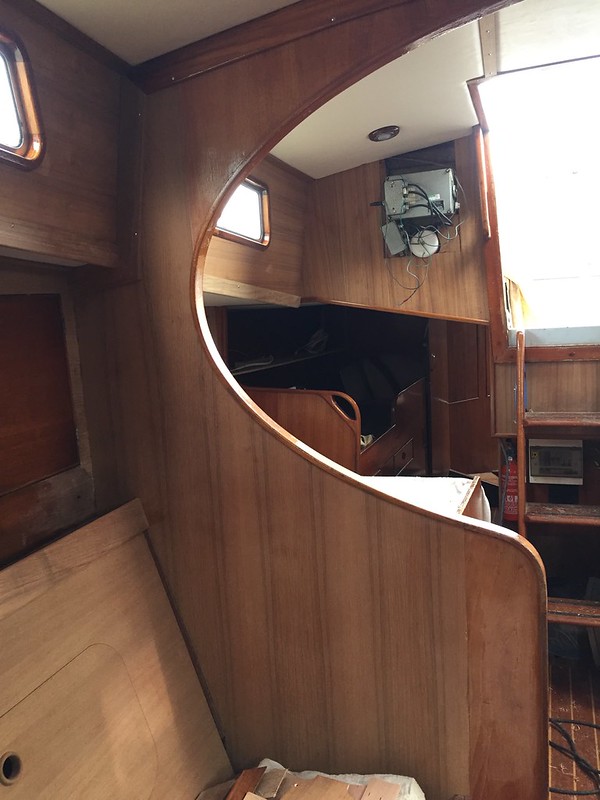
IMG_5749 by Rival Sailor, on Flickr
 
Last edited by a moderator:
The panels behind my chart table have a lot of cut-outs, and one had a large hole in it for a chartplotter which I have removed. I made a new panel from 12mm hardwood ply, which I stained to match the surrounding woodwork, and cut to take a smaller plotter. Depending on where your unwanted holes are it might be easier to simply make a replacement panel. In my case the hardest part was the fact that the panel did not have a single right angle to either sides or edges, but the end result looks fine.
 
I used Robbins 1.5mm teak faced ply, (now over £200 per sheet, eek!), to re-veneer most of the main cabin of a She 31. I had no previous experience of veneering, but it worked well, very easy to cut and handle. I used either moisture resistant PVA or contact adhesive depending on the location. Lasted well for a number of years while I owned that boat, and beyond AFAIK.
 
By chance I’ve just reveneered a teak table and extension using their adhesive backed teak veneer. I paid £80 I think for 2m x 600m. The material was very easy to handle and the adhesive appears strong. I’ve done a fair amount of venering and this was much easier than gluing unbacked veneer. I could hAve used teak faced ply but didn’t want the extra thickness. - will definitely use it again
 
I wouldn't re veneer a panel using veneered ply. You can buy various thin veneers from specialist suppliers cut an 'eye' shape and stick it with contact adhesive. The difficult part is staining to match and finishing. The traditional way is to use animal glue but contact is easier.
 
Top