
Seeing the Compass Heading

dolabriform

Well-Known Member
Joined
12 Sep 2016
Messages
1,917
Location
Kent
freewheeling.world
Hi all

I have a Leisure 23 SL which has an offset companionway. Depth and Log are mounted on the port bulkhead, with the compass mounted on the starboard bulkhead.

When on starboard tack, I am sitting in front of the compass and can easily see the heading. However when on port tack I have no chance of seeing the heading, especially as I'm normally leaning over to see past the coachroof.

What would you do in this situation? I've tried mentally changing the heading in my head ( no pun intended ) so if my CTS is 180 degrees, I'll add 30 so I'll try and reference 210 from a mark I can line up on the Compass. Unfortunately this is not easy as it sounds due to the angles involved and the lack of clarity because the compass is a bit foggy.

Any other ideas, short of moving the location of the compass?

Thanks
 
Add another compass?
I think the general rule is that they want to be at least a metre apart.

A lot of dinghy sailors use the TackTick digital compass. This gives boat heading on two faces offset by 45 degrees from the centreline.
Very few non-electronic compasses are as nice to use.

Are you trying to steer a compass course, or trying to watch for windshifts on a beat?
For the latter, some people like the 'tactical' compasses with bigger digits, but not me TBH. They might enable placing the compass further forwards where it can be read on both tacks?
 
I have a Henry Browne grid compass mounted centrally between the cockpit benches on a bracket screwed to the rear bulkhead below the tiller. I like this type of compass because once you have set the grid for the desired course all you need to do is keep the needle parallel to the two grid lines.

I don't think they are still made but they often appear on eBay.

https://m.ebay.co.uk/itm/Vintage-5-...t-working-condition-/202068527970?_mwBanner=1
 
Hi all

I have a Leisure 23 SL which has an offset companionway. Depth and Log are mounted on the port bulkhead, with the compass mounted on the starboard bulkhead.

When on starboard tack, I am sitting in front of the compass and can easily see the heading. However when on port tack I have no chance of seeing the heading, especially as I'm normally leaning over to see past the coachroof.

What would you do in this situation? I've tried mentally changing the heading in my head ( no pun intended ) so if my CTS is 180 degrees, I'll add 30 so I'll try and reference 210 from a mark I can line up on the Compass. Unfortunately this is not easy as it sounds due to the angles involved and the lack of clarity because the compass is a bit foggy.

Any other ideas, short of moving the location of the compass?

Thanks

You need something like this, with 3 lubber lines at 45°.
ZPLAP55403.jpg
http://www.cactusnav.com/plastimo-m...MI0YCf9bv72QIVCrftCh1_5gUsEAQYBCABEgK8b_D_BwE
 
Many boats have put two compasses on for this reason. It depends on how your boat is arranged whether this is a sensible option or whether a compass over the companionway might work better. Another option, and what I think I would do, is to replace your grotty old compass with another with a line at 45 degrees, as some do. I have a dislike of bits of equipment that don't work properly anyway, and living with a murky compass is no fun.

Like wot Vic says.
 
The compass is a Contest 101 which has the lubber lines, tho as I said difficult to see.

I'm going to the boat tomorrow so I'll have at look at other options. Mounting another compass is not an option as the other bulkhead has all the electrickery behind it.

I'm trying to steer a compass course, I had thought about installing a NASA Target Compass, along with the Depth & Log, but not sure how effective theses are?
 
Hi all

I have a Leisure 23 SL which has an offset companionway. Depth and Log are mounted on the port bulkhead, with the compass mounted on the starboard bulkhead.

When on starboard tack, I am sitting in front of the compass and can easily see the heading. However when on port tack I have no chance of seeing the heading, especially as I'm normally leaning over to see past the coachroof.

What would you do in this situation? I've tried mentally changing the heading in my head ( no pun intended ) so if my CTS is 180 degrees, I'll add 30 so I'll try and reference 210 from a mark I can line up on the Compass. Unfortunately this is not easy as it sounds due to the angles involved and the lack of clarity because the compass is a bit foggy.

Any other ideas, short of moving the location of the compass?

Thanks
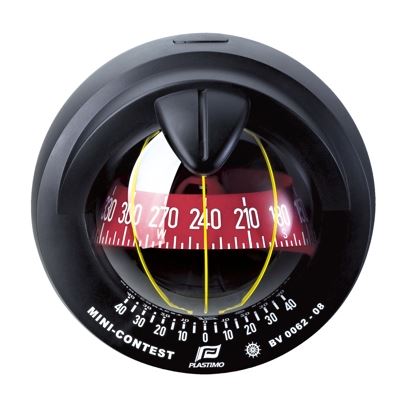
does the compass has 45 deg lubberlines
 
I have a Henry Browne grid compass mounted centrally between the cockpit benches on a bracket screwed to the rear bulkhead below the tiller. I like this type of compass because once you have set the grid for the desired course all you need to do is keep the needle parallel to the two grid lines.

I don't think they are still made but they often appear on eBay.

https://m.ebay.co.uk/itm/Vintage-5-...t-working-condition-/202068527970?_mwBanner=1
What a magnificent piece of kit. It makes our up-range Plastimo look like cheap tat - maybe it is ... ...
 
have you thought of an electronic compass on a smart phone or tablet etc.
Providing you have sufficient power and waterproofness (depending where you place it!) you could:
download a compass app. (if it has a compass magnetometer hardware) or
use a gps type app to give you course over ground (COG)

I'm not saying you should always be using it - you could use it to get a visual offset on your bulkhead compass and then occasionally glance at the phone to see if you are still on course.....etc
 
I would have thought that a GPS or plotter would almost supersede a compass for navigation. So I would not worry or spend a lot of money on another compass. Perhaps as suggested you want to check on wind shifts when out of sight of land. When beating I often sit on low side anyway to keep in close touch with the jib so maybe OP should try just sitting on the one side if he wants to see the compass. My compass has not been used seriously for many years so is always covered. olewill
 
I would have thought that a GPS or plotter would almost supersede a compass for navigation. So I would not worry or spend a lot of money on another compass. Perhaps as suggested you want to check on wind shifts when out of sight of land. When beating I often sit on low side anyway to keep in close touch with the jib so maybe OP should try just sitting on the one side if he wants to see the compass. My compass has not been used seriously for many years so is always covered. olewill

I guess it's strange but even though I use navionics on the ipad, I still want a usable compass as my primary source of navigation. I know that it's not as accurate as following a line on navionics, but as I spend my days looking at computer screens I prefer to switch off and go back to basics
 
It’s much more difficult to steer a course to a GPS generated COG. Even the most damped compass reacts better. Furthermore in tidal waters COG isn’t always the most helpful and I would be seriously worried about relying on battery power and electrickery as the only way to tell me which direction I was facing.

The joy of a magnetic compass is that it doesn’t run out of batteries and doesn’t really go wrong.
 
I think that all boats at sea should have a working magnetic compass, however attractive the idea of steering to an electronic display. If the current one is murky and not easily seen, then sailing with it is not going to be a pleasure, which is what we try to achieve.
 
Top