Securing jackstays

MJWB

Well-Known Member
Joined
24 May 2019
Messages
309
Location
Yorkshire coast
Visit site
Have seen a number of views on securing jackstays ranging from hard shackles (beware deck damage) to hooking through and over cleats to using something like 5mm line to lash them.
Also differing views on intermediate fixing points combined with closer to centreline routing and looping a single line harness lanyard around the jackstay to reduce the amount of travel outboard if unfortunate enough to end up heading over the side by accident.
Any thoughts out there please? Really interested to hear other's views and experience.
 
I always use the best quality steel shackles I can get, as I figure I don't give a damn about marks on the deck if my life's at stake.

Still interested to hear what others do though.

UPDATE: The shackles go to the bow and stern cleats and I put the jackstays on and off each time I use them, I don't want to leave them out to get weathered.
 
Last edited:
I don’t have jackstays, but do have anchor points along the centreline of the boat. Centreline because a lot less likely to end up in the water. I can get from cockpit to bow clipped on to at least one point. Short boat so only 3 anchor points needed.
 
I am going for Dyneema with a sturdily spliced loop, which is cow-hitched to strong points just outside the cockpit. The stays then run directly to the mast. They terminate in another spliced loop, this time with a thimble, through which I thread a loop that passes loosely around the mast. That loop is soft-shackled to a final leg which runs to the strong point for the removable inner forestay, from which the forestay is within reach when clipped on.

All the Dyneema is threaded through clear plastic tubing to protect against chafe.

Thought process as follows - and comments welcome.
- no hard shackles on deck to tread on.
- easy to remove; just three cow hitches and a soft shackle.
- yes, it can roll underfoot but this is mitigated by (1) being bright yellow (2) insisting that people lift their harness hooks rather than dragging them across the deck. My observation is this latter policy helps encourage bum-shuffling or crawling, which is no bad thing at all; also avoids unnecessary noise for the off-watch; most importantly ? preserves the teak.
- different legs of Dyneema mean I can replace part but not all
- the loop at the mast acts as a "no travel" strong point which I otherwise would lack; it also helps support the whole setup limiting the locus of travel of the stays
- Centreline foredeck arrangement, reasonably tight, seems enough to pull people "into" the boat.
- I encourage everyone to clip to a single point wherever possible; the jackstay is only for travelling up and down.
 
I think the first thing is to make sure you have good polyester webbing.., not nylon webbing

I like dyneema lashing

if you have normal horn cleats, you can lash through the cleat. If you have modern folding cleats, you would probably want to add padeyes and lash to them. You could go on the cleats, just like a dock line, but now it's hard to use the cleat. Of course, you should not leave jacklines on in port anyway.., but if you are only there for one night...

Even setups that use shackles, often have lashings at the other end, to adjust length.

iI you use a shackle, tape it or seize it . I think a well done lashing is more dependable. I can glance at it and see that it is not coming undone. It does need to be checked for chafe, but that's normal practice for all the lines when offshore anyway..
 
My jackstays run from the forward cleats to the aft cleats inside the shrouds. They’re made of polyester webbing and have a large loop sewn into the forward end: that’s fed through the gap in the clear and led back through the loop to secure it. The aft end has a patent buckle with a loop on it: that loop is then connected to the aft cleat by a line similar to that often used to secure guardrails.
 
I don’t have jackstays, but do have anchor points along the centreline of the boat. Centreline because a lot less likely to end up in the water. I can get from cockpit to bow clipped on to at least one point. Short boat so only 3 anchor points needed.

This is my approach as well. Jack Stays that run along the sides of the boat are more dangerous than none in my opinion, on my boat there is not an option to run a central jack stay.

I would rather fall in the water than be dragged through the water. With a life jacket and PLB I have a greater chance in the water in my estimation. I do need to unclip to move from cockpit to mast but the hand holds are good.
 
Last edited:
Don't loop a lanyard/tether around a jackstay. As you slide along the jackstay (especially under load having gone over the side) you will damage the fabric of the lanyard. It could then fail under load; in general you never want sliding fabric against fabric.

If you want a short tether use a short tether.
 
I used flat climbing tape, with a shackle at each end, running from fwd cleat to aft cleat, both sides. Once at anchor , or tied up, I removed them.
 
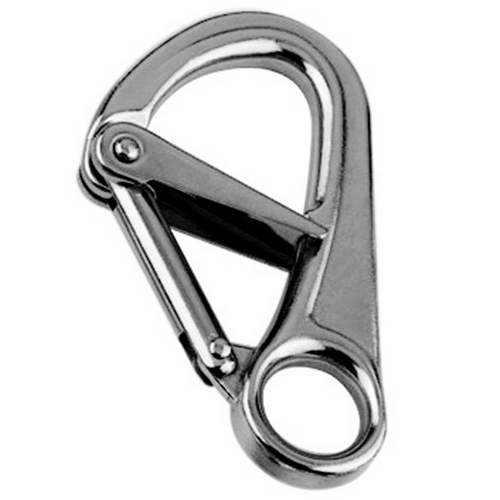
This is the type of safety hook I used on my jackstays attached to a U bolt bolted through deck.

safetyspringhookwithdoublelockinglatch_1.jpg
 
My jackstays are cowhitched through the holes in the bow cleats and lashed to loops at the bases of the pushpit rails. As they arrived oversize I am able to run them diagonally across the boat, crossing near the mast.
When going forward I can be on the high side as far as the mast, safe from falling in to leeward, then clip the short leg of my 3-point tether to the other jackstay, staying on the high side when going onto the foredeck.
 
The boat has a few dings, but nothing obvious around the jackstay attachments, I wouldn't worry too much about deck damage from the shackles.
 
Top