Securing Floorboards?

neil1967

Well-Known Member
Joined
28 Nov 2007
Messages
1,148
Location
Tavira, Portugal
Visit site
My Oyster 406 had the majority of floorboards screwed down when we bought her, with an occasional access panel. I have since unscrewed them all as I have been working under the floors. I notice that most modern boats that I go on tend not to have screwed down flooring. I am somewhat torn - I inherently don't like the idea of the boards flying around in the event of a knockdown, but equally I like the idea of being able to lift them quickly in the event of water ingress. To date most of our sailing has been coastal, but we are preparing for a Biscay crossing, which might influence matters. Grateful for any views, and especially ideas on how to secure floorboards easily but retaining the ability to lift them quickly when required.
 
How long does it take to unscrew a few screws, as long as you have the screw driver handy? As you say, unless they are secured with a catch or screws, the downside of leaving them loose could be worse than the upside.

If you haven’t got time to unscrew a few screws at a time of water ingress, your time might be better spent on getting ready to hop into the liferaft?
 
The best solution would be to fit quick-release catches of some kind, but this will be a lot more time-consuming than just popping the screws back in.

Something like quarter-turn dzus fasteners might not need too much effort as a conversion from screws?

Pete
 
The difficulty is in having a catch that is secure, quick to release, and not a bulky nuisance on the floor.
On my previous boat, there were two hatches in the floor- a big one above the batteries, and a smaller one next to it. I made a catch for the big one on the underside, that you reached by taking out the small hatch. The small hatch was therefore not secured, but it wouldn't have done much damage in a knock-down.
I'm planning on implementing a similar arrangement on my current boat, leaving a small central hatch unsecured and having underside-mounted catches on the adjacent boards.
 
If you are worried about quick access to something like the pump strum box then see if you can position it under the entrance steps . Then buy a 150mm diam dinghy access hatch for about £ 12-00 at the chandlers & cut & fit that in the floor under the steps where you will not stand on it. It would also make an access point to insert a sponge for the odd drips if that is where the low point is.

If you are only worried about those annoying little leaks that form puddles in shallow bilges that then show up at the sides when the boat heals, there is a simple answer. Cut into the shower hose line just before the pump & insert a hoselock fitting. Then get a 15 ft length of half inch braided hose & stick a hoselock connector into it. So as a quick hoover you can clear up puddles under the engine etc. just by connecting to the shower pump.

For in the middle of the saloon drill an 8mm hole in the floor board (do it on a veneer line so it does not show) & put a calor gas terminal & a short piece of 6mm copper tube (copper calor gas pipe ) into the hose. You can then poke this vertically through the hole & suck just about every bit of water that can gather.
Now you can screw the boards down plus you have an additional pump in an emergency
 
Last edited:
Total Loss is a set of narratives from survivors of yachts that have foundered. There are a few editions of the book now and new stories have been added and some removed. In one of the editions there is a good description of a skipper getting into difficulties as the cabin sole floated up and left lots of gaps for his feet to fall through. He also commented that the boards were sloshing around dangerously with a real risk of injury. If none of that was bad enough, all the paperwork had a high probability of blocking the strum box, as opposed to probably staying above fixed cabin soles. If you carried a wrecking bar it would make short work of ripping up a sole if you dropped the screw driver. My preference is to have them screwed down.
 
I'd not want deck plates wandering round loose, so they need to be secured. Mine, apart from a series of small hatches over the keel bolts and bilge pumps, are all secured by screws. I carry a small electric screwdriver and with that it's the work of moments to remove the screws if I need to lift the plates.
However, the only real time I can foresee needing to lift the plates in a hurry is if the boat took significant damage below the water line. Given the shallow nature of the hull shape the speed at which a large leak would flood the boat would, I suspect, largely preclude doing much in the way of damage control from inside the boat. In addition, the deck plates only actually cover about a third of the hull area: the rest is concealed by berths, lockers, heads, galley, tanks and the like, so the chances of actually being able to reach a damaged area are limited. I suspect that time would be better spent on abandon ship preparations rather then starting to lift deck plates.
 
I asked the same question about two years ago on this forum and I was given a very elegant solution. Like you, I want quick access to the bilges in the event of an emergency but I don't want heavy floor boards crashing around in the event of a knockdown, or worse, capsize.

His suggestion was to have quite small removable "plates" embedded in the floor board (in my case ply- board) which gives access to finger latches (under the floor boards) which hold the floor-board in place. If the small "plate" was nylon/plastic it wouldn't hurt anyone if it was sent flying. An alternative is a finger latch

View attachment 70315
 
3M double lock? Velcro on steroids. I understand it is used to hold ceiling panels in place. I gather if you use too much, you can't get the panels off again. So flooring should withstand inversion or the mild buoyancy of the sheet material.
 
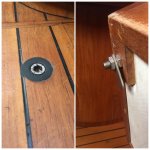
If it helps mine are secure with a large hex bolt and a small stainless bar that swings into place. The bolt means it can be adjusted precisely. Two in every board in opposing corners.

IMG_9096.jpg

I agree everything of reasonable size needs to be secured, especially if you have any sort of reasonably large windows. There's more than a few cases of boats being lost due to an internally smashed window during a knockdown.
 
If it helps mine are secure with a large hex bolt and a small stainless bar that swings into place. The bolt means it can be adjusted precisely. Two in every board in opposing corners.

View attachment 70344, .

Top idea. Ta for sharing. Been thinking about something like that for, well quite a few years now that looks perfect. We used similar back in theatre days called coffin clips or something for joining touring dance floor sections. But they woild cost money and be harder to install. What did you use for the surround round the hex cap head?
 
Total Loss is a set of narratives from survivors of yachts that have foundered. There are a few editions of the book now and new stories have been added and some removed. In one of the editions there is a good description of a skipper getting into difficulties as the cabin sole floated up and left lots of gaps for his feet to fall through. He also commented that the boards were sloshing around dangerously with a real risk of injury. If none of that was bad enough, all the paperwork had a high probability of blocking the strum box, as opposed to probably staying above fixed cabin soles. If you carried a wrecking bar it would make short work of ripping up a sole if you dropped the screw driver. My preference is to have them screwed down.

The edition I read seemed to have a balance of 'you need them screwed down' and 'you need quick access' tales.

I compromised with some screwed down, a small loose bit over the bilge sump and retaining the bit over the impeller with a simple clip.
 
Top