Second Alternator +ve Cable and Sterling Charger?

demonboy

Well-Known Member
Joined
11 Oct 2004
Messages
2,237
Location
Indonesia
www.youtube.com
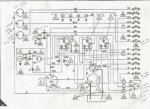
According to my starter wiring schematic (attached) I have a cable that runs to my alternator positive. It comes via the starter solenoid and back to the battery. Or the other way around, because there is a 13v live current coming from the battery to the alternator. I understand that some alternators need a feed from the battery to operate and this one I have fitted is a new Lucas 90amp.
Starter-schematic-3-001.jpg

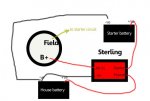
I am installing a Sterling alternator to battery charger and the wiring should be alternator +ve to the Sterling box, and nothing else. However if the above-mentioned cable was connected, surely the alternator would be charging the battery via the original cable and by-passing the Sterling, no?

At the moment I have disconnected the original cable but when I start my engine the alternator is only showing 2.7v output.

1) Does this alternator require a feed from the starter battery in order to generate power?

2) What would happen if I connected it whilst the Sterling was connected? Who would over-ride who?

3) What would be the correct way to wire this alternator to the Sterling?

For the record I have two spare older alternators (Lucas) and when I hook them up without that cable, they throw out the correct voltage and the Sterling operates correctly.

Any pointers gratefully received.
 
If it is the same as mine, there needs to be an energiser that starts the alternator working. In the AB charger there is a feed that goes back to the alternator which starts it off.
 
The existing connection from alternator to starter solenoid should be disconnected and instead made between the alternator output and the Sterling AB charger input

The two outputs from the AB charger should be connected to the two batteries.

Connection to the starter battery can be made at the starter solenoid ( as previously)


The connection to the house battery should be made directly to the battery after disconnecting whatever charging charging circuit there is at present.

Are you saying doing this does not work?

Can you post a wiring diagram that is large enough to read.
and
Can you indicate how the house battery is wired to the system at present.

When you switch on does the alternator warning light come on ?


EDIT

The excitation connection mentioned by PyeEnd is mentioned in the troubleshooting section of the instructions and described in the "extended installation" section
 
Last edited:
The existing connection from alternator to starter solenoid should be disconnected and instead made between the alternator output and the Sterling AB charger input

The two outputs from the AB charger should be connected to the two batteries.

Connection to the starter battery can be made at the starter solenoid ( as previously)


The connection to the house battery should be made directly to the battery after disconnecting whatever charging charging circuit there is at present.

Are you saying doing this does not work?

Can you post a wiring diagram that is large enough to read.
and
Can you indicate how the house battery is wired to the system at present.

When you switch on does the alternator warning light come on ?


EDIT

The excitation connection mentioned by PyeEnd is mentioned in the troubleshooting section of the instructions and described in the "extended installation" section

Hi Vic. I have installed exactly as you suggest, and as per the Sterling basic instructions. This set-up works on my older alternator and appears to be floating the starter battery as I would expect. This does not happen on my new alternator (I have had them all tested last week and all work).

The house batteries (4x 6v in series then parallel to make 12v) are wired directly from the Sterling, as per the instructions.

The extended installation section suggests using an ignition feed. Is this different to field? I have a field wire attached already.

This is how it should work, and how it works with my other alternators.

altr.jpg
 
The extended installation section suggests using an ignition feed. Is this different to field? I have a field wire attached already.

Yes, I think you'll need to add a wire from the starter solenoid (not the starter) to the Sterling - it's marked 4 on Sterling's diagram.
 
Hi Vic. I have installed exactly as you suggest, and as per the Sterling basic instructions. This set-up works on my older alternator and appears to be floating the starter battery as I would expect. This does not happen on my new alternator (I have had them all tested last week and all work).

The house batteries (4x 6v in series then parallel to make 12v) are wired directly from the Sterling, as per the instructions.

The extended installation section suggests using an ignition feed. Is this different to field? I have a field wire attached already.

This is how it should work, and how it works with my other alternators.

Your old alternator would have used the current through the warning light to give it the initial excitation it required to start generating. The new one, it seems has an internal feed . Normally no problem with the output connected directly to the battery but the AB charger prevents this. The connection described in the extended installation provides this.

Connect as described to the solenoid coil connection ( not the main battery connection) and the vital excitation will be provided while the key is in the start position.

The field wire is probably a connection directly to the alternator brushes and would be used if one of Sterlings Advanced alternator regulators was used rather than the AB charger.
Be sure to insulate it properly.
 
Been racking my brains to try to remember going through the same process as you.

Pretty sure:

1/ As Vic says, remove old energiser and put new one from from AB charger

2/ If it is battery sensed (can somebody confirm as I am unsure), the sense wire needs to go back to B+

3/ The online manual I found better worded than the one in the box, particularly over the issue of energising - http://www.sterling-power.com/image...or-to-Battery Chargers and Remote Control.pdf
 
2/ If it is battery sensed (can somebody confirm as I am unsure), the sense wire needs to go back to B+
In its standard configuration it is not battery sensed but there is provision to add a battery sensing connection to compensate for voltage losses. Covered in the paragraph headed "Voltage sensing" in the "Extended installation" section of the on-line instructions


The instructions supplied with the unit are worse than the online instructions? ... eek
 
In its standard configuration it is not battery sensed but there is provision to add a battery sensing connection to compensate for voltage losses. Covered in the paragraph headed "Voltage sensing" in the "Extended installation" section of the on-line instructions

Apologies - should have been clearer - I meant to ask whether the existing set up had a battery sense from the alternator, as if so this wire will have to go to the B+ instead, and a new battery sense added from the AB charger to the battery. I can't tell from the OP diagram, partly because it is a bit blurry when I enlarge it, and partly because I am not really certain what I am looking at! Perhaps the one marked W?
 
Been racking my brains to try to remember going through the same process as you.

3/ The online manual I found better worded than the one in the box, particularly over the issue of energising

You are absolutely right, I didn't know the online version was different. It does a far better job at explaining what to do. I'll let you know how I get on.
 
I am still unclear.

The connection referred to as '4' is actually two tiny connections marked 'IGN START A and B'. Is this for a multiple alternator set-up (i.e. I just use 'A' in my instance)?

Does the AB unit only provide current from this connection back to the alternator when the ignition button is pressed? If so, how does it know when the button is pressed? I have tried putting a volt-meter across the terminal marked A and there is no current either when the ignition circuit is on or when I press the start button.

Surely attaching a wire from the solenoid coil (the smaller of the three terminals on the solenoid that only receives current when the ignition is pressed) to the alternator B+ is doing the same thing, no? If so, this is easier for me to install than the wire from the AB unit. My problem is that this third terminal only receives 9.5v when the ignition button is pressed.

According to the instructions it says:

you need to use the starter solenoid feed terminal on the alternator-to-battery charger. It connects to the starter motor terminal which only becomes live when the starter motor bendix is engaged

Vic, you said to connect to the solenoid coil, not the starter motor terminal. Why is this?
 
Would it not be better to check with Sterling? My battery charger burned out in Gibraltar, I bought a Sterling replacement from Sheppards & found their istruction book left something to be desired, so I rang & spoke to their technical support & got the missing info. However, that was in 2003, things may have changed since then?
Stearman65.
 
I am still unclear.

The connection referred to as '4' is actually two tiny connections marked 'IGN START A and B'. Is this for a multiple alternator set-up (i.e. I just use 'A' in my instance)?

OK, let's just check which Sterling product you have - is it the newer model with red moulded plastic ends, or the original square black device with cooling fins? The online version of the installation manual only seems to relate to the original model.
 
Does the AB unit only provide current from this connection back to the alternator when the ignition button is pressed? If so, how does it know when the button is pressed? I have tried putting a volt-meter across the terminal marked A and there is no current either when the ignition circuit is on or when I press the start button.

Surely attaching a wire from the solenoid coil (the smaller of the three terminals on the solenoid that only receives current when the ignition is pressed) to the alternator B+ is doing the same thing, no? If so, this is easier for me to install than the wire from the AB unit. My problem is that this third terminal only receives 9.5v when the ignition button is pressed.

If your alternator needs energising to start charging, it only needs voltage applied for a few seconds. This is explained in the online installation manual. The reason for taking this voltage from the feed side of the starter solenoid is that this terminal only has voltage on it when the key is actually turned to the start position, to activate the starter.

The wire needed to supply this voltage is only thin, so it shouldn't be a problem routing it to your Sterling unit. If you don't wire it according to the instructions, it may not work.
 
The model is the newer version with the red sides and black body.

I understand that this feed only has voltage when the starter button is pressed, which is why I was suggesting running a wire from the solenoid feed to B+ instead of via the Sterling. It would be a lot easier doing it this way.

Rather frustratingly I have identified a load of other issues with my starter circuit, including low voltage, alternator warning light not coming on and an inability to start the engine without using the glow plugs. I need to get to the bottom of this first before I continue with trying to energise the alternator.

I'll come back after identifying this resistance in the circuit. And thank you for your help.
 
The model is the newer version with the red sides and black body.

Unfortunately, the installation instructions for that model don't seem to be on Sterling's website, so without sight of them it's difficult to assist precisely.

I understand that this feed only has voltage when the starter button is pressed, which is why I was suggesting running a wire from the solenoid feed to B+ instead of via the Sterling. It would be a lot easier doing it this way.

But if you do that, as soon as the engine's running you'll have 12v applied to your starter solenoid! Not a good idea.
 
I am still unclear.

The connection referred to as '4' is actually two tiny connections marked 'IGN START A and B'. Is this for a multiple alternator set-up (i.e. I just use 'A' in my instance)?

Does the AB unit only provide current from this connection back to the alternator when the ignition button is pressed? If so, how does it know when the button is pressed? I have tried putting a volt-meter across the terminal marked A and there is no current either when the ignition circuit is on or when I press the start button.

Surely attaching a wire from the solenoid coil (the smaller of the three terminals on the solenoid that only receives current when the ignition is pressed) to the alternator B+ is doing the same thing, no? If so, this is easier for me to install than the wire from the AB unit. My problem is that this third terminal only receives 9.5v when the ignition button is pressed.

I am almost glad that you are struggling with the instructions in a similar way to me at the time!

The instructions from the online manual

'Starter solenoid: Some alternators will not fire up without a voltage on their B+ terminal. Because the alternator-to-battery charger contains a split charge diode there will be no voltage feed on the B+ terminal which means that the engine will start but the alternator may not work. If this is the case, then you need to use the starter solenoid feed terminal on the alternator-to-battery charger. It connects to the starter motor terminal which only becomes live when the starter motor bendix is engaged, i.e. the first two seconds of having the ignition key fully turned.'

This means put the ignition feed from the AB charger (you have probably correctly identified the correct place, but my 'red box' manual is on the boat so cannot double check) to the energiser on the alternator. I took a short wire off my engine, which I think was from the alternator to the starter solenoid (to break the direct circuit back to the battery). With the AB charger the alternator kicks in just after the engine has started - presumably to keep extra load off whilst turning the starter motor. I am not sure if there is another way of achieving a short voltage - much of the control power on mine comes from the alternator, so requires it to be running to power the instruments. You probably need to be sure that you don't sent a current back down to the starter solenoid once the engine has fired up, just in case it keeps the starter motor engaged (I have just seen PVB's comment on this, so looks out, unless you stick a diode into it).

So the answer to your second question is yes, it only sends a short timed current back to the alternator. Don't know how it knows - just does!

Your last point about the 9.5v - is this correct, or is this because you measured it? If so, it may be a 12v circuit, but because the starter motor is drawing so much current you are only measuring 9.5v?

I went with the instructions as I reckoned Sterling knows a lot more about all this and me. It was hard enough trying to work out exactly what the instructions meant in the first place!
 
But if you do that, as soon as the engine's running you'll have 12v applied to your starter solenoid! Not a good idea.

Good point!

Pye_End, I'm glad to read I'm not the only one. Mind you, the installation should be easy enough and it works ok on my old alternator, so I know I am not doing anything wrong with the basic set up. The problem is this alternator that needs exciting, plus these other problems I have identified.

The 9.5v is what I'm reading on the solenoid feed when the starter button is pressed (not the alternator). Would this be expected?
 
The 9.5v is what I'm reading on the solenoid feed when the starter button is pressed (not the alternator). Would this be expected?

You posted a few months ago that you had big problems with your engine panel. Did you manage to sort out those problems?

If you're only getting 9.5v at the starter solenoid, you ought to check the connections on the start relay.
 
Top