
SeaTalk NMEA Confusion

Simondjuk

Well-Known Member
Joined
29 Aug 2007
Messages
2,039
Location
World region
Visit site
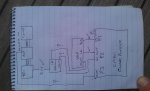
IMAG0291.jpgI could use a sanity check please. Will this work?

Basically, I'm installing a SH CP180i chart plotter and a GX2100E AIS enabled VHF, and want to fully interface them with my existing ST60 wind and tridata and ST5000+ auto pilot. I also have an E85001 SeaTalk/NMEA interface, which I need to bring into play to get boat speed, depth and wind data from the SeaTalk bus, translated into NMEA, and into the chart plotter.

It'd all be quite simple, except that I'm an input channel short on the chart plotter. I know outputs can be paralleled, but don't believe inputs can due to the likelihood of overtalk.

So, to effectively gain an extra port, I'm intending to try the below. The connections marked with a tick I'm happy make sense. Those with a question mark, I'm not so sure of. The main problem is that I don't understand exactly what the E85001 can do, and the manual doesn't help. I'm assuming it cannot act as a multiplexer, but am assuming it can merge the SeaTalk data being fed to it with the NMEA data passing through and thus get it to the plotter via the via the Port 2 input. I don't know if it can simultaneously send the NMEA data input back onto the SeaTalk bus, and if so, does it render the chart plotter's Port 3 output to the autopilot's NMEA input connection I've drawn in redundant? I suspect not, or at least not comprehensively, given that the VHF may not pass through all of the sentences it receives from the plotter, but am also wary that if it does, I may be inputting two lots of NMEA data into the instruments.

If the rough sketch makes any sense at, I'll be amazed. If anyone can advise if it looks sound, or suggest a better solution, I'd be most grateful.

Thanks in advance.
 
Last edited:
Hi
I have a relatively similar setup.. SH radio, CP180i, AIS Transponder, Autohelm and Seatalk/NMEA (YAPP) that is linked to a netbook which then provides wireless connectivity (for phones to view NMEA/Seatalk data).

Back to your diagram though. Reading it on the phone I am wondering what Seatalk data you would expect to be able to see on the plotter. I understand that Depth would be fun to have but not sure you can display wind or log (through water data). The plotter is happy to display it's own SOG from GPS data. So putting Seatalk into the plotter would not gain too much. Perhaps more interesting would be to put the Seatlk to NMEA and feed to a netbook to do Polar and wind type stuff on something like NavMonPC.

Seatalk IN on the Autopilot will be happy to receive both NMEA and Seatalk data. I believe it will prefer the Seatalk if it sees similar information.

Do you also have a Raymarine Radar that you might interface - This may also have Seatlk and NMEA connections. Even the older ones like the SL72 are happy to do the conversion.

I'd have to take a look at the diagrams when on board later - since the CP180i (As you have found) can only do certain things on certain interfaces and also as you have found, one is output only.

One thing that is also possible would be to take the output from plotter on P2 and let it feed two devices (i.e. the AH and the radio).

I will see what I have later since I have also remembered that I have a second GPS (Furuno) fully NMEA connected that can be switched on if the CP180i in the cockpit fails.
 
A bit complicated to get my head around just at the moment, but why do you need the nmea connection to the A/P? Surely it will get the data via ST from the 85001. You can connect a plotter out to both the radio and the 85001.
 
Martin, Keith,

Thanks for your thoughts on this.

To answer, I don't really need to feed the SeaTalk data to the plotter, but since it can apparently display depth, boat speed and wind trend graphs, it'd be a 'nice to do'. I'm one of those people who likes a function to work if it's provided.

I'm not sure I do need the NMEA input to the AP, since as you say, I imagine that the AP will get the necessary data via SeaTalk from the E85001. Not using that output, or indeed paralleling from any of the other outputs doesn't gain me an input to get the SeaTalk data to the plotter which is what I'm lacking. That said, I'm now thinking that I've missed a trick, and if I simply put the E85001 inline somewhere on any one of the NMEA connections, that it will populate SeaTalk with NMEA data and vise versa... or is that what I've already done in the only way possible?... I'll have to look at it again.

I have no RADAR, so no additional connections to be had there.

Anyway, just the data connections to make this evening, so perhaps all will become clear, or even more confusing, then.

Thanks again, I have a new angle from which to look at it due to your input.
 
To answer, I don't really need to feed the SeaTalk data to the plotter, but since it can apparently display depth, boat speed and wind trend graphs, it'd be a 'nice to do'. I'm one of those people who likes a function to work if it's provided.
I have exactly the same kit as you. I did consider putting NMEA into the E85001, but in the end opted for a 3-way switch into the CP180. When I'm at my main PC later I'll upload a diagram.
 
Hi Simon,

I also have a SH CP190i chart plotter and a Navico ST5000 Wheelpilot, but I was under the impression that the ST5000 needed a Navico JB5000 junction box between it and an NMEA0183 chartplotter to translate from NMEA0183 to Seatalk. Although on your diagram you show the autoplit (I am assuming that "AP" is the autopilot) connected directly to the CP180i, do you use the E85001 SeaTalk/NMEA interface to allow the chart plotter to tell the autopilot what to do?
If this is a suitable replacement for the JB5000 can you please direct me to a source.

Thanks,

Paul

View attachment 33494I could use a sanity check please. Will this work?

Basically, I'm installing a SH CP180i chart plotter and a GX2100E AIS enabled VHF, and want to fully interface them with my existing ST60 wind and tridata and ST5000+ auto pilot. I also have an E85001 SeaTalk/NMEA interface, which I need to bring into play to get boat speed, depth and wind data from the SeaTalk bus, translated into NMEA, and into the chart plotter.

It'd all be quite simple, except that I'm an input channel short on the chart plotter. I know outputs can be paralleled, but don't believe inputs can due to the likelihood of overtalk.

So, to effectively gain an extra port, I'm intending to try the below. The connections marked with a tick I'm happy make sense. Those with a question mark, I'm not so sure of. The main problem is that I don't understand exactly what the E85001 can do, and the manual doesn't help. I'm assuming it cannot act as a multiplexer, but am assuming it can merge the SeaTalk data being fed to it with the NMEA data passing through and thus get it to the plotter via the via the Port 2 input. I don't know if it can simultaneously send the NMEA data input back onto the SeaTalk bus, and if so, does it render the chart plotter's Port 3 output to the autopilot's NMEA input connection I've drawn in redundant? I suspect not, or at least not comprehensively, given that the VHF may not pass through all of the sentences it receives from the plotter, but am also wary that if it does, I may be inputting two lots of NMEA data into the instruments.

If the rough sketch makes any sense at, I'll be amazed. If anyone can advise if it looks sound, or suggest a better solution, I'd be most grateful.

Thanks in advance.
 
Well blow me if it doesn't all work when connected as per my back of a fag packet drawing!

I'm still not sure if I need the link from the plotter to the NMEA in on the autopilot, and may try disconnecting it just out of interest to see if the E85001 can do the entire business. The only reason I put it there to begin was that I was thinking that the NMEA out from the VHF may not carry all of the sentences coming into the VHF from the plotter, but perhaps it does. We'll see.

I've not really fiddled with what sentences the plotter outputs, so far only having switched on DTW on port 3 out as this was off by default meaning that the DTW data page on the autopilot head showed dashes. I wonder if there's any reason not to turn the whole lot to on, as I can't believe a little more traffic can have much of an effect on the speed of the network.

Nigel, tanks for the diagram. It helped me confirm that some of my thinking was on track. My aim was to get the kit up and running with no additional kit, and I've managed that, so it's all good for now. I may however go down the PC interface route in due course.

Paul, my Raytheon ST5000+ has an NMEA input port on the back of the control head. Bizarrely, this was used on the set up I inherited with the boat. They'd converted SeaTalk, from an old NAV398 to NMEA, then fed it to the autopilot which would have accepted the plotter's original SeaTalk output. I suppose it allowed them to take an NMEA connection to the DSC VHF however.
As for where to find an E85001, I can't help I'm afraid, as mine came with the boat.

I'll report back with my findings on what happens if I take away the Port 3 to autopilot connection in case it's of any use to those who search the archives in future.

Thanks again for the pointers, one and all.
 
Last edited:
I'm still not sure if I need the link from the plotter to the NMEA in on the autopilot, and may try disconnecting it just out of interest to see if the E85001 can do the entire business.

The GX2100E manual doesn't seem to mention repeating its nmea input, just outputting dsc/dse sentences. If it doesn't repeat your cunning plan is thwarted I think. Even if it does repeat, are you absolutely sure the AP will accept routes from seatalk (yes seems a strange question given it's a raymarine ap, but worth checking)
 
That's what I'm wondering. The manual only mentions the few sentences relevant to the VHF, but I'd like to understand if it spits out all that it takes in using those mentioned few that it needs on the way through, or disposes of those it doesn't want from that channel. I'll disconnect the plotter to A/P channel, and if I lose XTE, DTW, etc from the A/P I'll have confirmed that the rest if the sentences have been binned by the VHF.

No, I'm not at all sure about the routes on SeaTalk. In fact, I don't know much about them at all, as they're not something I often use.
 
.......

Paul, my Raytheon ST5000+ has an NMEA input port on the back of the control head. Bizarrely, this was used on the set up I inherited with the boat. They'd converted SeaTalk, from an old NAV398 to NMEA, then fed it to the autopilot which would have accepted the plotter's original SeaTalk output. I suppose it allowed them to take an NMEA connection to the DSC VHF however.
As for where to find an E85001, I can't help I'm afraid, as mine came with the boat.

I'll report back with my findings on what happens if I take away the Port 3 to autopilot connection in case it's of any use to those who search the archives in future.

Thanks again for the pointers, one and all.


Thanks for the info Simon, I had a quick Google yesterday, and there are EB850001's available on t'internet, so I might just give it a go when I get home.

Paul
 
If you tap into the NMEA connections with some terminal software you'll be able to see the sentences being carried. I assume that you can do the same on Seatalk, but I've not had to find out about that.
 
If you tap into the NMEA connections with some terminal software you'll be able to see the sentences being carried. I assume that you can do the same on Seatalk, but I've not had to find out about that.

Not possible on Seatalk without some external hardware and the ability to read hexadecimal. One of the YAPP devices does this though - connect to Seatalk one end plug the other end into a USB slot, start a terminal program on your computer, and you can see human readable Seatalk data for some of the messages - all of the important ones anyway.
 
Top