Sealine S24 UV joint out drive Rubber bellows

Bigplumbs

Well-Known Member
Joined
7 Nov 2015
Messages
8,190
Location
UK
Visit site
After just over 5 years I had the out drive bellows replaced on my Sealine S24 (Volvo Penta say you should replace every 2 years). I was skeptical about the need to replace them but replace I did. I asked the mechanic guy who spends most his time doing stern drives to keep the old bellows for me.

I had a good look at the 5 year old bellows today and as I suspected they were as good as the day they were put on.

Don’t waste your money and the earths resources doing this stuff every 2 years. The sky will not fall in despite what others will tell you
 
This is terrible advice and everybody should ignore it.

The fact that yours did not fail does not mean that others will not, as there are a variety of factors that can affect the lifetime of the bellows.
It is "preventative maintenance".

Volvo can't issue a service schedule that says "You can change them every 5 years if you don't lift the drive up all the way very often and you don't have too many barnacles" so instead the service interval is there so that most owners won't end up with water in the Universal Joint and upper drive bearings after two years.

I have had water in a Universal Joint due to a leaky bellows on a DP-E drive - it can happen.
 
Last edited:
Don’t waste your money and the earths resources doing this stuff every 2 years. The sky will not fall in despite what others will tell you
What happens if the bellows fail? Volvo saildrive gaskets are due every 7 yrs. Nobody (even Volvo) are aware of the gaskets failing after 7/8/9 years possibly much longer). But IF the gasket did fail when it is overdue you can be pretty certain your insurer would be laughing as they walk away. So I think if you are going to make authoritative statements that people are wasting money you need to at least ensure they understand the consequences if you are wrong, and preferably back up your convictions with a financial indemnity if you are wrong!

I am sure there are many service parts which are replaced “unnecessarily”, some because the effort required to disassemble and inspect is as much as replace, and some because removal for thorough inspection might actually risk damage. Leaving it in situ without inspection seems “smart” but that’s assuming all the parts are of equal quality, all users who report no wear have the same usage pattern as you, and that the failure mode is gradual.

If people want to take calculated risks that is fine - but statements of fact based on single experiences are dangerous.
 
I used to replace the water pump each year on my honda 30. When I looked at the old one I did wonder why, but I didn't want to find out it's life off St Albans or in the middle of a shipping lane.

The one advantage was that the drive leg was easy to remove as the 'crud' never built up round the drive shaft or bolts.
 
What happens if the bellows fail?

A leak will result in the Steel Universal Joint running in water and going rusty, possibly requiring replacement.
The bearings either side of the UJ could also go rusty.

It could also result in water going past the drive plate bearings into the engine bay.
Healthy bilge pumps and an endless supply of power would probably keep the boat afloat.
 
This is terrible advice and everybody should ignore it. (y)
Few hundred quid every other year and boat probably needs hauling for a jet wash and A/F anyway ?
vs
A major job removing legs and shifting engines in order to replace transom assembly bearings and new U/J or even worse new jackshaft, just to save the cost of a bit of a £50.00 bit of rubber

The other mystery is folks risking an expensive engine overheat (which will always fail at the most inconvenient moment) to save the cost of of a vital bit of rubber to keep water cooling the engine. ?
 
As already said this is not good advice as it is based upon a boat kept, I understand, in a freshwater (maybe brackish) marina and from previous posts it appears it isn’t heavily used. Also, being based on inland waters the legs may not have been lifted or trimmed very often.

Fine to share this experience with the associated detail so others can make informed decisions but given the potential consequences of the bellows leaking or failing perhaps not quite so fine to suggest that it is a good strategy for all boats regardless of use and location.
.
 
SX drives also corrode together if not separated regularly. Best wishes to anyone who leaves bellow. As the op states the world may not fall in. But you may get costly bills. I’m sure insurance would like to see these types of extended “reactive service” intervals
 
I agree with all responses. My previous boat, a Sealine, had a SX-A outdrive and the bellows were inspected every year and replaced every two. Yes, they were flexible enough and the SS jubilee clips did not have corrosion even though I was based in brackish water and going out to sea every time. The issue is that barnacles attach themselves everywhere, even between the bellows segments, and they could easily punch a hole if you tilt the outdrive or even by simply steering the boat. They are relatively inexpensive to replace and a very cheap insurance policy compared to the cost of sinking your boat. Similarly, my raw water impeller would have been inspected every year and replaced every two. Sure enough the vanes were flexible and as good as new but if they were to fail and you ended up with a piece of rubber stuck inside the cooling passages, then your are
in a bit of trouble. Bottom line, it is not worth saving a few pounds here and there on critical components.
 
A leak will result in the Steel Universal Joint running in water and going rusty, possibly requiring replacement.
The bearings either side of the UJ could also go rusty.

It could also result in water going past the drive plate bearings into the engine bay.
Healthy bilge pumps and an endless supply of power would probably keep the boat afloat.
If, If If.......... Why don't you deal in facts and work on real evidence rather than unproven theory.
 
As already said this is not good advice as it is based upon a boat kept, I understand, in a freshwater (maybe brackish) marina and from previous posts it appears it isn’t heavily used. Also, being based on inland waters the legs may not have been lifted or trimmed very often.

Fine to share this experience with the associated detail so others can make informed decisions but given the potential consequences of the bellows leaking or failing perhaps not quite so fine to suggest that it is a good strategy for all boats regardless of use and location.
.
And I was also told that boats kept unused on the hard is worse on Bellows. So what is the truth. All I i know and repeat is that the Bellows were as good as the day they were installed. Fact not theory
 
A leak will result in the Steel Universal Joint running in water and going rusty, possibly requiring replacement.
The bearings either side of the UJ could also go rusty.

It could also result in water going past the drive plate bearings into the engine bay.
Healthy bilge pumps and an endless supply of power would probably keep the boat afloat.
And the sky could also fall in on you. All theory my friend. Show me the facts. The world needs less waste
 
I used to replace the water pump each year on my honda 30. When I looked at the old one I did wonder why, but I didn't want to find out it's life off St Albans or in the middle of a shipping lane.

The one advantage was that the drive leg was easy to remove as the 'crud' never built up round the drive shaft or bolts.
I have at lease 15 outboards. My impellers are left in for at least 5 years and when replaced they also look as good as new. Again fact not theory. Never had one fail yet in 20 plus years of boating The world needs less waste
 
The environment in which the subject boat is kept and the hours run may well be relevant . eg whether the boat was in fresh water or ashore and the engine hours run in the 5 years .
But in fact the original post does demonstrate that nothing bad occurred after the bellows had been 5 years in place.
 
Man who owns 15 outboards and multiple boats but does minimal maintenance lectures those doing planned preventative maintenance on waste!

I know someone with a different brand of drive leg who had a failure which resulted in a lifeboat tow and some very expensive parts - he might have a different view from you on waste.
 
And I was also told that boats kept unused on the hard is worse on Bellows. So what is the truth. All I i know and repeat is that the Bellows were as good as the day they were installed. Fact not theory

It's a bit like saying you have crossed the road for 5 years without looking and you haven't been run over.
It might well be a fact for you, and I would believe it.

But that doesn't mean it would translate to generally good advice for everyone else in potentially different circumstances.

Barnacles / No Barnacles is a major factor.
 
Last edited:
The exhaust bellow doesn't need replacing usually, they last a long time, and anyway it's filled with water as part of the exhaust cooling system. Why did you bother replacing that and adding to the world's waste. Personally I replace the drive shaft bellow every two years, I suspect your boat sitting in fresh water makes a huge difference.


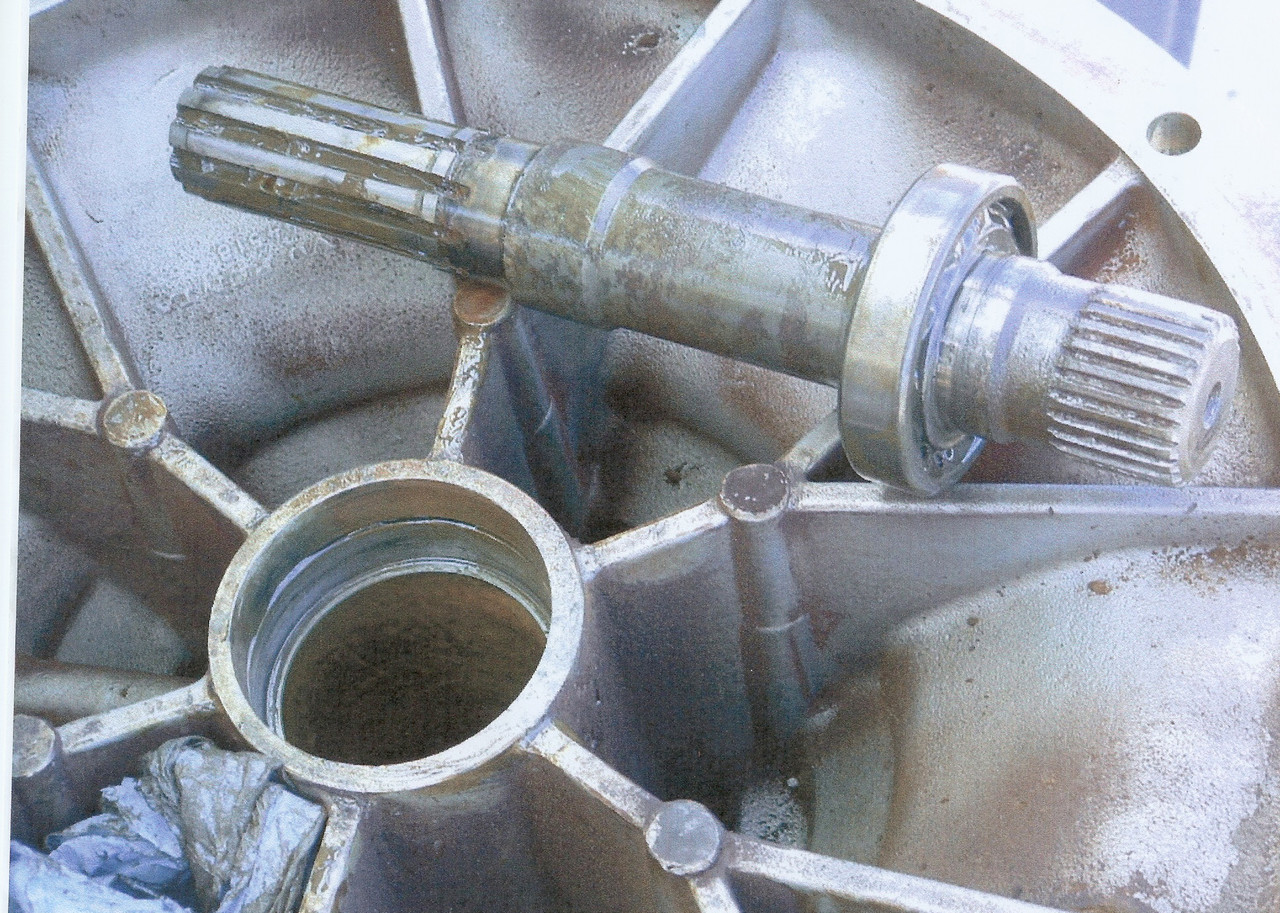
The outer bearing siezed and rotated on the prop shaft. The inner then collapsed and rotated in the alloy housing
Got away with new bearings and seals along with a rebuilt U/J and lot of peening and "Loctite"
The seller assured me that the legs had been "Done" the previous season.
 
Last edited:
I have at lease 15 outboards. My impellers are left in for at least 5 years and when replaced they also look as good as new. Again fact not theory. Never had one fail yet in 20 plus years of boating The world needs less waste
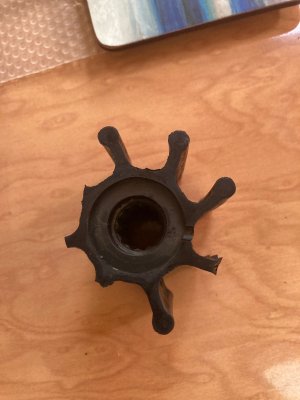
Well I've had the boat 16 months and this happened to one of my engines impeller. As it's my first boat, using your logic - statistics of one person - I and everyone needs to change impeller every 16 months
 

Attachments

  • IMG-20251011-WA0001.jpg
    IMG-20251011-WA0001.jpg
    243.3 KB · Views: 1
Top