
Seakeeper

Princess52

Member
Joined
16 Apr 2014
Messages
40
Location
Plymouth, Sutton Harbour
Visit site
Hi people

I recently read on the forum of various retro fits of a Seakeeper Giro to Nick H boat recently. We bought out v52 new last July. Based out of Plymouth I have recently pondered the merits of the new Seakeeper 5 so got a price to retro fit. £36k. Appreciating that the boat was £850 ish (I think) to me 36k is still painful particularly as I could just Move to another anchorage that is smoother (which I have done a couple of times).

I suppose my question from those with Seakeeper Giros is wether it is worth it. I'm not even sure that I could get it past the wife at this point anyway.

The work required is;


1. Move and re-position 2 x Air con condensers
2. Remove the start and auxiliary ETA boxes
3. Move and re-route Crew cabin sink drain, supply and toilet cable
4. Remove and re-position Air con inlet skin fitting
5. Remove and re-position Generator inlet skin fitting
6. Remove and re-route cables and hoses
7. Chop tray mould out
8. Cut down existing stringers/beds
9. Remove transverse stringer
10. Build beds for Gyro onto existing stringers/beds
11. Reinstate transverse stringer
12. Fit Gyro

Gyro would fit centrally aft of the engines about 300mm forward of the rudder table,
allowing 100mm clearance below the Gyro to the hull would allow 750mm up to the underside of the crew cabin floor, the Gyro is only 617mm high.
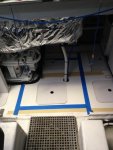
image.jpg
 
In the context of boat costing £850k, I'd spend that £36k for a gyro in a heartbeat. The difference between stabilised and non-stabilised boats in a busy anchorage is just huge. Your wife will be its biggest fan once you've done the job.
 
The quote seems pretty good value. I got a quote for a 65ft boat ( next one up the 9) and the quote was £72775.00 ex vat so £36k seems a bargain.

We have not done it - yet - but I suspect in due course we will.

The balance I make - like you - is just how much of a problem is it that I am solving. We anchor out a lot. Most of the time it is OK, sometimes it is not.

Will I get more for the boat when I sell it? Probably, or it will sell quicker as it is more desirable. Will I get all my money back? Probably not - but you don't get your money back on a boat anyway so I suppose that is not the best argument!

At that price personally I would do it, but everything is relative and I am in the same conundrum, just with bigger numbers!

Other 65s in the Marina have had it done ( 2 of them) so I can also go out on one in the summer to see what it is like - I suspect that will be the clincher!

In the med we run the gen a lot anyway for AC etc. You may do this less so given the Plymouth location so you may not like the idea!
 
Check on the maintenance schedule for the Seakeeper gyro; is it annual and are there major overhauls, is time specified?
Is it a DIY job?

i know that the active fin stabiliser are expensive to service, I think every couple of years the seals etc must be changed costing about $2-3k in The states for Trac and Sleipner fins.

Id be worried that spares for the Seakeeper would be outrageously priced, as there is no generic bits and pieces you could source at discount prices.
 
i know that the active fin stabiliser are expensive to service, I think every couple of years the seals etc must be changed costing about $2-3k in The states for Trac and Sleipner fins.
Really? Fwiw, all my 1996 vintage Naiads got in their whole life is one oil+filter change (just about 10 years ago, IIRC).
...geez, it's hard work typing with the fingers firmly crossed... :)

PS: not that I'm suggesting to go for fins, anyway. On a V52, I would also tend to prefer the Seakeepers.
And with regard to the OP questions (worth it or not), well, that's a prime example of a subjective evaluation, I'm afraid.
It's already hard to put a value on comfort in general, let alone for each individual onboard.
All I know is that I've never met anyone who didn't appreciate the difference stabilizers can make.
 
Last edited:
=MapisM;5218454]Really? Fwiw, all my 1996 vintage Naiads got in their whole life is one oil+filter change (just about 10 years ago, IIRC).
...geez, it's hard work typing with the fingers firmly crossed..
. :)

PS: not that I'm suggesting to go for fins, anyway. On a V52, I would also tend to prefer the Seakeepers.
And with regard to the OP questions (worth it or not), well, that's a prime example of a subjective evaluation, I'm afraid.
It's already hard to put a value on comfort in general, let alone for each individual onboard.
All I know is that I've never met anyone who didn't appreciate the difference stabilizers can make.

i've got a feeling the maintenance schedule for your stabs is every 3 years strip down and rebuild.

http://www.trawlerforum.com/forums/s3/stabilize-not-stabilize-18011-5.html

.Quote:Originally Posted by gwkiwi
I love my Naiad stabilizers and gave kept my dinner down more than once, just make sure if you buy a boat with them that they were serviced in the past three years or budget $3k to get the fins removed checked and the seals replaced .


Good luck
Costs us about $1300 for 7 ft Wesmars. Schedule it during a bottom job haulout. Top notch yard does it.
 
Last edited:
First thing to say is that they really work, exceptionally well. You look at the size of the boat, and then at that tiny sphere in the lazarette, and it defies belief that it can have such a profound affect on the boat's rolling. Having said that the 5 is quite small for your boat, although I know that Seakeeper had reasonable results on a Princess 62 with the first generation model 7, so you'll probably be OK.

As to whether you need one, well like everything else to do with boats, it depends how you use it.

We spend about 40 days and nights a year at anchor, and the gyro is a big benefit much of the time. The anchorages we frequent are quite open to rolling swells and even on the calmest days they can be affected by the wakes from lots of passing boats, so it's a lovely feeling not to have to worry that the boat will start slapping from side to side as a big swell goes through. We also use it for long passages at displacement speed. I don't regret fitting it for a second.

If you only anchor occasionally though, and the anchorage isn't too affected by swell or wakes, and/or you can usually find somewhere else that's unaffected, and you normally run at planning speed, then there's obviously less need. I probably wouldn't bother fitting one to a Solent based boat for instance, as some of the nicest anchorages like Newtown and Beaulieu River are completely protected.

The unit will be about £20k, plus delivery and duty from the US, so that quote sounds very fair given the schedule of works, which is a bit more involved than mine was. There is relatively little servicing required, just anodes each year and a bearing check at 2,000 hours.

One thing I would consider, and I would do if keeping a boat for a while, is to fit a decent battery bank and inverter which can run the gyro once it's up to speed. In the situation I describe above when the anchorage is calm, but there are occasional swells from passing boats, the running load on the gyro is minimal, it barely registers on the ammeter, but we still have to run the genny the whole time. The slight background noise of the genny is the only real disadvantage of the gyro, so an inverter would get over that at least some of the time.
 
First thing to say is that they really work, exceptionally well. You look at the size of the boat, and then at that tiny sphere in the lazarette, and it defies belief that it can have such a profound affect on the boat's rolling. Having said that the 5 is quite small for your boat, although I know that Seakeeper had reasonable results on a Princess 62 with the first generation model 7, so you'll probably be OK.

As to whether you need one, well like everything else to do with boats, it depends how you use it.

We spend about 40 days and nights a year at anchor, and the gyro is a big benefit much of the time. The anchorages we frequent are quite open to rolling swells and even on the calmest days they can be affected by the wakes from lots of passing boats, so it's a lovely feeling not to have to worry that the boat will start slapping from side to side as a big swell goes through. We also use it for long passages at displacement speed. I don't regret fitting it for a second.

If you only anchor occasionally though, and the anchorage isn't too affected by swell or wakes, and/or you can usually find somewhere else that's unaffected, and you normally run at planning speed, then there's obviously less need. I probably wouldn't bother fitting one to a Solent based boat for instance, as some of the nicest anchorages like Newtown and Beaulieu River are completely protected.

The unit will be about £20k, plus delivery and duty from the US, so that quote sounds very fair given the schedule of works, which is a bit more involved than mine was. There is relatively little servicing required, just anodes each year and a bearing check at 2,000 hours.

One thing I would consider, and I would do if keeping a boat for a while, is to fit a decent battery bank and inverter which can run the gyro once it's up to speed. In the situation I describe above when the anchorage is calm, but there are occasional swells from passing boats, the running load on the gyro is minimal, it barely registers on the ammeter, but we still have to run the genny the whole time. The slight background noise of the genny is the only real disadvantage of the gyro, so an inverter would get over that at least some of the time.


How does the weight of Seakeeper compare to fins?
 
Will I get more for the boat when I sell it? Probably, or it will sell quicker as it is more desirable. Will I get all my money back? Probably not - but you don't get your money back on a boat anyway so I suppose that is not the best argument!

IMHO, in the present market, anything you can do to make your boat stand out is worth doing. With my own boat, a gyro stabiliser was an option from new but unfortunately not one that the first owner of my boat chose to buy. Had he specified it, I would gladly have paid at least £50k more for the boat than I did and I think there would be plenty of buyers out there who would do the same. So yup, stabilisers are a big chunk of money but IMHO you'd get most of that back when you sell plus the enjoyment of using them of course
 
One thing I would consider, and I would do if keeping a boat for a while, is to fit a decent battery bank and inverter which can run the gyro once it's up to speed. In the situation I describe above when the anchorage is calm, but there are occasional swells from passing boats, the running load on the gyro is minimal, it barely registers on the ammeter, but we still have to run the genny the whole time. The slight background noise of the genny is the only real disadvantage of the gyro, so an inverter would get over that at least some of the time.

good point !
we run our stabs from the battery's for a while,
I'm considering the add solar panels, mainly for that


and would like to confirm what Jimmy TB say's,
after you can convince the lady for the investment, she will be the biggest endorser !
 
good point !
we run our stabs from the battery's for a while,
I'm considering the add solar panels, mainly for that
Wouldn't a Victron Quattro be ideal for running stabs? Run the stabs on inverter and the Quattro fires up the generator whenever the batteries are sufficiently discharged
 
I have been having a similar conversation about getting a seakeeper fitted. I was quoted a similar amount to supply and install a seakeeper 5.
In the end I decided not to bother because:
at planing speed it isn't doing anything to help
at anchoring the boat will still pitch if its a bit lumpy so still not a great place to be, so I would end up moving anyway. (SWMBO not keen on anchoring - no shops)
but.... come selling time it would be an attractive option, or I could just knock £30K off the price and I'm no worse off.
£35K buys a lot of diesel and short stay fees, so buying a seakeeper and going slowly costs more than going fast for quite a few years.
or then again........aaargh still can't decide
 
Wouldn't a Victron Quattro be ideal for running stabs? Run the stabs on inverter and the Quattro fires up the generator whenever the batteries are sufficiently discharged

thats what we have Mike,
2 x Victron Quatro 5Kw,
connected to the two battery banks 630Ah/24V + alternators,
and automatic switchover to genny power when they switch on,

I just need to install the auto- start relays/timers,
on the todo list for the easter breack
 
thats what we have Mike,
I thought you did, Bart. When you are at anchor with the stabs on, typically how much of the time is spent with the stabs powered by the inverter/batteries and how much time with the generator?
 
Check on the maintenance schedule for the Seakeeper gyro; is it annual and are there major overhauls, is time specified?
Is it a DIY job?

i know that the active fin stabiliser are expensive to service, I think every couple of years the seals etc must be changed costing about $2-3k in The states for Trac and Sleipner fins.

Id be worried that spares for the Seakeeper would be outrageously priced, as there is no generic bits and pieces you could source at discount prices.

Trac full service interval is 6 years, although we went about 7 and a bit without major issues.
 
i've got a feeling the maintenance schedule for your stabs is every 3 years strip down and rebuild.
http://www.trawlerforum.com/forums/s3/stabilize-not-stabilize-18011-5.html
LOL, you can find all sort of things on the net, these days. Good thing that my boat can't read! :)
Let's see, $3k every 3 years, that's a saving of $18k so far (and counting).
I'll let you know when I will see the first drop of water inside the bilge.

Regardless, replacing some seals is hardly something you can call "strip down and rebuild", in my books.
 
LOL, you can find all sort of things on the net, these days. Good thing that my boat can't read! :)
Let's see, $3k every 3 years, that's a saving of $18k so far (and counting).
I'll let you know when I will see the first drop of water inside the bilge.

Regardless, replacing some seals is hardly something you can call "strip down and rebuild", in my books.

I have a tendency to exaggerate! :D

The truth is usually located somewhere between what I say and the actual facts.

going on the basis that the ' stub-shafts' are blocking the bloody big holes in your hull, I wouldn't be too worried. The worst that can happen is a small leak through the seals.
 
Kashurt, I think that you have summed it up quite neatly for all the reasons that you mention. I also ran the concept past my wife who was of the view why bother. If it is choppy move to a spot that is calm. It is a difficult one to argue against particularly as it is a 42k spend. I think I will wait.
 
Top