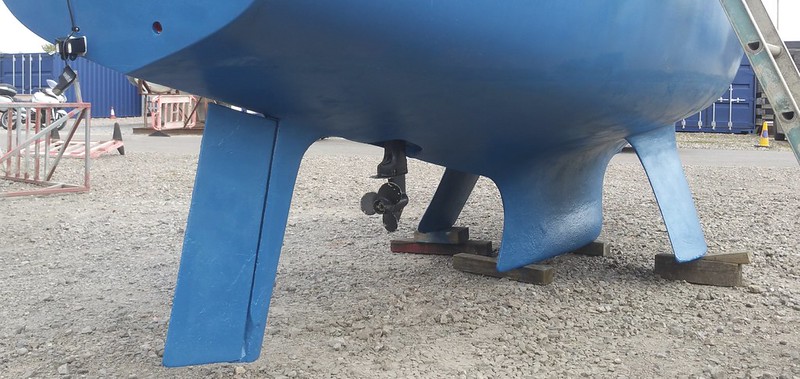
Seajet Hard Antifoul

I've used a hard antifoul in the past because my habit is to jump in with a wetsuit on and scrub the hull a few times per year, would also use a hard AF if your boat regularly sits in mud or if it's used very regularly. Otherwise self polishing would be a better option...
 
I bought the boat in February and she had two coats of Hemple Hard on her but she has been out of the water for ages so I just wanted to top up. The local chandler had Seajet in the colour I wanted so I went for that today as I just wanted to do a single top-up coat and thought a similar product would be best.
 
I put Seajet on my Achilles 24 in the mild dry week at the end of March 2020.

51975756294_e9d4489ab8_c.jpg


The boat then sat in a central Solent mud-berth for 18 months.

She was given a quick high-pressure wash (but no scrubbing) when she was hauled out last September, and I was quite impressed by her condition.

51975756219_441888ee09_c.jpg


The keel was rusty under the paint - I hadn't had time to treat it properly.

In case it needs saying, self-polishing isn't suitable for mud berths because every tide will remove a portion of the antifouling.
 
Last edited:
I thought that was exactly the point. The straps meant the jetwasher didn't get those portions...

...but before I had painted the bottom, I had taken days with the Bahco scraper to get the barnacles off the hull.

The fact that after 18 months, a quick squirt with the jetwash had made most of her almost as clean as just after painting, showed the AF to have worked.
 
I thought that was exactly the point. The straps meant the jetwasher didn't get those portions...

...but before I had painted the bottom, I had taken days with the Bahco scraper to get the barnacles off the hull.

The fact that after 18 months, a quick squirt with the jetwash had made most of her almost as clean as just after painting, showed the AF to have worked.
Surely the point is to stop the barnacles growing in the first place, so the boat can actually be sailed through the water. If the boat was covered with barnacles similar to those under the straps then I would suggest that the antifoul paint had failed miserably. Jet washing it off is easy, assuming it has not been abused ( ie left too long with poor paint finish) & jet washed immediately after haul out. So the fact it came off easily is pretty much irrelevant. Just needs a more powerfull washer. In fact the water line is not very good either.
But to each his own & if you are happy then so beit. In all fairness to the paint, one can accept that the boat has been in the water longer than one would expect.
 
As far as I've heard, it's pretty well hopeless to expect antifouling to continuously prevent growth as effectively as you suggest, in a mudberth.

As the Achilles was a triple keeler, I was pleased to believe I could take the boat to a scrubbing grid (or any bit of hard, to dry out on) and quickly remove several seasons' worth of the same crusties which had been so very stubbornly attached before she was antifouled, far beyond removal by jetwash.

But I daresay any other AF might have been at least as effective.

I won't deny, the whole business was fairly thankless and I delight in not needing to do it again! ?
 
Last edited:
I've used a hard antifoul in the past because my habit is to jump in with a wetsuit on and scrub the hull a few times per year, would also use a hard AF if your boat regularly sits in mud or if it's used very regularly. Otherwise self polishing would be a better option...
Agreed: currently available hard antifoulings usually much worse performance than eroding ones. Boats that are "dry sailed" ie spend most time ashore but launched and used for a day or week or two at a time usually use hard AFs, also fast powerboats that would blast off eroding antifouls with high water speeds.
 
My understanding is the Seajet is the new kid on the block and unknown almost completely in Oz. Usage will be limited. You don't really want to know if its 'OK' - you want to know how it compares with XYZ and is it rated in your local area. It may, or may not, be on special to get usage up - this is false economy for you if its not very successful (or very good if its really magic).

I'd go back to the beginning and find out which AF are used in your area, where you keep your yacht, and ask your neighbours what they use. I'd also have a word with local boat yards (or have a look at what they apply). I'd ask on here what people find as a successful AF. All of this is a bit nebulous as AF usually works - the more you apply the longer it lasts, the more you use your yacht the better it remains clean, more expensive AF last longer than cheap ones.

Personally I would not weorry about colour too much - I'd worry as to whether it works.

AF has 2 significant costs - the costs of the AF and the cost of slipping (in order you can complete the AF). There are minor costs, masking tape, rollers etc and I'm ignoring the cost of your time. .Some expensive AF can be cheap if they last twice as long and remove the frequency of slipping.

But AF however you do it is an expense - enter the project with your eyes open (or based or decent information).

I'm based in Sydney so my experiences are totally irrelevant but we use top of the range which for you might be International's Micron (I don't know what they call top of their range currently) and we get a 2 year life.

For props and saildrives Velox is well respected - again ask for views here as you need to treat it as well, or you will be cleaning your prop, frequently. And - if you are persuaded to use Velox - make sure you know where to buy it.

Good Luck

Jonathan

PS I'd also check what AF you have on currently - applying a hard AF onto an eroding AF does not sound too clever. There may also be incompatibility issues with what is on there now and what you want to apply. You may need to apply a primer/sealer coat.
 
Last edited:
Hi Jonathan,

I was over thinking it really. The antifoul on the boat was quite fresh in that the boat hadn't spent long in the water but she had been on the hard for seven months. Most products suggest a three month maximum gap. She had Hemple Hard on her so I was going along the same route but the local chandlers had run out of it so I went for the most similar product in a colour I liked. The chandler said that they sold loads of Seajet and that it was well regarded. Got the first coat on today and it covered well and looks good.
I will see how it fares this season. I have SCUBA gear so I can give her a rub down if needed. If it works well then I will stick with it. If not then I will try something else.
I will have a look at the Velox.

Thanks,

Matt
 
Matt,

Don't be mean, apply the AF generously. The more you put on the longer it will last. An advantage of adding a coat over the old coat is that when the new coat wears through you will see the different coloured coat underneath. The other reason you will know your AF is wearing - the frequency of fouling increases :(

If you have AF left over - give an extra coat to the leading edges, bow, keel, rudder and water line. Personally leaving a little for 'next time' does not work and dries out.

Let us know how the Seajet performs.

Good Luck

Jonathan
 
Top