Seacock removal

Jolly-Roger

New Member
Joined
30 Aug 2013
Messages
6
Location
Kefalonia
Visit site
P9210006.jpg

P2010052.jpg


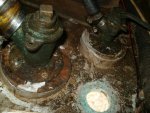
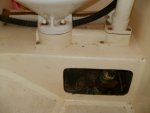
I am trying to remove 2 Blakes seacocks on a Westerly Merlin, which have become seized. I suspect they were not used/serviced by the previous owner for the last 5 years! As can be seen from the photo, the space in which to work is very limited. I have succeeded in removing the outlet valve from the holding tank. I have removed two bolts from the larger seacock and the other two sheered off. I have tried hammering from below and prising the flange from above, but there is no movement. I suspect they are sealed in with resin or Silkaflex.
My next step may be to grind off the bolt heads and plate from below and then drill around the shaft of the seacock.
Is this the only way or does anyone have any ideas how to proceed?
 
Crowbar or a bigger hammer.
Sometimes a bit of wellie is all that's needed and a single thump with a lump hammer can be far less damaging than a number of more timid blows.
 
Can I ask what you usually have over that panel?

We are in the similar process of replacing such things but also replacing the heads, its been suggested I cut such a panel to gain access
 
In reply to Rigger Mortice, I have tried the lump hammer method. Doubtful if I can get a crowbar into the limited space. There is a chance of cutting away some of the wooden disc to get a crowbar underneath the flange.
In reply to Symondo, the panel is always open to allow access to the seacocks. I did consider cutting another panel under the heads to gain access and then cover the hole with ply. Might not look too bad if done properly.
In reply to pvb, I have no electrical power, so would have to bring in a generator. I may be able to hacksaw the heads off.

Thanks for the ideas guys, it pays to have several options!
 
Not necessary to remove the bodies to service them. Pour penetrating oil down the inside of the cone and through the hose spigot. Put the keep plates back on loosely then use a drift from the outside to punch the cones upwards. Might need a lot of thumping, but once you break the seal of gunge they will pop out. The keep plate will stop them from flying up into the boat. You still have the problem of the snapped securing bolts and you might want to punch them out first and put temporary bolts in all the holes to hold the body firmly to the hull.
 
Not necessary to remove the bodies to service them. Pour penetrating oil down the inside of the cone and through the hose spigot. Put the keep plates back on loosely then use a drift from the outside to punch the cones upwards. Might need a lot of thumping, but once you break the seal of gunge they will pop out. The keep plate will stop them from flying up into the boat. You still have the problem of the snapped securing bolts and you might want to punch them out first and put temporary bolts in all the holes to hold the body firmly to the hull.

Thanks Tranona, you are right, I should have one more go at freeing them off, but I thought it would be easier with them out of the boat. It is 5 years of corrosion and I do not hold out too much hope. Because the seacocks are seized open, I would have to seal them from underneath, to stop the oil running out. Someone suggested using a mixture of Acetone and ATF (automatic transmission fluid), which is supposed to be better than WD40!
 
Once the keep plate on the top is loosened there is nothing preventing the cone from coming out except hardened scale. This may be persistent but it is not superglue! Put the keep plate back loosely on as Tranona suggests to prevent the cone from flying across the boat, then use a lump hammer, at least 2 lb but I prefer 4 lb, with a metal drift, from outside the boat. I would not start cutting anything yet: these are expensive seacocks that can almost always be serviced.
 
I decided to have another go at soaking the larger seacock (which is the most accessible) with Acetone/oil. Went to the boat this morning (between earthquakes!) to take the tubing off, but this too is jammed solid! Tried a crowbar, but just cannot get any leverage on it, in the confined space.
 
I've removed intransigent seacocks relatively easily by using an angle grinder on the outside.
.

+1 Just work round the hole from the outside as carefully as you can with an angle grinder. When the flange is off just lift the lot into the boat
 
Cut it off and replace the hose. Chances are that when you get it off you will find it coked up with deposits. Use proper sanitation hose for replacement.
 
+1 Just work round the hole from the outside as carefully as you can with an angle grinder. When the flange is off just lift the lot into the boat

Not on a Blakes seacock which this is! It does not have a flanged skin fitting, but is held in with (very expensive) bronze bolts.
 
As the others have suggested you might consider leaving the seacocks in position and making good the sheared bolt when you have the cones out

If you can do something else for a couple of day's a long soak with your chosen compound will help. It also clears the mind. I have had good results with the ATF/Acetone mix.

When you come back to it give it the bodies some heat, and let the thing cool right down. Then give it some more and give it a razzle with the club hammer. Take care with the acetone mix, don't set the boat alight.

You may have borrow that generator to drill and punch the old bolts out but they are soft. I would replace with stainless.
 
I ground off the heads out side on my Konsort. This did me no good at all as you then have a square part to the bolt before the thread starts so I couldn't knock it inside. I was removing the whole heads compartment along with the internal moulding which was in a bad state. At that point I managed to drift the bolts out but that is a bit of overkill in your situation. I also had a situation where the outlet was forward of the inlet by about 20cm and inline fore & aft so you got your own back so as to speak. The boat wasn't factory completed by the way although that may not have made much difference.
 
Someone suggested using a mixture of Acetone and ATF (automatic transmission fluid), which is supposed to be better than WD40!

Most things are better than WD40 for unseizing stuck things. It's a water displacer (hence WD), not a lubricant or penetrating oil, albeit it has just enough ability at those things to cause people to keep trying it. Plus Gas is good for dismantling stuff.

I second the advice to free up the cone in situ - it's a pity you've nadgered the securing bolts trying to remove the body. When I had a Blakes seacock stick I was able to hammer it out exactly as described here, using a short length of broom handle and a club hammer, although a metal bar might communicate the shock better than the wood.

Pete
 
Is it possible that the bolts have been tapped into the flange and that the nuts are only serving as lock nuts? (we have no view of the outside of the hull - are the bolt heads let into the hull or countersunk?) That might explain why hammering doesn't work. Is it possible to drill out one bolt to check? If you can access the heads on the outside can you remove the heads (eg drill them off) and then punch them through?
Andrew
(if it were my boat I wouldn't hesitate to replace the fittings - what is the quickest way to sink a boat . . .?)
 
Is it possible that the bolts have been tapped into the flange and that the nuts are only serving as lock nuts? (we have no view of the outside of the hull - are the bolt heads let into the hull or countersunk?) That might explain why hammering doesn't work. Is it possible to drill out one bolt to check? If you can access the heads on the outside can you remove the heads (eg drill them off) and then punch them through?
Andrew
(if it were my boat I wouldn't hesitate to replace the fittings - what is the quickest way to sink a boat . . .?)

There is a plate on the outside with square holes to take the square section under the domed head of the bolt. The remains of the broken bolts should come out with a drift. However they probably have a lot of sealant holding them in so will need some perseverance.
 
Is it possible that the bolts have been tapped into the flange and that the nuts are only serving as lock nuts? (we have no view of the outside of the hull - are the bolt heads let into the hull or countersunk?)

Only if someone has done something very odd with what is otherwise a standard Blakes seacock.

There should be a ring on the outside with square holes in it (ensuring the bolts don't turn). The inlet seacock version of this is often a complete disc rather than a ring, with holes punched in the middle to form a crude strainer. The bolts are carriage bolts, with a shallow domed head and a square section underneath that locks into the hole in the ring/plate. There's no way of turning them from outside.

Pete
 
Top