Seacock Issue?

gavin400

Well-Known Member
Joined
25 Aug 2009
Messages
426
Visit site
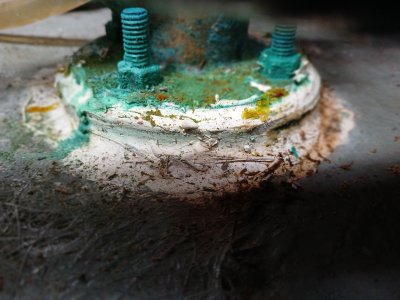
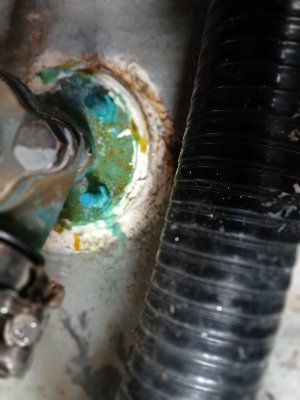
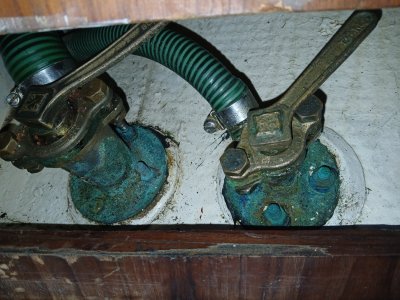
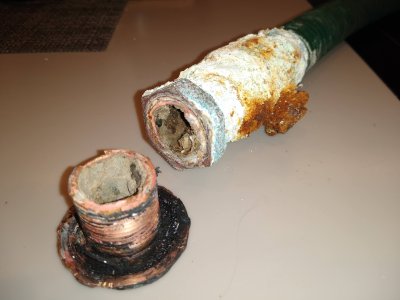
My Blakes seacocks have green verdigris but only on the bases and the bottom plate, the rest of the seacocks seem ok.

The first pics are of cockpit drain - the bolts were replaced only 2 yrs ago as the originals were damaged when removing the cocks during an engine replacement.
New bolts purchased on ebay and advertised as Blakes and were certainly costly enough to suggest they are genuine Blakes.
Strangely the other cockpit drain cock has much less verdigris.
Im pretty sure the seacocks are original to the boat 1976

The other pic is20250803_125335.jpg20250803_125245.jpg20250803_125240.jpg20250803_124500.jpg the heads cocks - all original.
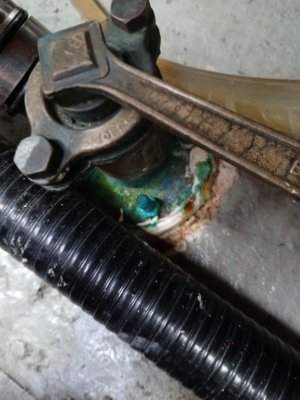
Should I be worried?

Thanks for all advice.
 
No need to be worried. The green happens to mine. I periodically clean with a stainless wire brush. Stainless because steel rust on the boat, that’s the only reason,

They have been doing this for the 15 years I have owned the boat, and probably are original from 73.

They will be fine.

Tip
Operate the seacocks every time your at the boat a few times to stop them seizing in place. If you don’t operate for say a year the grease becomes still and they can stick in place. If this happens, removal of the plug and cleaning, regressing reinstates.

Plug is the term for the cone.
 
My Blakes seacocks have green verdigris but only on the bases and the bottom plate, the rest of the seacocks seem ok.

The first pics are of cockpit drain - the bolts were replaced only 2 yrs ago as the originals were damaged when removing the cocks during an engine replacement.
New bolts purchased on ebay and advertised as Blakes and were certainly costly enough to suggest they are genuine Blakes.
Strangely the other cockpit drain cock has much less verdigris.
Im pretty sure the seacocks are original to the boat 1976

The other pic isView attachment 197212View attachment 197213View attachment 197214View attachment 197216 the heads cocks - all original.

Should I be worried?

Thanks for all advice.
The green colour is corrosion product, some variety of copper chloride. Almost certainly the cone is not a perfect fit in the body, resulting in a small leakage of seawater. I suggest you grind them in for a better fit and apply some grease.
 
Perhaps @vyv_cox will comment on this? I removed some heavily corroded brass fittings from a dinghy mast, and to clean them I immersed them in a strong solution of kettle cleaner (Oust!) It worked very well, removing both corrosion products and varnish where that had been applied. The surface was left pinkish as if a small amount of zinc had been removed, but this was superficial and on polishing went back to the yellowish brass color.

This was very much an experiment, but I was surprised how effective the kettle cleaner (probably sulphamic acid) was. Photo attached of the result; they were heavily covered with black and green verdigris before.

_e494ab8a-e55f-44d5-a0a7-d0fa64d51df7_.jpg
 
Perhaps @vyv_cox will comment on this? I removed some heavily corroded brass fittings from a dinghy mast, and to clean them I immersed them in a strong solution of kettle cleaner (Oust!) It worked very well, removing both corrosion products and varnish where that had been applied. The surface was left pinkish as if a small amount of zinc had been removed, but this was superficial and on polishing went back to the yellowish brass color.

This was very much an experiment, but I was surprised how effective the kettle cleaner (probably sulphamic acid) was. Photo attached of the result; they were heavily covered with black and green verdigris before.

View attachment 197224
The safety sheet says it is Lactic acid Safety Data Sheet - 091661 - Oust All Purpose.pdf https://share.google/VFAhjqisdDhopIxt0

Not a chemical I am familiar with. The kettle descaler we use is citric acid, I think. We used to use this acid to clean up rusted specimens prior to microscopic examination because it did not attack the metal. Very slow acting, normally left overnight. Formic acid behaves similarly.

I am guessing that the supposed method of cleaning brass in Daddies Sauce is somewhat similar - an organic acid, presumably vinegar and maybe others. I guess that varnish can also be attacked by an organic acid (?)

I suspect that the dezincification may have occurred earlier. When I tested bronze and brass in far stronger dilute HCl I found no attack or even disclouration after about half an hour's immersion.
 
The safety sheet says it is Lactic acid Safety Data Sheet - 091661 - Oust All Purpose.pdf https://share.google/VFAhjqisdDhopIxt0

Not a chemical I am familiar with. The kettle descaler we use is citric acid, I think. We used to use this acid to clean up rusted specimens prior to microscopic examination because it did not attack the metal. Very slow acting, normally left overnight. Formic acid behaves similarly.

I am guessing that the supposed method of cleaning brass in Daddies Sauce is somewhat similar - an organic acid, presumably vinegar and maybe others. I guess that varnish can also be attacked by an organic acid (?)

I suspect that the dezincification may have occurred earlier. When I tested bronze and brass in far stronger dilute HCl I found no attack or even disclouration after about half an hour's immersion.
The dezincification was definitely only a surface effect, and mechanically cleaned areas did not show it. A quick rub with a scouring pad restored the brass appearance. Regarding speed, I left them to soak for a few hours - not more than about three - and then rinsed them thoroughly. There was slight effervescence while in the kettle cleaner, and the solution gained a slight green tinge.
 
My Blakes seacocks have green verdigris but only on the bases and the bottom plate, the rest of the seacocks seem ok.

The first pics are of cockpit drain - the bolts were replaced only 2 yrs ago as the originals were damaged when removing the cocks during an engine replacement.
New bolts purchased on ebay and advertised as Blakes and were certainly costly enough to suggest they are genuine Blakes.
Anglia Stainless is my (cheaper) source for silicon bronze bolts as use with Blakes seacocks
 
The dezincification was definitely only a surface effect, and mechanically cleaned areas did not show it. A quick rub with a scouring pad restored the brass appearance. Regarding speed, I left them to soak for a few hours - not more than about three - and then rinsed them thoroughly. There was slight effervescence while in the kettle cleaner, and the solution gained a slight green tinge.
I just checked and Zinc lactate is colourless, but copper lactate is green, so the slight colouration of the liquid implies that some copper - probably from the verdigris - was dissolved.
 
Top