
Sea Kindliness

Danny_Labrador

Well-Known Member
Joined
13 Oct 2004
Messages
14,189
Location
Harrogate
Visit site
In my eternal theoretical quest for the perfect yacht (yes I know its a compromise) but I have an addiction.

I came across this site from Cruising Resources.

3675032998_85592a7393_o.jpg


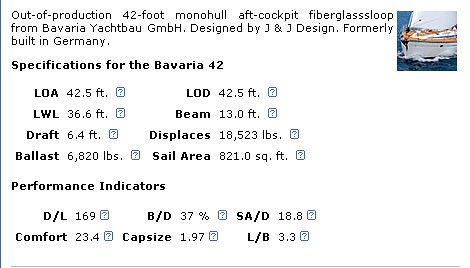
Its full of useful for data but they also list a figure for COMFORT - which I guess is what we would call sea kindliness.

The figure appears to be an index taking into account displacement / beam / length etc.

Example :-

3675032956_192ddbcbe4.jpg


They list a definition :-

3674264367_3ed6d2973c_o.jpg


Do you think it has any value as a figure for comparison ?

Have a play here from you experience do you think the figures actually work ?
 
do you have any idea of the formula which uses those co-efficients please ? It must be quite simple in comparison with this one

http://home.att.net/~hcyoung/

The old Displacement/Length ratio also helps
http://www.tedbrewer.com/yachtdesign.html. He has a "comfort ratio" using

Displacement in pounds/ (.65 x (.7 LWL + .3 LOA) x B(E1.333))

EDIT Just done a little line in a spreadysheet for Ted's Rule

=Displ[lbs]/(0.65*(0.7*LWL[ft]+0.3*LOA[ft])*(Beam[ft]*EXP(1.333)))
 
I'd certainly take Ted Brewers Motion Comfort index into account. That Bavaria 42 has a Motion Comfort index of under 24, a Cherubini 44, for example, a heavy displacement blue water cruising boat, has a MC of over 40.
The name of the index is a bit misleading, I find; sea kindliness index would have been a better term. When I was comparing cruising boats many years ago I made up my own 'comfort' index which was intended as a measure of the internal volume and available living space, based on beam, LOA and LWL. It was very specifically aimed at measuring liveaboard comfort not motional stability - I've never found an accepted formula for measuring 'liveaboardability' but it would be another useful measure in your quest for the perfect boat!
 
Hmmm. A measure of a boats “up and down jumpiness” as a function of disp. LOA, LWL and beam. Very very simplistic formula, that misses a fundamental element of how a boat will respond to waves and that is the shape of the sections. Within the variables they define you can do a HUGE amount to affect the response of a hull to wave induced motion, for example bow flair, depth and shape of the forefoot, beam at the transom vs the midships, etc.

Then, in what conditions are we considering this, moored, up wind, down wind, where do you want your comfort? A boat that is comfortable in head seas probably wont be down wind, and visa versa.

A bit of a simple index that I don’t think really adds anything to be honest. (Not that a meaningful one would be easy!)
 
isn't there some correlation between the displacement and the form features you mentioned. i.e. a heavy boat will have a less fine entry and delivery than a light vessel, with th esame dimensions.

Light displacement vs heavy for the same LOA/LWL/B figures will produces a more "jumpy" boat. Not a perfect formula but a realistic starting point?
 
I think Marchaj and Larrson and Elliasson's books go into this. The actual weight of the boat is not the whole story, making a boat too stable can make it worse. Fishing vessels for instance are often very tall. They are designed to roll slowly, which is a lot more workable than a boat that snaps upright due to having immense stability. Damping of the roll is important too. When it comes to pitching, having v-shaped ends will be a lot softer motion than a flat planing underbody, even if the beam/length/displacement are the same. Also having more mass aloft can make the boat hit the waves harder, so forget the radar, heavy sailcloth etc! An excessive amount of anchor and chain up front will have a similar effect, get the weight in the middle of the boat, or better still get rid of it.
The formula give as 'Ted's rule' above is uite close to prismatic coefficient, a low prismatic, i.e finer ends, will be more comfortable in a pitching situation.
I guess you have to weigh up being bounced around in some chop against having standing headroom. A lot of the rest of it boils down to 'length is good'.
 
I get 41 for my pilot cutter.

Under sail it is very comfortable in everything I have experienced so far. /forums/images/graemlins/smile.gif

But can be really uncomfortable under power alone in the same conditions (can roll in a swell in a nasty way without sails to stabilize). /forums/images/graemlins/frown.gif
 
Top