
Sea cocks on a yacht

coopec

N/A
Joined
23 Nov 2013
Messages
5,211
Visit site
The yacht II'm building is a 43ft long keel ketch.
So far I figure I need sea cocks for:
-Engine inlet
-Forward toilet inlet
-Waste tank outlet
-Aft toilet inlet
-Aft toilet outlet
-Deck wash inlet (Jabsco)
-Watermaker inlet
- ?????

Are there any rules as far as positioning? I wouldn't want the water-maker inlet close to the waste tank outlet for example. Is there a rule of thumb regarding distance and positioning? (The W/L length is 32 ft)
Thanks in advance
Clive Cooper
 
Don’t forget one for your galley sink outlet, and also outlets for basins in the fore and aft heads? Or is all your grey water going to the waste tank?
 
The yacht II'm building is a 43ft long keel ketch.
So far I figure I need sea cocks for:
-Engine inlet
-Forward toilet inlet
-Waste tank outlet
-Aft toilet inlet
-Aft toilet outlet
-Deck wash inlet (Jabsco)
-Watermaker inlet
- ?????

Are there any rules as far as positioning? I wouldn't want the water-maker inlet close to the waste tank outlet for example. Is there a rule of thumb regarding distance and positioning? (The W/L length is 32 ft)
Thanks in advance
Clive Cooper

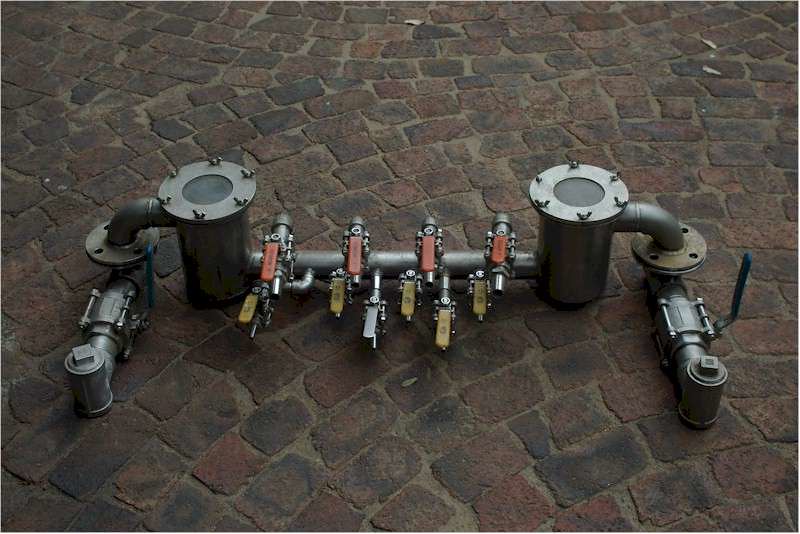
Hi Clive

This is my inlet setup twin 2 " 3 part ball valves each feeding a strainer then into a "sea chest" each outlet with its own isolation valve. This feeds all inlets 2 heads, deck wash pump, water maker waste tank rinse pump amd gally seawater wash tap, engine and generator cooling water + spares.

My sinks either go out the side above the water or straight down through the hull by a stand pipe welded to the hull. There is a ball valve on all outlets at the top of the standpipe above
water line level

Front head sink share the shower tray, washing machine, sink and a vent drain.

The aft head seacock share the head and black water tank outlet.

Bilge pump outlets separate for each pump also above waterline.

Head outlet are aft or on opposite side of the hull to inlet.

All are 3 part ball valves so servicing is easy and does not need and thread disturbance.

36086124865_1b0fe66605_b.jpg
 
Last edited by a moderator:
Don’t forget one for your galley sink outlet, and also outlets for basins in the fore and aft heads? Or is all your grey water going to the waste tank?

Yes all the gray water goes into a sump. I'm not to sure what pump to use to empty the sump. Currently I have a macerator pump which is supposed to be self priming. I'm now thinking of a small diaphragm pump.
 
(Sinks, basins and showers too. Are you having a sea water galley pump too?)

Oops, missed the bit about gray water.
 
Thanks for that Roger
I'll do something similar. But I better not get too clever as I wouldn't want to start cooling the engine with the contents of the black water tank.

I freaked out when I saw the water tank manifold as I have something very similar (though he obviously has eight water tanks while I have six)
.View attachment 70746
 
Last edited:
cockpit drains?
Bilge pump outlets?

I'm not worried about putting holes through the hull above the waterline. With cockpit drains I've taken 3 out through the transom an one out through the side of the yacht.

All 3 bilge pump outlets are above the waterline. The gray water outlet is above the waterline with enough pressure to spray the boat in the next berth. ;)

Thanks

Clive
 
I wouldn't want the water-maker inlet close to the waste tank outlet for example. Is there a rule of thumb regarding distance and positioning?

I'm not aware of a specific rule of thumb, but people often try to put intakes on the opposite side of the keel from toilet outlets, this goes double for watermaker intakes.

Also aim to get the watermaker intake further forward than dirty or oily outlets, so that when you're underway, or anchored in any kind of current, the effluent will be swept away from the intake instead of towards it.

Pete
 
You could use one inlet for both the deck wash and the watermaker. Or you could use a larger than normal diameter sea cock for the engine cooler and use that for watermaker, deck wash and engine cooling: you'd need to calculate the flow requirements carefully to make sure you don't starve the engine or watermaker if you're running them both at the same time.
If you're fitting a deck wash pump, it'd be worth fitting a sea water tap at the galley sink. We've found it very useful and saves last of fresh water. Tee'd off our deck wash pump.
 
Doesn't the watermaker need an outlet as well as an inlet?
Also consider whether you might want one of those fridges that dumps the heat to a sink drain.

From experience, I'd rather have one or two more thru-hulls that are easily checked than a complex system which is a bugger to unblock when your engine sucks a plastic bag into the inlet or whatever. If you can have a straight run that you can rod through you may appreciate it.

While you are thinking about where the holes go, consider depth sounder and paddle wheel. Both in terms of not having too many holes close together and access internally.
I think there is a case for the grey water outlet being discreetly underwater.
 
Doesn't the watermaker need an outlet as well as an inlet?

Yes, but the brine outlet can be above water and it seems the OP isn't counting those.

Also consider whether you might want one of those fridges that dumps the heat to a sink drain.

Dumping the heat into the water instead of the cabin seems like a good idea in hot climates, but in a new build I think I'd choose the type that uses a dedicated through-hull radiator rather than replacing the galley sink seacock. The latter seems designed mostly for ease of retrofitting, must surely be less efficient, and gently cooking or incubating the galley sink drain grot 24/7 seems unappealing.

If you can have a straight run that you can rod through you may appreciate it.

Indeed. On the current boat the engine intake is in the saildrive leg, but on the previous one I used a tee where an elbow would have fitted to take the hose away at 90º to the seacock. The remaining upward-pointing leg of the tee had a blanking plug in it, and if opened provided a straight-through path down through the seacock to push out any wayward jellyfish or plastic bags.

I think there is a case for the grey water outlet being discreetly underwater.

Agree - if post #8 isn't an exaggeration then I wouldn't appreciate being moored alongside and having my nice clean topsides hosed down with the OP's dirty washing-up water or soap-scum and stray pubes :)

Pete
 
I'm not aware of a specific rule of thumb, but people often try to put intakes on the opposite side of the keel from toilet outlets, this goes double for watermaker intakes.

Also aim to get the watermaker intake further forward than dirty or oily outlets, so that when you're underway, or anchored in any kind of current, the effluent will be swept away from the intake instead of towards it.

Pete

Thanks Pete. Actually all the posts are very helpful and I will have to sit down very shortly and come up with a plan.

Your comments regarding positioning are broadly along the line I was thinking. Thanks

Clive
 
One of the things we have is combined toilet intake and wash hand basin discharge. By closing the common seacock you can run water into the wash hand basin to fresh water flush the loo. Handy at times especially when leaving the boat and ypu dont want to leave sea warer to go smelly in the loo
 
Top