SD Power Cats at Sea

OK then, time for some additional thoughts, now that I can call it a working day.

1) Absolutely. I posted my experience in this previous thread, but in a nutshell talking about air entrapment effect on the boats we're talking about - at any speed they can achieve - is plain nonsense.

2) I think that the "railway" effect of the two parallel hulls becomes relevant only above a minimum speed - I'd say 5 or 6kts at least. Below that (and particularly at almost zero speed, as when maneuvering), it's just a matter of where forces are applied, hence the props "at the corners" - so to speak - are more effective.

3) It depends on what you actually mean by 'better': safety or comfort?
I would dare to say that a well built cat is at least as good as an equally well built full D trawler in terms of safety. I'm using this type of monohull for the comparison because that's typically considered the best to deal with really rough stuff.
But in terms of comfort, there are bigger differences. My experience with cats is limited to short cruises on some 40' to 50' diving boats. Occasionally, when diving outside the reef, I saw their behaviour in some 6' to 8' short(ish), irregular waves. No big deal really, the boat handled that perfectly, but everybody onboard had to sit and grab firmly the rails, because the boat movements were very stiff, and she quickly snapped back even from a relatively small roll. I am pretty sure that a similar size stabilyzed monohull would have been more comfy, because her typical behaviour is very different: the roll motion is smooth and gentle, with a longer period.
Maybe this difference would be less relevant in bigger and longer oceanic waves, where a wider surface exposed to the waves movements is less relevant given the size of the wave, but I don't have hands on experience on that.
 
Going faster creates higher pressure between the hulls than the surrounding area and lift is created. It creates a sensation of the boat being on a cushion of air. Hulls remain firmly in the water along their entire length so it is not planing.
 
Havent read through the thread properly and i'm not answering the question, I just saw this in St Tropez last year - i think it is a cat, and if so, it's he biggest i've ever seen!

DSCF1770.jpg


DSCF1772.jpg


DSCF1771.jpg
 
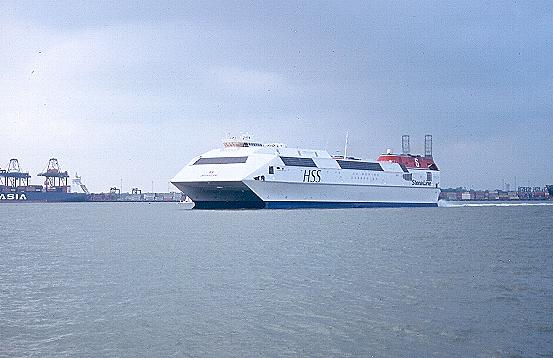
Chris, that magnificent beast looks like a wave piercing catamaran, possibly designed by Craig Loomis (he of Earthrace fame.....) - same concept applies to the wave piercing cross channel ferries.

Re cushions of air and such like, Victor has explained it well above - I would just like to add that the effect is more pronounced on planing cats with relatively narrow tunnels, and especially assymetric hull catamarans (like the racing cats, where the inboard sides of the hulls are straight and parallel).
If the air is funnelled into a tunnel of smaller cross-section area, then either the air has to speed up (otherwise it will 'stack up' at the entrance), or the pressure has to increase (ie the air becomes more dense).
I have sat on the bows of small fast assymetric (and symmetric) hulled planing power cats underway at speed in rough conditions, and there was no comparison with a 'conventional' planing monohull of similar size - the cats certainly appeared to be running on a cushion of air, it was such a smooth ride.
To all of those who are sceptical re the above, may I commend you to take various powercats (maybe start with one of Victors Motorcats?) out on sea trials and see for yourself what they are like.
 
[ QUOTE ]
Havent read through the thread properly and i'm not answering the question, I just saw this in St Tropez last year - i think it is a cat, and if so, it's he biggest i've ever seen!


[/ QUOTE ]

They get much bigger /forums/images/graemlins/wink.gif

hss-harwich.JPG
 
Fortunately I have built up equal amounts of experience on a wide variety of cats as well as monos so I have been fortunate. Just like monos - some cats are great and others are awful. Wide beamed power catamarans provide a lot of space but are usually heavier/less efficient and often less comfortable at speed as they have less cushioning effect. These motor cats are usually sailing cats without the mast and have not been designed principally for motor boating.

I like our motorcat 30 design even if the aesthetics are not to everyones taste. The fact is that it is very efficient, stable, shallow draft/beachable, and relatively comfortable in heavy weather compared to most monos. It has given me and family a hell of a lot of fun in all sorts of weather with very modest running costs. Practical Boatowner did a heavy weather test on Motorcat and Sportsboat did one on the powercat and both made very impressive reading.

I have believed for many years now that a light displacement catamaran around 3:1 length to beam ratio represent the best compromise in leisure boat design. Many of the good displacement cats seem to be very efficient at 15 knots whatever the size and max out at around 21-25 knots. they do not have problem of excessive beam for berthing in marinas.
 
I have to disagree a bit there Victor. You seem to be talking only about fast planing style powered cats not the SD or D cats.

An SD or D cat with a length beam ratio of 2.2 (very wide) is a highly efficient boat for displacement speed cruising and still economic at high speeds.

What on earth are you gaining as regards efficiency by making such a boat more narrow?

I am not at all sure about cats which have about the same length/beam ratio as a standard boat. I know mono hulls with a length beam ration about 2.8.
 
Can you give me some examples of wide beamed, efficient, reasonably quick displacement power catamarans?. If you find one it will be very light and probably have little accommodation.

For example, I dont believe the displacement Lagoon, Transcat or the Excitecat are particularly efficient. The wide beam produces a lot of added accommodation weight and wetted area. The added beam also reduces the cushion effect for cruising comfort at 15 knots and above.

I believe both displacement and planing power catamrans are best served reasonable narrow say 3:1 beam length ratio. I believe the opposite applies to sailing catamarans as they have to accommodate the rig and more aerodynamic forces.
 
haha you're quite right, sorry, it was late at night /forums/images/graemlins/cool.gif
I meant the biggest privately-owned one i'd seen, as in not a passenger ferry /forums/images/graemlins/smile.gif
 
Ok some examples

a 72 foot Marlow has a beam of just over 20 feet so an L/B ration of 3.6. I think this mon hull offers more space than the high ration close together cats. Usually fitted with twin 1000 hp cats. Needs 1400 hp cats to get to 26 knots. Its is a very efficient boat.

Take the ratio for these SD cats Click HERE an you have a ration of 55 foot to 25 foot = 2.2. This very large boat has a range of over 3000 miles and can travel up to 26 knots on less than half the engine size of the mono hull above.

Those are just some examples.
 
[ QUOTE ]
The added beam also reduces the cushion effect for cruising comfort at 15 knots and above.

[/ QUOTE ]I have no reason to doubt what you said about your experience with catamarans.
Mine is limited, as I alredy said.
But talking about 'cushion effect' at 15kts, that's beyond me.
Could you explain what do you exactly mean by that?
I can accept hydrodynamic effects at 15+kts, as those generated by the hydrofoil discussed for example in this previous thread.
But any aerodynamic effect at these speeds (and with relevant differences depending on beam width?!?), that is simply against common sense.
 
I found the site interesting. They are built in sandwich so light and strong. I have little experience on 55ft cats but have some on 45ft. I used a 45 ft motorcat with a length:beam ratio much nearer 3:1 built in same way and it weighed in at 13 ton much less than the 45ft example you quote. It had a similiar performance to your example but only used 2x230 hp engines (200hp less than yours). It had a noticeable air cushion effect.

Still suggests to me that narrower cats around 3:1 are best as displacment motor boats for leisure purposes. Better for mooring on pontoons and they are more efficient and comfortable at higher displacement speeds.
 
Wait a minute, are you sure you're not comparing "your" 45' with the 55 shown in the link that Gludy posted?
The 430hp engines are in fact used for their 55', whilst the 45' has 330hp engines, so the difference is actually 100hp per engine, not 200.
Besides, concerning weight of Pacific Expedition cats:
45' is 21,8T
55' is 26,5T
When you say that "your" 45' weighed 13T less, do you mean she was some 9T or 13T?
Mind, even 13T is impressively light for a 45' - that alone would explain nicely the 100hp less per engine, regardless of any other considerations. Even more so, would she be just 9T.
Obviously, the first concerns raised by these figures are related to the boat strength...
Do you have a link to the manufacturer of this boat?

I also looked at the other link you posted, and found the concept interesting, but they don't publish any data (or I didn't find any) about the incidence of this effect at different speeds.
I'm still very skeptical about these effects at anything below fast planing speeds, particularly when considering bigger and heavier boats. Those "World Cat" are in fact in a totally different league (23'-33' fast and light open boats) compared to what Gludy is talking about (45'-65' SD boats capable of both occasional fast(ish) cruises, but meant for oceanic passages as well).
 
Boat I was comparing the 45ft Expedition cats was a "Starcat" which we were loosely involved with at one time. Lack of interest stifled any plans for production. It was 14m LOA, beam 5.5 m and had 2x230 engines giving around 18 knots. 100 hp less per engine. I believe motor catamarans are best served narrower than their sailing cousins.
 
Whilst I think that there is a significant problem with wide cats in marinas etc and for that reason think many may choose a narrower cat, I cannot see any valid point you have put forward other than that as to why the power cats should be narrower.

The example I gave you offers an ocean going boat with lots of space. What disadvantage does it have by having a 24 foot beam?

I have a real problem accepting the air cushion effect at the speeds we are talking about.
 
Top