Scratch window

No, but one of the lock keepers here was showing off his VW acrylic headlights. Started with 600 grade wet and dry, 1200 then 2000 used with water with a dash of dish washing detergent as a wetting agent, then finished off with G3 and G10, shining better than when the car was new. However if the problem is crazing rather than surface scratches that may take forever. A lot easier if you can get the window out.
 
You won't polish out crazing without ruining the optical properties of the acrylic. You may get a limited benefit from trying Brasso or similar on a small scratch, but one where you can snag with your fingernail may never come out.
VW use polycarbonate not acrylic for headlight covers..
Donald
 
It depends on the depth of the crazing - it might be OK if it's light; but as said it will take a long time. I suspect if it's got to the point where it's annoying you then it's probably too late...

However, also bear in mind that you will remove any UV protective coating that's on there - so subsequent deterioration may well be faster. That's certainly the case for headlights whether acrylic or polycarbonate, which is why it's often advised to apply a protective clear plastic film or coating designed for the purpose after restoration.
 
I had a play with a very badly crazed window off a Westerly Griffon cabin window. So bad you couldn't see out of them. They'd been replaced so there was nothing to lose. If you didn't know the crazing is only on the outside of the window.
I'd read on here sometime ago that if you heat it up then the crazes disappear so wedging it on my ancient Black and Decker Workmate I tried that with a propane torch gently at first then within reason applying more heat. The crazes did disappear when hot but came back again when cooled down. I then tried toothpaste and Brasso with no effect. Then I tried wet and dry, then tried it on an orbital sander with no effect, and eventually progressed to using 80 grit sandpaper. Amazingly there were no deep scratches or frosting and it took all the surface crazing out. However when you held it up to the sun you could still see some crazing sparkling in the light.
Why there was no gouging done by the sandpaper I've no idea. Whether heating it up hardened the surface so it didn't scratch, or whether the speed of the sander had a heating and remelting effect I don't know. That's beyond my little brain. After that something else came up and I went off and did other things and didn't progress further. My own boat is now showing crazing so next winter I might go back again and do some more experimenting.
Mike
 
It depends on the depth of the crazing - it might be OK if it's light; but as said it will take a long time. I suspect if it's got to the point where it's annoying you then it's probably too late...

However, also bear in mind that you will remove any UV protective coating that's on there - so subsequent deterioration may well be faster. That's certainly the case for headlights whether acrylic or polycarbonate, which is why it's often advised to apply a protective clear plastic film or coating designed for the purpose after restoration.
Acrylic, which I don't think would be used by major car manufacturers due to its poor impact capabilities suffers much less from UV and doesn't normally have any film or coating applied. Polycarbonate on the other hand does impact significantly from UV and does require a coating to make it UV stable. So if you abrade acrylic it will still retain its UV capabilities.

Donald
 
A while back, one of our aircraft had a scratch on the pilots side of the windscreen (some jerk had pulled a fuelling hose over it) So I gave the polishing stuff to a junior mech. Later.. We air tested the plane and the test pilot said to lean over and get his view of the runway on finals. Bit of a kink, as the bloke had polished very hard in the scratch, which left a bit of a valley, so distorted the view.

On boats, just lent a heap of fine ( 400/600/ 1200) paper to a friend to 'de-frost' his Plastimo compass. Worked a treat.
 
Seems I might have to replace them .
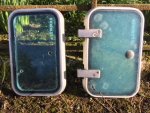
Well if it is any comfort I have replaced both windows in my little boat about 15 years ago. About 3 years ago I had to replace one window again and now the remaining one really needs to be replaced. Crazing was the biggest problem although the final straw in one cas was actual hole from external damage. Basically it is the sun that kills em. olewill
 
76DE4807-A189-4C21-884C-19D86F853534.jpeg
Here is a before and after with mine. I used 60 grit sand paper to get the crud off. Then some wet and dry to take the scratches off and then polished it with cutting compound. The first step was the longest and most tedious but you have to be aggressive to get through the craze which is less than a millimetre deep imo
 
View attachment 70607
Here is a before and after with mine. I used 60 grit sand paper to get the crud off. Then some wet and dry to take the scratches off and then polished it with cutting compound. The first step was the longest and most tedious but you have to be aggressive to get through the craze which is less than a millimetre deep imo

Where your just misty or where they craze ? If they where craze , you done very well , its temped me to give it a go
 
Both misty and crazed. There is a small amount of crazing still on the inside but the vast majority was on the outside. There was a few bits that went deeper from where impacts must have occurred and I didn’t sand these out to avoid a dip but as you can see from the pictures the difference is significant both in terms of light that will get in and being able to see optically through it. It was a tedious process and I found black sanding paper of a harsh grit such as 60 or 80 worked best to get the worst off. I used a machine. I even hit it with an angle grinder with a sanding disc but that just melted the surface. My advice would be not to worry and give it a good go. If it doesn’t work get a new bit of plastic!
 
Fortunately :ambivalence: we don't have much of a problem with that here in the UK!

But the OP is in the Med. !

"Living the dream . Can often be found anchored in a bay somewhere in the Med", he says in his profile
 
Last edited:
One of my hatches had had something spilled on it, like a solvent of some kind, which left a really rough stripe like sandpaper right across it. Another was badly scratched and scuffed as if someone had walked across it several times with steel sole inserts.

I spent a lot of time, like an hour on each, with a cloth and a tin of Peek polish and, although you can still see a faint trace of damage in both hatches, you would not spot it if you didn't know it was there. :)

Richard
 
One of my hatches had had something spilled on it, like a solvent of some kind, which left a really rough stripe like sandpaper right across it. Another was badly scratched and scuffed as if someone had walked across it several times with steel sole inserts.

I spent a lot of time, like an hour on each, with a cloth and a tin of Peek polish and, although you can still see a faint trace of damage in both hatches, you would not spot it if you didn't know it was there. :)

Richard

Mine are quite bad Richard the old owner I Think wife like to clean and we think she may had use abbasive cleaning products,
It taken a lot of work in the cockpit remover scratch on the gel . Lucky she never did the top sides as they still live new.
Going to give one window a try and see how it goes .
VicS yes we can be found anchored some where in the Med :)
 
Top
