Sanity check of alternator alarm solution

roaringgirl

Well-Known Member
Joined
1 Nov 2014
Messages
886
Location
Half way around: Wellington, NZ.
bit.ly
My friend's boat has 2 alternators, one big balmar for the house bank, one smaller one for the engine start bank.

Problem: the *only* draw on the start battery is the starter motor; once the engine has been running for 10 mins, the start battery is full, the small alternator output drops to 0 and the "alternator not charging" alarm starts beeping.

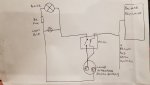
Solution: I wired in a relay, switched by the ignition feed, which turns on the engine-room blower (and a small light bulb), both powered by the start battery - this way there's always a small drain on the start battery when the engine is running, and the alternator will always output a bit and the alarm will be silent.

Can anyone see a problem with this? I just need a sanity check.

Thanks
 

Attachments

  • Screenshot_20211231-104936_Gallery.jpg
    Screenshot_20211231-104936_Gallery.jpg
    870.8 KB · Views: 18
I'm just a dumbass, but surely the real answer is that your friend doesn't need two alternators?

I know it's not as cheap as a fan and a lightbulb., but it would be more elegant to have a single alternator and a charge splitter.

He would get better charging with a single alternator and, for example, a sterling alternator regulator. This does proper multi-stage charging and Sterling claim that this charges the battery 4x faster and increases the battery's effective capacity by 25% or more - it manages to achieve this because a standard alternator just puts out a fixed voltage, and hence the battery doesn't benefit from the absorption or float stages.
 
I'm just a dumbass, but surely the real answer is that your friend doesn't need two alternators?

I know it's not as cheap as a fan and a lightbulb., but it would be more elegant to have a single alternator and a charge splitter.

He would get better charging with a single alternator and, for example, a sterling alternator regulator. This does proper multi-stage charging and Sterling claim that this charges the battery 4x faster and increases the battery's effective capacity by 25% or more - it manages to achieve this because a standard alternator just puts out a fixed voltage, and hence the battery doesn't benefit from the absorption or float stages.
My friend's boat has 2 alternators, one big balmar for the house bank, one smaller one for the engine start bank.

Problem: the *only* draw on the start battery is the starter motor; once the engine has been running for 10 mins, the start battery is full, the small alternator output drops to 0 and the "alternator not charging" alarm starts beeping.

Solution: I wired in a relay, switched by the ignition feed, which turns on the engine-room blower (and a small light bulb), both powered by the start battery - this way there's always a small drain on the start battery when the engine is running, and the alternator will always output a bit and the alarm will be silent.

Can anyone see a problem with this? I just need a sanity check.

Thanks
My friend's boat has 2 alternators, one big balmar for the house bank, one smaller one for the engine start bank.

Problem: the *only* draw on the start battery is the starter motor; once the engine has been running for 10 mins, the start battery is full, the small alternator output drops to 0 and the "alternator not charging" alarm starts beeping.

Solution: I wired in a relay, switched by the ignition feed, which turns on the engine-room blower (and a small light bulb), both powered by the start battery - this way there's always a small drain on the start battery when the engine is running, and the alternator will always output a bit and the alarm will be silent.

Can anyone see a problem with this? I just need a sanity check.

Thanks
No problem with your proposal if it solves the problem - with two alternators you can jury rig to keep essentials going if one goes tits up.
Jim
 
Normally, isn't the 'alternator not charging' light sensing a voltage difference between the alternator output and the start battery?
It doesn't know anything about the current only that the alternator internally is at the same or different voltage to the battery?
So is the switch panel fed from the house battery?
And the warning light also?

So is the circuit actually sensing that the Balmar is charging the house batteries at a higher voltage than the engine battery.?
Or is the voltage output of the engine alternator going berserk because it's not designed for zero load?

Might it be better to wire the engine alternator, charge warning lamp and battery in the conventional way so that if the light came on, people would know what it meant?
 
As said why would the alternator fail light come on when engine start battery is full? It should be a simple a stand alone charging circuit with stand alone warning system. Not sure what sensing system is used but old way is to have a lamp in series with the supply to the alternator excitation. (regulator). When alternator starts charging the current through lamp for excitation is not needed so lamp goes out. Makes me wonder if wiring is not stand alone or if warning bulb is incorrect wattage. Can't suggest anything but something is screwy. ol'will
 
As said why would the alternator fail light come on when engine start battery is full? It should be a simple a stand alone charging circuit with stand alone warning system. Not sure what sensing system is used but old way is to have a lamp in series with the supply to the alternator excitation. (regulator). When alternator starts charging the current through lamp for excitation is not needed so lamp goes out. Makes me wonder if wiring is not stand alone or if warning bulb is incorrect wattage. Can't suggest anything but something is screwy. ol'will

I don't understand how the lightbulb would go out when the alternator started charging. Can you draw the circuit you are describing?
 
I don't understand how the lightbulb would go out when the alternator started charging. Can you draw the circuit you are describing?

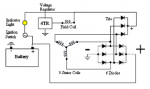
The light terminal on the alt is negative when the alternator isn't excited. Therefore the light illuminates. When excited the potential of the light terminal changes to positive therefore the light goes out as current does not flow + to +.
 
1641054277082.png
That's the basic classic circuit.
The light comes on when you switch on the ignition because the regulator takes current through the lamp and into the field coil.
When the alternator starts charging the battery, the voltages at both ends of the warning light are the same so no current flows through it, it goes out.
 
Top