
Sanding the hull

claymore

Well-Known Member
Joined
18 Jun 2001
Messages
10,651
Location
In the far North
Visit site
There is still some old antifoul on it. I've powerwashed a lot of it off and now need to get the hull smooth again before antifouling. I've done a bit of scraping and the loose stuff is about gone so will use an orbital palm sander or B+D mouse.
I'll use a mask, of course but am mesmerised by the choice - anyone got a recommendation?
TIA
 
I find it difficult to believe that there's anything worth sanding after the pressure washing.... ( :) ) however, as you have an interest in preserving the local flora and fauna for future generations of Claymores, the use of carefully placed plastic sheeting and wet sanding will catch the remaining molecules of poison as you prise them off the hull. I favour a Bahco scraper
https://www.amazon.co.uk/s/ref=nb_s...ywords=bahco+scraper&rh=i:aps,k:bahco+scraper

as one can re-sharpen the blade which thereby appeals to one's frugal nature and inclinations. To avoid digging the edge of the scraper into the gel coat, round off the sharp points at the outer edges with a metal file.

If you have spent some past housekeeping loot on an oscillating tool, then a Worx carbide remover

https://www.amazon.co.uk/Worx-WA5093-Sonicrafter-Oscillating-Multitool/dp/B00C1CEBM8

will make short works (geddit ? ) of any hills and valleys of old AF. Again, wet sanding with a fine spray of water with a dash of PVA glue will bind the debris so that it collects in pools on the plastic sheeting. However, wet plastic sheeting has a coefficient of friction of about zero, so boots with cleats are recommended.
 
I find it difficult to believe that there's anything worth sanding after the pressure washing.... ( :) ) however, as you have an interest in preserving the local flora and fauna for future generations of Claymores, the use of carefully placed plastic sheeting and wet sanding will catch the remaining molecules of poison as you prise them off the hull. I favour a Bahco scraper

https://www.amazon.co.uk/s/ref=nb_s...ywords=bahco+scraper&rh=i:aps,k:bahco+scraper

as one can re-sharpen the blade which thereby appeals to one's frugal nature and inclinations. To avoid digging the edge of the scraper into the gel coat, round off the sharp points at the outer edges with a metal file.

If you have spent some past housekeeping loot on an oscillating tool, then a Worx carbide remover

https://www.amazon.co.uk/Worx-WA5093-Sonicrafter-Oscillating-Multitool/dp/B00C1CEBM8

will make short works (geddit ? ) of any hills and valleys of old AF. Again, wet sanding with a fine spray of water with a dash of PVA glue will bind the debris so that it collects in pools on the plastic sheeting. However, wet plastic sheeting has a coefficient of friction of about zero, so boots with cleats are recommended.

Goodness that’s a lot of philosophy, the effects of New Year still not worn off.
 
My Dears
i'm currently working on the Micro 18 - not Claymore.
Thanks for the advice - its an outside job but its the mask I'm really interested in!
 
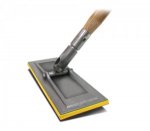
Use one of these on a 5 ft pole

drywall_pole_sander-300x261.jpg

with 80 grit w/d used wet.

If eco conscious collect the run off with drop cloths and dispose of as toxic waste.

The 80 grit is usually the recommended grade to provide a good key when applying most a/f.

The angled head on the pole turns a backbreaking arm killing job into something this old fart can still manage. in the boatyard.

BTW most yards that I use now specifically ban dry sanding a/f.
 
On a H&S spraying course last year, the H&S chapess said that a mask over the mouth was not good enough, as some toxins can translocate through the skin, and wet surfaces such as eyes. Frightening. Don't use detergent or e.g. Swarfega for cleaning your face and hands afterwards, just lots of fresh water to start with till the gross contamination has gone.


I have a Draeger 5500 with pre-filter (particulate) and R90 filters, but I can claim the cost from HMRC. By far the best stuff I have used for agr spraying.
 
When dry sanding do you supply air fed masks to all of the other people around ? Do you have special ones for the local wildlife ?
 
I can help here - I'll be doing it in the wet - a nice rainy day and with wet paper. I also have a sheet which will be laid on the ground to catch the bits.
If anyone fancies an hour or two - she's only 5.5m and I'm sure I can get Dear Heart to supply any members of a working party with fresh baked scones and her rather fine raspberry jam etc. Who knows - she may even relent and let me have one......
 
I don't think anyone can advise you which mask to use.

When working in the dust Lab we had to go to see a trained person for a fitting. We had 4 different dust masks to choose from in the Lab depending on which design fitted each person. Only 3 folk did anything in the Lab.

And they aren't that good, if anything was actually toxic and stood half a chance of escaping the fume cupboard, I used an air fed hood.

Working wet is a better idea.

I used Jif on a green scourer on the BnQ Mouse to get the slime residue off Carousel.
 
Top