
big_s
Active Member
Hi,
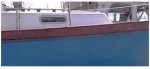
I recently bought a Samphire 26 in need of some serious tlc. The Samphire design is notable for its teak plank(strake?) surround at the top of the hull between the rubbing rail and the capping rail, the latter two sandwiching the first in place:
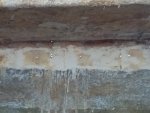
While removing the headlining contact adhesive from the interior of the hull I noticed that lots of the screws securing this and the rubbing strake to the hull have penetrated right through the hull. It looks like a previous owner may have tried to cure the resulting leaks with additional layers of fibreglass and gelcoat. Unfortunately much of this was done on top of areas that had not had the contact adhesive or headliner foam backing fully removed! The result is a total mess with pockets of water found between layers of glass and the hull. Here are some example holes in a just small section of the interior - yep that is daylight!:
I don't like the plank/bulwark construction as 200+ screw holes is 200+ potential leaks so I want to remodel this upper part of the hull. Having removed the outer teak plank, rubbing strake and capping rail I found this:
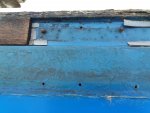
The lower screw holes are where the rubbing rail was secured. Behind the plank was a recess into which another thin section of teak was secured all the way around the hull - I removed a small section to the right in the photo just to understand what was going on behind. I believe the screw tips visible to the right are possibly joining the deck to the hell? - they are not accessible internally. These screws screw in to the teak in the recess and these as well as the grey adhesive tape hold the teak in the recess in place . I believe the top two layers of glass are the joint formed at the edge of the hull and the edge of the deck?
So my thinking is this: can I leave the teak in the recess in place, continue the deck layer of glass out a fraction and then downwards so that if covers this recess and the teak in it, and then joins with the hull just below the recess.. I can fill and fair this glassfibre joint edge to be visually acceptable. In doing so this whole recessed area and the edges above it would be encapsulated in glass/epoxy (?) I will fill and seal all remaining screw holes in the hull - I will not reinstall a rubbing rail.
As for the capping rail, I am undecided as to whether a replacement of the current rotten capping rails would be subsequently necessary.
Finally I may create a kind of hawse hole that passes through this recessed area, one on either side of the yacht, to allow easier deck drainage as the current deck level drains require internal plumbing and drain skin fittings in the hull that are cumbersome and undesirable.
Any and all advice welcome as to whether this is a sensible/feasible course of action, or not!
Many thanks!
I recently bought a Samphire 26 in need of some serious tlc. The Samphire design is notable for its teak plank(strake?) surround at the top of the hull between the rubbing rail and the capping rail, the latter two sandwiching the first in place:
While removing the headlining contact adhesive from the interior of the hull I noticed that lots of the screws securing this and the rubbing strake to the hull have penetrated right through the hull. It looks like a previous owner may have tried to cure the resulting leaks with additional layers of fibreglass and gelcoat. Unfortunately much of this was done on top of areas that had not had the contact adhesive or headliner foam backing fully removed! The result is a total mess with pockets of water found between layers of glass and the hull. Here are some example holes in a just small section of the interior - yep that is daylight!:
I don't like the plank/bulwark construction as 200+ screw holes is 200+ potential leaks so I want to remodel this upper part of the hull. Having removed the outer teak plank, rubbing strake and capping rail I found this:
The lower screw holes are where the rubbing rail was secured. Behind the plank was a recess into which another thin section of teak was secured all the way around the hull - I removed a small section to the right in the photo just to understand what was going on behind. I believe the screw tips visible to the right are possibly joining the deck to the hell? - they are not accessible internally. These screws screw in to the teak in the recess and these as well as the grey adhesive tape hold the teak in the recess in place . I believe the top two layers of glass are the joint formed at the edge of the hull and the edge of the deck?
So my thinking is this: can I leave the teak in the recess in place, continue the deck layer of glass out a fraction and then downwards so that if covers this recess and the teak in it, and then joins with the hull just below the recess.. I can fill and fair this glassfibre joint edge to be visually acceptable. In doing so this whole recessed area and the edges above it would be encapsulated in glass/epoxy (?) I will fill and seal all remaining screw holes in the hull - I will not reinstall a rubbing rail.
As for the capping rail, I am undecided as to whether a replacement of the current rotten capping rails would be subsequently necessary.
Finally I may create a kind of hawse hole that passes through this recessed area, one on either side of the yacht, to allow easier deck drainage as the current deck level drains require internal plumbing and drain skin fittings in the hull that are cumbersome and undesirable.
Any and all advice welcome as to whether this is a sensible/feasible course of action, or not!
Many thanks!


