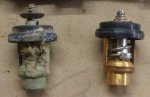
Salt encrustation in outboard motor.

driver0606

Well-Known Member
Joined
6 Oct 2007
Messages
240
Location
Always travelling
Visit site
Hello. I have a 1989 Evinrude 9.9 hp used in salt water. It started running too hot last year. The water pump has been changed and the system flushed with the French equivalent of Salt Away without improvement. It seems to be salt encrusation and I wonder if there are any more aggresssive products that might avoid a strip down. Any ideas, please?
 
There will be a plate that allows access to the waterways around the head. Find this and carefully remove it and then dig out the accumulated salt with suitable screw drivers etc. New gasket and put back on. Getting to see this chamber will show you the real size of your issue and allow application of your chosen lotion to the salt directly.
 
Last edited:
I had an overheating issue with my aging 2hp Tohatsu.
Your engine is bigger but they all run on the same design principles dont they?
For what its worth this was my experience...

The plate the spark plug goes into bolts to the back of the cylinder.
Removed the 4 bolts.
This is the hardest part as they tend to be seized and the metal is quite soft.
It is easy to accidentally twist off the bolt head.
If this happens you have to drill out the bolt and rethread the hole. Tapping the bolt helps, as does using a blow torch to heat the surrounding metal, expanding it.

Once you have the plate off its relatively easy. You can see into the jacket that surrounds the cylinder.
Im guessing you will see a lot of salt build up. This can be removed with a bit of wire.

My Tohatsu was a bit stubborn. The jacket was definitely part of the problem but to fix it i had to drop the leg and force water through the vertical pipe. Again, soft bolts were the major issue. Once I got them off it was easy to take to bits, wash out the pipe and reassemble.

It now runs sweet, so was definitely worth the hassle.
Good luck.
S
 
There will be a plate that allows access to the waterways around the head. Find this and carefully remove it and then dig out the accumulated salt with suitable screw drivers etc. New gasket and put back on. Getting to see this chamber will show you the real size of your issue and allow application of your chosen lotion to the salt directly.

Can you identify this plate you mention in the exploded diagram below?


I had an overheating issue with my aging 2hp Tohatsu.
Your engine is bigger but they all run on the same design principles dont they?


The OP has an Evinrude ..... Rather different to how you describe your tohatsu

Very probably he will have to remove the cylinder head , #14 in the diagram because the 8 shaped water passage around it will be choked with carbonate scale. Once off he will also be able to see how badly the cylinder block channels are scaled.

Maybe also take off the exhaust covers # 23 and #24


convert
 
Outboard service engineer told me to use Fernox and run the engine in it ...

Flush well in fresh water after to remove the Fernox.

I had already heard people say it was not suitable ... but as he said - central heating systems are many different forms .. alloy as well as copper / brass based exchangers in the boilers ... and biggest persuader - was he was a well respected Outboard service guy with a big work load.
 
Outboard service engineer told me to use Fernox and run the engine in it ...
Flush well in fresh water after to remove the Fernox.
I had already heard people say it was not suitable ... but as he said - central heating systems are many different forms .. alloy as well as copper / brass based exchangers in the boilers ... and biggest persuader - was he was a well respected Outboard service guy with a big work load.
Fernox is a brand name, There are many chemicals and other products with that name.

Fernox DS3 is the one I would use . It is a descaler based on sulfamic acid and is available from plumbers merchants.

Limescale Remover DS-3 2Kg - Fernox UK

Rydlyme is another, probably more potent, marine descaler and available from some chandlers, It's based on hydrochloric acid but the exact composition is a mystery .
The trouble though with chemical descalers is that they are not effective when any parts are completely blocked.
 
Fernox is a brand name, There are many chemicals and other products with that name.

Fernox DS3 is the one I would use . It is a descaler based on sulfamic acid and is available from plumbers merchants.

Limescale Remover DS-3 2Kg - Fernox UK

Rydlyme is another, probably more potent, marine descaler and available from some chandlers, It's based on hydrochloric acid but the exact composition is a mystery .
The trouble though with chemical descalers is that they are not effective when any parts are completely blocked.

As I understand from OP post .... its not completely blocked, but enough to cause it to run hotter ?

Another effective remover in fact is Citric Acid or Vinegar ... but problem here is volume needed to do the job.
 
I did a bunch of testing a few years ago. Lactic acid removes the most scale with the least damamge to aluminum. Vinegar was the worst. In the US the top outboard de-scale chemical is CLR, which is lactic acid. Sulfamic acid is also good (Lime-Away in the US).
 
Hello. I have a 1989 Evinrude 9.9 hp used in salt water. It started running too hot last year. The water pump has been changed and the system flushed with the French equivalent of Salt Away without improvement. It seems to be salt encrusation and I wonder if there are any more aggresssive products that might avoid a strip down. Any ideas, please?

Have you checked the thermostat? Stick it in a pan of hot water and check if it opens as the temperature increases.
 
Thank you for all your replies, very informative. I checked the thermostat and am at present running without it.

I do not want to strip the engine at present. The problem only appears at high power settings, so I can use it at like this until the end of the "season" like this if necessary.

1) Fernox DS3 sounds interesting, but I worry about the water pump and rubber seals, does anybody have any experience?

2) Vinegar also sounds interesting and is cheap (I flush with a 30 litre drum) although the comment from thinwater is worrying. What concentration would be safe?
 
Have you tried Blue thru. It probably will not solve your present problem if there is a stubborn blockage but it may be of use used regularly to prevent further blockages of the cooling channels. I have used it but difficult to know whether it makes any difference but many swear by it.
blue-thru
 
I think I could try vinegar first. To recap, my engine is a 1988 Evinrude 9.9 which has the thermostat housing at the top of the cylinder head when the engine is vertical. If I introduce water into the thermostat housing, it runs freely out of the exhaust but more slowly out of the tube that goes into the top of the water pump, suggesting the blockage is more in the head and the block. I could temporarily seal the outlet from thermostat housing to the exhaust, and the water pump inlets and fill the head and block with neat? vinegar and leave it for ? hours before flushing. This way there would be no risk of it getting into the cylinders via the exhaust system.

If there is anybody out there who is not too bored with me, perhaps you could kindly comment on my plan.
 
I think I could try vinegar first. To recap, my engine is a 1988 Evinrude 9.9 which has the thermostat housing at the top of the cylinder head when the engine is vertical. If I introduce water into the thermostat housing, it runs freely out of the exhaust but more slowly out of the tube that goes into the top of the water pump, suggesting the blockage is more in the head and the block. I could temporarily seal the outlet from thermostat housing to the exhaust, and the water pump inlets and fill the head and block with neat? vinegar and leave it for ? hours before flushing. This way there would be no risk of it getting into the cylinders via the exhaust system.

If there is anybody out there who is not too bored with me, perhaps you could kindly comment on my plan.
Its good news that the water runs quickly from the thermostat housing and out of the exhaust, That means that the passages round the head are clear.

Well worth trying to clean the block water channels in the way you suggest but acetic acid is pretty weak acid so vinegar is going to much slower than sulphamic acid and slower even than lactic acid.
Vinegar is only about 5% acetic acid , so fairly dilute as well. If the engine is heavily scaled you might have to repeat the process .
 
Its good news that the water runs quickly from the thermostat housing and out of the exhaust, That means that the passages round the head are clear.

Well worth trying to clean the block water channels in the way you suggest but acetic acid is pretty weak acid so vinegar is going to much slower than sulphamic acid and slower even than lactic acid.
Vinegar is only about 5% acetic acid , so fairly dilute as well. If the engine is heavily scaled you might have to repeat the process .

Come over here and Vinegar is undiluted ! It actually leads to hospital cases of severe burned throats .. stomach etc. But I know such is not available in UK.

I think a slow solution may be better - given the alloys etc. used in engine construction.

Even Calgon / Scale remover works ....

I would think the passage to exhaust out is larger and faster than inward ? But - yes - seems good news that part appears good.
 
Top