Sailing in Big Seas

Many thanks, great minds think alike, I already have it :encouragement:
The 'On the Wind' podcast has an interview of Fatty G.. he's quite a character!

I agree that Fatty book is excellent. I would also highly recommend the articles on Jordan Series Drogue use on Morganscloud.com. Well worth paying the small amount for.
 
I've read South by Shackleton, and the boat they used was little more than a converted lifeboat, and they said they encountered 'monstrous' waves, and when those guys say that, I guess they weren't lying. It's really interesting to me - are seastates like that only really occurring in the higher/lower latitudes? Compared to that, the original video looks mild, and I'd go kayaking it for a laugh if it wasn't too cold (maybe not actually).

The pictures shown in my post #5 were taken in that area. We sailed approximately the same route as the James Caird towards South Georgia. If you are interested google for "Records of the Canterbury Museum Volume 32 2018" and you will find the original navigational notes of Worsley with comments. Amazing read.

There is a distinct difference between Northern and Southern higher lattitudes. Because the North has a lot of land blocking wind it can on occasion be relatively mild in the Atlantic area. The summer high pressure area above the North Pole also helps. Bering Strait is a different story. E.g. Svalbard on 75 to 80 North has more sailing visitors every year in regular AWB's. Not a walk in the park, but yes it can be done without excessive expedition equipment.

The Southern higher lattitudes are open space without anything blocking wind. That is a truly brutal and harsh area with lots of wind and big seas. Serious expedition gear and experience is required for that area. But if that is your cup of tea, it is a truly amazing sail.
 
... and this is a fun read. :p

http://www.oceannavigator.com/Ocean-Voyager-2011/Dangerous-waves-and-your-boat/

Sobering to know that a ten foot breaking wave could roll our 32 footer if caught beam-on.

I can vouch for that, I was rolled well past 45 degrees a few days ago, 1 cable East of Scarborough!
It's the most I have ever been rolled, everything was in alignment for a short sharp wake-up call..when least expected!
The wind, though only the top of a F4, had blown all the way from Norway, and the seabed contours shallow steadily to where I was, and the waves are somehow focused in the bay.
I did a U'turn, still rolling like a sow, and went straight back in to Scab with my tail between my legs, smashed crockery and bilge water in the bookshelf..
My ocean going gaffer has a 50% ballast ratio but you wouldn't have known it. Thanks for the link.
 
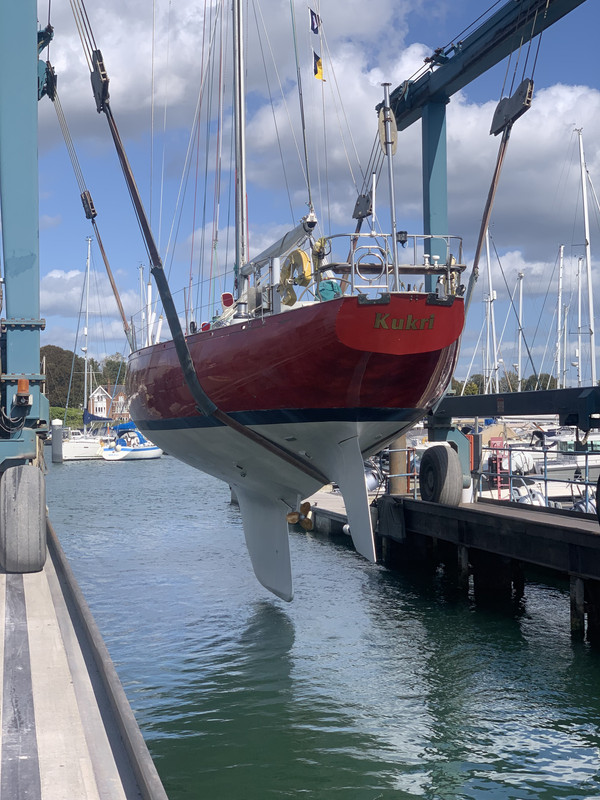
This heaves to very nicely. Fin keel, but the volume of the two ends and the shape of the canoe body mean that she doesn’t get wiggly when seas pass under her, and there is enough length of keel to resist sideways drift. Cutter, so as you reef down you bring the sail area inboard and over the centres of gravity, of lateral resistance and of buoyancy.

Boats with fat backsides and sloop rig usually won’t, imho.


I can certainly vouch for Kukri’s ability to heave to although I always thing of those hulls as ‘longish fin’ .

Big seas in small boats can be exciting or exciting and dangerous or just plain violent. Out on the ocean my experience is that the motion is often far less violent than in the Channel etc. Probably the worst I’ve had was F8/9 in the Bristol Channel. I lost the anchor off Lynmouth and made for Swansea.

People worry about ocean crossing, but I’ve known people who’ve done an Atlantic Circuit and never been in above a F5/6. Choose your time and route...
 
I was not commenting on that, I was commenting on the misconception that the Hydrovane was the only unit that could be mounted off centre
Some windvanes can be mounted offcentre.. but it beggars belief to claim they work properly, at all angles of heel on either tack, if mounted far enough off centre to clear a boarding ladder..half an inch would be insignificant, but half a yard?
 
Interesting thread this, thanks!

What makes a wave break at sea? Is the wind or when the wave gets 'top-heavy' and begins to collapse? Do you get breaking waves off the continental shelf or is it mainly in shallow waters? Fascinating stuff :)
 
Yes I looked at that but it’s not much of an offset - more to allow a transom hung rudder than people getting (and diving) on and off the boat. Given the tiny tiny percentage of time it would be used instead of the electric one my choice was no.

One of the hidden benefits to the Hydrovane is that if you happen to lose your rudder, you have a spare.

A number of people seem to benefit from this every year!
 
Interesting thread this, thanks!

What makes a wave break at sea? Is the wind or when the wave gets 'top-heavy' and begins to collapse? Do you get breaking waves off the continental shelf or is it mainly in shallow waters? Fascinating stuff :)

Continental shelves/shallowing waters are indeed bit culprits! Others include headlands, opposing wave trains, distant swell patterns, wave trains with differing amplitudes and direction, time the wind has blown on a stretch of water, a front going through, tidal flows, headlands, bars, points of tidal confluence, sea mountains......:eek:

The good news is they can mostly be avoided :)
 
One can always move and offset one's 'swim ladder'...

The reason Hydrovanes and similar are popular is as much due to the fact that they are independent.... no bits of string from vane to wheel as you have with Monitor or Aires...

Wind vane discussions always come down to the one that people have, so I will start by saying “Monitor”, but the point I want to make is that, although one never gets rid of the string, Scanmar have been developing their design so that it now does two things that it didn’t before. They now supply their own autopilot unit which uses the servo paddle and they now have a kit which turns the paddle into an emergency rudder.
 
Last edited:
I can certainly vouch for Kukri’s ability to heave to although I always thing of those hulls as ‘longish fin’ .

Big seas in small boats can be exciting or exciting and dangerous or just plain violent. Out on the ocean my experience is that the motion is often far less violent than in the Channel etc. Probably the worst I’ve had was F8/9 in the Bristol Channel. I lost the anchor off Lynmouth and made for Swansea.

People worry about ocean crossing, but I’ve known people who’ve done an Atlantic Circuit and never been in above a F5/6. Choose your time and route...

As mentioned above, I helped a guy take a Contest from Patras t Gibraltar in November some years back. We encounter two major storms, (one south tip of Italy) the other south of Sicily), with massive confused seas.

He carried on across the Atlantic through the Panama Canal and finally sold the yacht in Australia.

After the voyage I met him and he told me that the seas that we had experienced in the Mediterranean where the worst that he had experienced during the whole trip.

Shallow seas and land masses creating very poor wind conditions.
 
One of the hidden benefits to the Hydrovane is that if you happen to lose your rudder, you have a spare.

A number of people seem to benefit from this every year!

I did think of that but after some research I found that nobody has ever succeeded in steering their boat using Hydrovane only even in test.
 
Another interesting fact from the Morgan's Cloud series of articles on heavy weather sailing (all excellent) is that average wave height is usually calculated from the mean of the top 30% of waves. But that there will be variability such that waves twice that size will also come along but at much less frequency. (This is without factoring in the rarer rogue waves.)

"But what we can say with reasonable certainty is that in a Force 8 gale, a wave will come along between two and six times a day that is big enough to capsize pretty much any yacht, for sure, [under 80 feet in length and if beam on] and:

it breaks,
and if we don’t have the right anti-capsize gear deployed properly."
 
Last edited:
Top