
saildrive rubber flange 15 years old...looks ok, should I worry.?

thanks everyone, great advice as usual, so the general consensus is that, unlike a cars timing belt, failure is unlikely to be catastrophic!
we have a volvo md2030, i didn't know about the second skin, there are 2 flaps on the outer hull side, but i guess these are a 3rd non watertight layer?

The VP saildrive on the 2030 only has one seal. The rubber bit stuck to the bottom of the hull isn't a seal, it's just a cover for the hole. Here is my MD2030C Saildrive seal after 5 years in service.
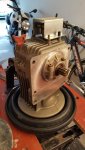
VPSaildrive.jpg
 
The outer flap is a one piece item and is not intended to be watertight it had a small hole at the end of the slit.
It serves two functions to smooth the water flow over a large hole in the hull and less known to protect the main diaphragm from reflected UV rays which were believed to have been responsible for the leaks in a yacht permanently moored over a sandy bottom in the Middle East after the flap disappeared
 
The Yanmar dealer I asked to replace mine when rebuilding the boat stated he knew of only two ever failing - one with a broken engine mount on a drying berth that hit a rock or some such in the mud and without one of the mounts it was pushed up out of the hole and the second caught an underwater cable at quite high speed. He looked at mine and said honestly don't waste the money changing them (about 10 years old) and was happy to write a letter for my insurers to say they were inspected and fine. The Yanmar SD20 manual at least says to inspect after 5 years not to replace though I believe later models say replace.
 
So....

Saildrives have been around for decades, 4-5 ?, there is minimal history of failure - and the few failures mentioned here have been as a result of 'misuse'. Failure is not catastrophic - though a failure in mid-Atlantic would be more than a nuisance. The few failures reported seem manageable in the short term allowing time for a repair - before the yacht actually sinks.

There were grave doubts expressed when Saildrives were introduce, possibly resulting in Yanmar providing the double flange and an electrical warning of leaks (the warning system appears to fail more frequently than the flanges).

Insurance companies, the comment by Pants excluded, seem relaxed about flanges - much more so than their attitude to rigging (you are more likely to have a catastrophic rigging failure than the flange fail?).

Its a remarkable and unsung success story.

The suppliers are unlikely to change their recommendations - flange replacement must generate a reliable income for their dealers. Leaving the service frequency as is - provides a very comfortable margin for safety - no-one can accuse them of not having our safety at the forefront of their thoughts?

It would be fascinating to see some statistics - how many flanges sold, as replacements, vs the numbers of Saildrives sold and how many flanges have been replaced because they actually failed, why did they fail and after what period. I'm not holding my breath for the answers.

Interestingly - sail drive flange replacement does not surface here very often - suggesting either people pay and have the flange replaced, its an easy replacement (and I know that is not the case) or - flanges do not rise above the horizon, out of sight, out of mind.

Given how we agonise over other issues - as I said - a remarkable success story - all credit to Volvo (? - I think it was Volvo).

Jonathan
 
So....

Saildrives have been around for decades, 4-5 ?, there is minimal history of failure - and the few failures mentioned here have been as a result of 'misuse'. Failure is not catastrophic - though a failure in mid-Atlantic would be more than a nuisance. The few failures reported seem manageable in the short term allowing time for a repair - before the yacht actually sinks.

There were grave doubts expressed when Saildrives were introduce, possibly resulting in Yanmar providing the double flange and an electrical warning of leaks (the warning system appears to fail more frequently than the flanges).

Insurance companies, the comment by Pants excluded, seem relaxed about flanges - much more so than their attitude to rigging (you are more likely to have a catastrophic rigging failure than the flange fail?).

Its a remarkable and unsung success story.

The suppliers are unlikely to change their recommendations - flange replacement must generate a reliable income for their dealers. Leaving the service frequency as is - provides a very comfortable margin for safety - no-one can accuse them of not having our safety at the forefront of their thoughts?

It would be fascinating to see some statistics - how many flanges sold, as replacements, vs the numbers of Saildrives sold and how many flanges have been replaced because they actually failed, why did they fail and after what period. I'm not holding my breath for the answers.

Interestingly - sail drive flange replacement does not surface here very often - suggesting either people pay and have the flange replaced, its an easy replacement (and I know that is not the case) or - flanges do not rise above the horizon, out of sight, out of mind.

Given how we agonise over other issues - as I said - a remarkable success story - all credit to Volvo (? - I think it was Volvo).

Jonathan

That seems like a very fair summary to me Jonathan. :)

One thing I would question is whether the Yanmar moisture sensors actually every fail. According to the manual, you are supposed to unscrew the sensor (it's a 30 second job on my engines) and hold a wet finger across the two stainless steel prongs to see if the buzzer goes off. I've tested mine rather more intermittently every few years and they have never failed to trigger the alarm. In fact, I think all they are is a resistance bridge so I'm not really sure how they could ever fail, other than being through disconnected through physical damage or cable corrosion or similar.

If there were a break in the twin core cable, would that also trigger the alarm? It might if the alarm expects to see a resistance of say 100 ohms and triggers if it sees a much higher or much lower resistance. I don't know if the sensors are that clever as I've never disconnected mine.

Richard
 
Sorry Richard,

I'm no expert - I just recall the occasional posts here on 'false' alarms.

I am at fault - I should have made clear my comment was based on anecdotal recollections

Jonathan
 
Sorry Richard,

I'm no expert - I just recall the occasional posts here on 'false' alarms.

I am at fault - I should have made clear my comment was based on anecdotal recollections

Jonathan

No problem Jonathan .... you are right about the "false alarms" I've had a couple of those on my port engine but it's due to condensation between the two seals which sometimes settles on the sensor contacts and sets off the alarm. You just have to unscrew it and wipe the contacts with a cloth and the alarm stops. One could argue that the sensors are, if anything, a bit too sensitive but that might also be a benefit. :)

Richard
 
Jonothan, Richard, everyone else, I am pretty sure we have the definitive objective truth about this now. lets just pause to recognise how awesome the internet has been for these matters!!, before it, we would have a couple of the above opinions!, and if unlucky you'd meet a 'bedwetter'!! I feel that people worry too much about leaks, anything that might happen when your away from boat is a worry, but not life threatening, anything at sea and your always going to be able to, at the very very worst, do some bailing with buckets.. and we rarely sail long passages.. Id rather spend money making sure the engine and tiller aren't going to fail us in a wind or tide at night somewhere.. seeing as you lot know so much, what would be your attention to longevity of engine?? in my head its this.... oil, water, impellers, filters, matrix inspection, spray the cables wires electrics, rusty bits with wd-40, run it as often as we can., some diesel bug addative..... i am going to flush some acid into the matrix for a few minutes once this season, an easy job for a plumber!!, also why i don't get worried about water!, such low pressure through a hull, 0.05bar at 50cm, pah!...
anyone got any good ideas for any obvious sensible maintenance that i've missed? its a volvo md2030 on saildrive .. i worry about starter motor!, does anyone replace them at intervals??
thanks..
 
Jonothan, Richard, everyone else, I am pretty sure we have the definitive objective truth about this now. lets just pause to recognise how awesome the internet has been for these matters!!, before it, we would have a couple of the above opinions!, and if unlucky you'd meet a 'bedwetter'!! I feel that people worry too much about leaks, anything that might happen when your away from boat is a worry, but not life threatening, anything at sea and your always going to be able to, at the very very worst, do some bailing with buckets.. and we rarely sail long passages.. Id rather spend money making sure the engine and tiller aren't going to fail us in a wind or tide at night somewhere.. seeing as you lot know so much, what would be your attention to longevity of engine?? in my head its this.... oil, water, impellers, filters, matrix inspection, spray the cables wires electrics, rusty bits with wd-40, run it as often as we can., some diesel bug addative..... i am going to flush some acid into the matrix for a few minutes once this season, an easy job for a plumber!!, also why i don't get worried about water!, such low pressure through a hull, 0.05bar at 50cm, pah!...
anyone got any good ideas for any obvious sensible maintenance that i've missed? its a volvo md2030 on saildrive .. i worry about starter motor!, does anyone replace them at intervals??
thanks..

Both Richard and we carry a complete set of spares, its our second engine :).

We tend to only use one engine at a time, except for close quarter manoeuvring. I don't know how Richard fares but trying to manoeuvre on one engine, at low speed, is challenging. We try to keep engine hours balanced.

However what we find, and I cannot speak for Richard, is that if we have an issue on one engine we quickly learnt to overcome the issue - and expect that same issue to occur on the second engine fairly quickly.

My flippant comment on having a complete, spare, engine was - well flippant.

We do have a spare alternator, spare starter motor, spare wiring loom and other bits and pieces and then filters, belt, injectors and impellers (some of which were liberated from retired engines). We carry the 'consumables' the bigger items are stored at home (hoping we never need them and/or-we can hobble home and sort it out there).

Jonathan
 
Engines used to be called auxiliaries for a reason ;). For owners of MoBos it's a different matter, but for us "yachties" we have sails, and it's a good idea to practice sailing in/out of anchorages or onto buoys just to keep your hand in. My boat sails like a big dinghy, like most AWBs. I've had 2 engine failures. First time was partially my fault because when the boat was re-powered, the mechanic managed to mess with the fuel guage and it now reads high. I didn't realise, and I ran out of fuel between the sea-walls at Krk harbour entrance. My previously reliable guage read 1/4 of a tank. I had to unfurl the sails and tack back out to anchor. Second time was entirely my fault, I ran out of fuel (again) in a thunderstorm off Mali Losinj, we sailed to the fuel berth - embarrasing but not the end of the world.

I've learnt a couple of things .... firstly, get my guage fixed, but when the engine cuts out, get the sails out fast and get under way again (assuming there's enough wind) ..... because you're not going to fix an engine problem quickly. Get the sails out or drop the anchor. Once the boat is safe, investigate the problem and fix it if you can, but all the spares in the world aren't going to help in the time immediately after the engine cuts out. I really liked Patrick Laines response to engine failure, just sail offshore until the weather lets up and don't panic.

The best we can do is to reduce the likelihood of engine failure through regular visual checks and servicing of fluids, filters, belts etc. Carrying every conceivable spare may be important if your sailing ground takes you away from civilisation, but what usually happens is that the spares sit in the boat rusting (or hardening for rubber parts) until maybe, one day, you need them - then they might not work, or might fail prematurely. Impellers and belts are the must-have spares IMO, but these days, most expensive parts can be sourced and delivered pretty quickly.
 
thanks, yep, sails stay up until they become a problem!! at a size just big enough to sail as fast as needed, which is usually just enough to steer out of danger..
i like the idea of electrification, a silent instant and more reliable motor i would happily have in return for loss of range..
 
thanks, yep, sails stay up until they become a problem!! at a size just big enough to sail as fast as needed, which is usually just enough to steer out of danger..
i like the idea of electrification, a silent instant and more reliable motor i would happily have in return for loss of range..

If it could also double as a generator when sailing then it would be ideal .... :encouragement: .... my saildrive just rotates in neutral doing nothing useful when sailing.
 
If it could also double as a generator when sailing then it would be ideal .... :encouragement: .... my saildrive just rotates in neutral doing nothing useful when sailing.
If you had it charging the battery, it would put a load on it and the propeller act as a brake. You don't get something for nothing.
 
If you had it charging the battery, it would put a load on it and the propeller act as a brake. You don't get something for nothing.

I realise that, but trade half a knot for a few hundred watts of energy? ... worth it in my book. :encouragement:

Outremer-avec-hydro.120.png
 
Top