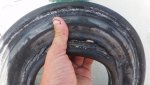
saildrive rubber flange 15 years old...looks ok, should I worry.?

TactilePaul

Well-Known Member
Joined
18 May 2017
Messages
100
Visit site
I know there are insurance issues here, but do they fail catistrofically, do they show when they are wearing out?, i know that a rubber timing belts on cars dont really show any outward signs of age when replacement is due..
thanks.
Paul.
 
I know there are insurance issues here, but do they fail catistrofically, do they show when they are wearing out?, i know that a rubber timing belts on cars dont really show any outward signs of age when replacement is due..
thanks.
Paul.

well it plugs up a pretty big hole...

as with timing belts you can just carry on driving until it snaps if you want, or replace it for peace of mind.
 
Is it a Yanmar or a Volvo? My Yanmars have two seals with a water detector between the seals. The upper seal is plainly visible from the engine bay so I keep it clean and dry and can see that it, and its circumferential clip, are in perfect condition. The lower seal is, obviously, not visible, but that is surely the one that is going to fail first as it's in continuous contact with seawater. When, and if, that lower seal fails it will trigger the alarm. Until then, unless I'm having and engine or seal removed for other reasons, I'm going to leave well alone. :)

Richard
 
There seems to be no history of catastrophic failure but, at 15 years, I'd replace it, just to be sure.

Mine (Volvo) is 21 years old now and just to be sure I’m thinking of changing it when it gets to 25 and then the next one should last the life of the boat.

____________________________________________
 
I had one fail at 19 years old in a commercial vessel with high engine hours. That was due to a combination of barnacles on it (the outer fairing had been lost and not replaced) and a failed engine mount causing excessive vibration. It failed with a small crack which let in an occasional drip and that became a slow trickle after a couple of months of heavy use during which we were unable to find a place to haul out (no tides in the caribbean and hard to get the parts there). Eventually I actually managed to replace it with the boat still afloat in the water, but that's another story!

I have never heard of one failing catastrophically except one account when the saildrive hit a rock. Never without an impact. They fail very slowly and give you plenty of warning. Have a bilge pump with a float switch, and a spare pump just in case.

Take off the outer fairing from below on your next haul out and inspect the main seal closely with a bright light. If there are barnacles then remove all traces of them. If there's any sign of cracking or damage then replace it. there should be visible signs for a long time before it fails. If not then I'd leave it right where it is. Aint broke, don't fix! The one you've got is tried and tested, if you replace it then there's a fair chance something will go wrong during the replacement process and it's a lot of work.

To ensure no sharp-edged barnacles get on it, always maintain an outer fairing. We made new ones from cheap mud flaps for trucks, they are just the right size, easy to cut to shape and cost a tenner a pair!

The second seal on the inside of a yanmar saildrive is completely useless to hold water, it will just pop off if there is water pressure under it. The main purpose of the upper seal is just to stop dirt and chemicals getting on the top of the main seal which could damage it or wear through it when it vibrates.
 
Last edited:
Is it a Yanmar or a Volvo? My Yanmars have two seals with a water detector between the seals. The upper seal is plainly visible from the engine bay so I keep it clean and dry and can see that it, and its circumferential clip, are in perfect condition. The lower seal is, obviously, not visible, but that is surely the one that is going to fail first as it's in continuous contact with seawater. When, and if, that lower seal fails it will trigger the alarm. Until then, unless I'm having and engine or seal removed for other reasons, I'm going to leave well alone. :)

Richard

I'm not sure that this will be necessarily correct - it might be - but as most seals are replaced long before they are likely to fail surely the jury is still out. The top part of the seal, or the top seal, is subject to atmospheric degradation and UV, accepting it is an dark engine room. The other side of the seal subject to seawater and barnacles. I'm not a polymer chemist, never actually heard of seals failing (at all) see previous post, so what the mechanism of failure is, apart from the description above - I don't know. But if it is hardening of the polymer in conjunction with vibration - it may fail on the engine room side first rather than the seawater side.

Jonathan
 
I attached a picture of what the badly split seal looked like. Even in this state it only leaked a tiny dribble because it is so stiff and thick. I wouldn't lose sleep over it.

Also attached a picture of how I changed it in the water, using some airbags, a very, very small crane intended for dinghies, a lot of ingenuity, a very accomodating marina owner (thanks Bob!) and a kayak! This was not easy and I don't recommend it, but when the nearest crane big enough is thousands of miles away and costs thousands of dollars....
 

Attachments

  • 20170303_094441.jpg
    20170303_094441.jpg
    510.8 KB · Views: 3
  • 20170301_150848.jpg
    20170301_150848.jpg
    514.8 KB · Views: 3
Interestingly, I recall, the 7 year renewal was introduced at the same time as the Saildrive itself. There was no history to support 7 years, 3 years or 23 years. With time catastrophic failure does not seem to occur and I'd put good money on there being a lot of old flanges 'in use' well, very well, beyond 7 years.

I'm not suggesting ignoring the 7 year 'recommendation', nor am I suggesting the Volvo and Yanmar do not have sensible safety margins - but a 3: 1 margin, which would be low would give (I think) a flange life of 21 years and a more normal margin of 6:1 a life beyond that of the Saildrive itself.

It would be interesting if statistics were available.

Jonathan
 
Mine (Volvo) is 21 years old now and just to be sure I’m thinking of changing it when it gets to 25 and then the next one should last the life of the boat.

Or your life if it goes earlier:ambivalence:

I would suggest that there are issues affecting the change other than just how many years.
ie how many hours has the engine been run.The vibration must have an effect.
I seem to pick up lots of weed when sailing in the channel islands & once sailed 60 miles with the engine ticking over whilst trying to get rid of weed. The shaking gave the whole mounting a good rattling before the obstruction finally disappeared.
I once broke an engine mounting so that the engine dropped a couple of inches. Fortunately it happened within a few yards of my berth, but if it had happened just before I had entered the creek, I would have still risked motoring in to my berth. I would have had no option. The strain on the rubber would have been quite large.
So one has to take such instances in to account
I change mine every 7 years as it takes about 8 hours on my own. The cost of the seal is not really that great in the grand scheme of things
 
Last edited:
I'm not sure that this will be necessarily correct - it might be - but as most seals are replaced long before they are likely to fail surely the jury is still out. The top part of the seal, or the top seal, is subject to atmospheric degradation and UV, accepting it is an dark engine room. The other side of the seal subject to seawater and barnacles. I'm not a polymer chemist, never actually heard of seals failing (at all) see previous post, so what the mechanism of failure is, apart from the description above - I don't know. But if it is hardening of the polymer in conjunction with vibration - it may fail on the engine room side first rather than the seawater side.

Jonathan

As you say, there is very little information about failed saildrive diaphragms which is presumably a good sign. The only failed diaphragm that I'm aware of was caused by a mechanical impact below the waterline.

The lower Yanmar seal is the really heavy duty thick one and, I would guess, is made from nitrile rubber so I doubt will deteriorate due to environmental conditions although might obviously be susceptible to physical attack by barnacles or similar.

The top diaphragm is thinner but has a smaller surface area and it is designed by Yanmar to be the second line of defence and will stop water ingress for a long time. It probably won't function adequately for long if it was the only seal but any initial slow leakage past the lower diaphragm will be detected by the sensor long before the upper seal reaches its design limit. The great advantage of the upper seal is that I can, and do, regularly inspect it and check that it is clean and in good condition and flexible and that the clamp ring is in good condition so if it were going to fail first then I would become aware of it and be able to take remedial action.

Richard
 
The upper seal is a result of commercial reaction to Volvo introducing the sail drive as a means of fitting engines to flat bottomed sailboats which was a game changer
The critics and rival engine manufacturers declared that the seal was a major disaster just waiting to happen so belts and braces ie twin seals and arbitrarily defined replacement dates although there have been many cases of boats lifted with slings round the drives etc there are few reports of the diaphragms failing .
 
Saildrive is an eloquent design, no doubt about that. It saves the boat builder a fair amount of cost. Issues like alignment, vibrations and so on have virtually disappeared.

That said, I think the boat design engineers have done a very poor job in building-in maintainability. Replacing it, certainly on my boat, is a major task. It's very labour intensive and, imho violates the important code of practice, "do no harm". I imagine that there is a high risk of collateral damage, scratching interior wood, engine bearers and so on and the risk of putting everything back together properly. Better engineering would have provided easier replacement.

Why do Yanmar recommend 5 year replacement interval and Volvo 7 years? When I bought my boat (new) I wrote to the Builder to ask for evidence to support the recommendation. I received a patronising response.
 
thanks everyone, great advice as usual, so the general consensus is that, unlike a cars timing belt, failure is unlikely to be catastrophic!
we have a volvo md2030, i didn't know about the second skin, there are 2 flaps on the outer hull side, but i guess these are a 3rd non watertight layer?
 
I attached a picture of what the badly split seal looked like. Even in this state it only leaked a tiny dribble because it is so stiff and thick. I wouldn't lose sleep over it.

Also attached a picture of how I changed it in the water, using some airbags, a very, very small crane intended for dinghies, a lot of ingenuity, a very accomodating marina owner (thanks Bob!) and a kayak! This was not easy and I don't recommend it, but when the nearest crane big enough is thousands of miles away and costs thousands of dollars....

I take my hat off to you sir!:encouragement:
 
Saildrive is an eloquent design, no doubt about that. It saves the boat builder a fair amount of cost. Issues like alignment, vibrations and so on have virtually disappeared.

That said, I think the boat design engineers have done a very poor job in building-in maintainability. Replacing it, certainly on my boat, is a major task. It's very labour intensive and, imho violates the important code of practice, "do no harm". I imagine that there is a high risk of collateral damage, scratching interior wood, engine bearers and so on and the risk of putting everything back together properly. Better engineering would have provided easier replacement.

Why do Yanmar recommend 5 year replacement interval and Volvo 7 years? When I bought my boat (new) I wrote to the Builder to ask for evidence to support the recommendation. I received a patronising response.

True, it's the boat builder that builds the engine compartment and hence affects access and effort required to change the seal. No different to a boat manufacturer (or owner) instaling a generator over the stern gland and prop shaft of a shaft driven boat. The saildrive is an elegant solution. Did the inventor look at all the cars and trucks running around on inflated rubber tyres and think .. what if I used a tyre wall like arrangement to seal an outboard shaft in the bottom of a boat? They are pretty robust, the vibration is very much reduced and on my boat, access to the saildrive is pretty good. The one I removed when I re powered was 5 years old and looked as good as new, I could see no discernable difference between the old one and the one that came with the new engine other than the date stamp.
 
It is worth discussing it with your insurer. I was told a couple of years ago that Pants may be willing to extend the service interval provided the seal is inspected annually by someone qualified to express an opinion on its condition.
 
thanks everyone, great advice as usual, so the general consensus is that, unlike a cars timing belt, failure is unlikely to be catastrophic!
we have a volvo md2030, i didn't know about the second skin, there are 2 flaps on the outer hull side, but i guess these are a 3rd non watertight layer?

I don't think that the Volvo drives do have the second seal - that is a Yanmar thing.
 
Top