Sail to power, early lessons for your amusement

Sticky Fingers

Well-Known Member
Joined
21 Feb 2004
Messages
7,732
Location
Home Saffron Walden, boat Swanwick.
Visit site
Well folks, we've now racked up about 15 hours in the new boat and about 140 miles, and whilst I'm very pleased to say there hasn't been any major disasters we have discovered a few things that might well be in the realms of the bl__dy obvious to old hands. So in no particular order,

1. There's nowhere to store my fenders. Oh hang on I may have mentioned that before.
2. It's very noisy.
3. Things happen remarkably quickly, not always in a good way.
4. It's very important to unplug your boat from the shore power before setting off.
5. Almost as important, don't attempt to use yachting technique to cross the swell from a passing ship.
6. Related to 5, either close the sunroof or wear ocean grade waterproofs.
7. Making tea on the go is a total non starter.

Otherwise, been a great few days, Mrs Scala managed some high speed work albeit a bit trepidaciously and did a well executed MOB drill so that's all good, and my parking is getting slightly better each time.

Thanks in particular to @Elessar for help and support.
 
Last edited:
Points 3, 4 and 5 require deeper explanation and preferably including video footage.

If it helps I have plenty of Roy's debacles on video so can share your burden, except the shore power thing. His never gets unplugged.
 
No video of 3 4 or 5 I'm afraid. Shorepower, well at least we know that (a) the strain relief in the connector works; (b) the marina safety trips work; and (c) not very many people got too angry to have their microwaves, BBQs or bacon sandwiches disrupted by the outage I caused. Also probably a good thing that my usual practice of looping the cable round a pontoon cleat saved the pontoon power pedestal.

3 is just a matter of getting used to it I think. The days of sticking the autopilot on and going below for a pee or to rummage around for a pilot book are gone, I don't think I'll be doing much of that. Hitting the swell more or less head on at 30kts caused a certain amount of unintended vertical motion, the first a bit uncomfortable, the second a full half pipe. The wall of water that ensued on landing* mostly entered the boat through the huge sunroof opening so Mrs Scala and I were a tad damp. Some squeaking was audible, and not from the sunroof.

So an instructive day.


* I really don't think an extra 2 degrees on the deadrise would have helped much.
 
Last edited:
No video of 3 4 or 5 I'm afraid. Shorepower, well at least we know that (a) the strain relief in the connector works; (b) the marina safety trips work; and (c) not very many people got too angry to have their microwaves, BBQs or bacon sandwiches disrupted by the outage I caused. Also probably a good thing that my usual practice of looping the cable round a pontoon cleat saved the pontoon power pedestal.

3 is just a matter of getting used to it I think. The days of sticking the autopilot on and going below for a pee or to rummage around for a pilot book are gone, I don't think I'll be doing much of that. Hitting the swell more or less head on at 30kts caused a certain amount of unintended vertical motion, the first a bit uncomfortable, the second a full half pipe. The wall of water that ensued on landing* mostly entered the boat through the huge sunroof opening so Mrs Scala and I were a tad damp.

So an instructive day.


* I really don't think an extra 2 degrees on the deadrise would have helped much.
For number 3, trim the bow down and punch through it - unless the wake is absolutely enormous.
 
For number 3, trim the bow down and punch through it - unless the wake is absolutely enormous.
5 was the swell. The ship was a car carrier, in the main channel in the Solent opposite Southampton Water by N Thorne, I heading SE in the shallower water. The swell had done the expected as it hit the shallower water.

I don't know if I want to try it again on purpose :oops:

Bow down would take a few seconds, so (as things happen quicklier than I'm used to) I'd have to have spotted it a few hundred metres off.
 
>>4. It's very important to unplug your boat from the shore power before setting off.

A variation on this is "It is also very important to untie all mooring lines before setting off, especially the one running to the forward centre cleat that I can't see from the helm".
 
Actually, a couple more.

8. Labelling trim tab controls with useful terms like "port" and "starboard", and "down" and "up"; "down" being at the top of the switch and "up"' at the bottom; and the indicator lights that go down when they mean up, when in fact the opposite is true for every label, is completely perverse, I've read the manual and I know what it does but it's all wrong.
9. Going behind a sailing yacht at a good distance often earns a wave. OK that's good thing.
 
Well folks, we've now racked up about 15 hours in the new boat and about 140 miles, and whilst I'm very pleased to say there hasn't been any major disasters we have discovered a few things that might well be in the realms of the bl__dy obvious to old hands. So in no particular order,

1. There's nowhere to store my fenders. Oh hang on I may have mentioned that before.
2. It's very noisy.
3. Things happen remarkably quickly, not always in a good way.
4. It's very important to unplug your boat from the shore power before setting off.
5. Almost as important, don't attempt to use yachting technique to cross the swell from a passing ship.
6. Related to 5, either close the sunroof or wear ocean grade waterproofs.
7. Making tea on the go is a total non starter.

Otherwise, been a great few days, Mrs Scala managed some high speed work albeit a bit trepidaciously and did a well executed MOB drill so that's all good, and my parking is getting slightly better each time.

Thanks in particular to @Elessar for help and support.
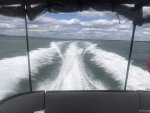
can’t do this on a saily boat :)

791558E0-08F1-4198-8F42-6697D01732EB.jpeg
 
Actually, a couple more.

8. Labelling trim tab controls with useful terms like "port" and "starboard", and "down" and "up"; "down" being at the top of the switch and "up"' at the bottom; and the indicator lights that go down when they mean up, when in fact the opposite is true for every label, is completely perverse, I've read the manual and I know what it does but it's all wrong.
9. Going behind a sailing yacht at a good distance often earns a wave. OK that's good thing.

ah end every boat seems to have them wired up a different way. Bad if you go on different boats!
 
No video of 3 4 or 5 I'm afraid. Shorepower, well at least we know that (a) the strain relief in the connector works; (b) the marina safety trips work; and (c) not very many people got too angry to have their microwaves, BBQs or bacon sandwiches disrupted by the outage I caused. Also probably a good thing that my usual practice of looping the cable round a pontoon cleat saved the pontoon power pedestal.

3 is just a matter of getting used to it I think. The days of sticking the autopilot on and going below for a pee or to rummage around for a pilot book are gone, I don't think I'll be doing much of that. Hitting the swell more or less head on at 30kts caused a certain amount of unintended vertical motion, the first a bit uncomfortable, the second a full half pipe. The wall of water that ensued on landing* mostly entered the boat through the huge sunroof opening so Mrs Scala and I were a tad damp. Some squeaking was audible, and not from the sunroof.

So an instructive day.


* I really don't think an extra 2 degrees on the deadrise would have helped much.
Glad you are enjoying the transition.
Remember folks we have come from sail ( dropped it when family turned up ) .
The deadrise thing .
It’s not a linear improvement .Every extra degree ( mines a huge 23 btw ) has a noticeable improvement on wave / wake bashing .
This is because ( sorry can not exactly remember my infamous book is not with me ) the vertical acceleration is either squared or increased to the power of 3 as the deadrise reduces .
So an extra “2 degrees “ if you sq it or cube it .....will be a noticeable reduction in vertical acceleration.
In simple terms = smoother ride ...goes through rather than over and crashes waves / wakes .

Comes at a price = inc wetted area ...less lift at low speeds = more drag .
So to get round those you need more Hp and lifting strips maxed out .
Hence my 48 has tha same power and size of engines as a Lardy squaddie 58 .

Remember deadrise is just the very stern easily measurable , comparable and visible bit .
The rest gets finer as you forwards so it’s a starting point .....but worth consideration when it comes to wave crushing .

As you flatten the stern you gain more lift , so less drag , less Hp , smaller lighter and the real reason cheaper machinery can be installed .Flatter fuller , beamier aft sections favour more voluminous interiors as well .
So sat at a dock or worse still “ skirted “ at a on shore display like Boot ...no one gives a dam and if you did builders don’t care as the wife’s already seen the interior .

Its when you return later for your 2 nd mobo the technically stuff side becomes interesting.
 
Last edited:
Glad you are enjoying the transition.
Remember folks we have come from sail ( dropped it when family turned up ) .
The deadrise thing .
It’s not a linear improvement .Every extra degree ( mines a huge 23 btw ) has a noticeable improvement on wave / wake bashing .
This is because ( sorry can not exactly remember my infamous book is not with me ) the vertical acceleration is either squared or increased to the power of 3 as the deadrise reduces .
So an extra “2 degrees “ if you sq it or cube it .....will be a noticeable reduction in vertical acceleration.
In simple terms = smoother ride ...goes through rather than over and crashes waves / wakes .

Comes at a price = inc wetted area ...less lift at low speeds = more drag .
So to get round those you need more Hp and lifting strips maxed out .
Hence my 48 has tha same power and size of engines as a Lardy squaddie 58 .

Remember deadrise is just the very stern easily measurable , comparable and visible bit .
The rest gets finer as you forwards so it’s a starting point .....but worth consideration when it comes to wave crushing .

As you flatten the stern you gain more lift , so less drag , less Hp , smaller lighter and the real reason cheaper machinery can be installed .Flatter fuller , beamier aft sections favour more voluminous interiors as well .
So sat at a dock or worse still “ skirted “ at a on shore display like Boot ...no one gives a dam and if you did builders don’t care as the wife’s already seen the interior .

Its when you return later for your 2 nd mobo the technically stuff side becomes interesting.
Flat = most efficient least comfortable on bumps.
The sharper it gets, the more comfortable and less efficient.
A blade is super comfortable but requires infinite power.
Everything else is in between.

What you forget P is that slower is more comfortable too. And most people want more space, less fuel and are happy to slow down over an occasional bump in order to have a happy wife. That is more important than dead rise for most people.

Which is why Itamas are a very niche market. I think it’s great that they have their enthusiasts though.
 
I remember there being a ‘shore power’ cord on one of the ambulance or cars we had.

if you didn’t unplug it before turning the ignition on it would fly out of the vehicle socket at high speed.

Being in the way was painful...

W.
 
Won’t it plop in the water ?
Yes.

And Scala was being a little generous I feel.
I was crewing and the lead wasn’t disconnected.
If you were the skipper who would you blame?

Ok the skipper should check.
But when the crew should know better it’s easy to assume.

So I don’t think he needs a gadget. It won’t happen again.

First time I’ve ever done that as well. Except in my caravan (that I had before i could afford a boat)
 
Top