Sail spilling out of stack pack - lazyjack options

JimC

Well-Known Member
Joined
30 Aug 2001
Messages
1,570
Location
Lancashire
Visit site
When I drop my mainsail it sometimes spills out of the stackpack between the aft and middle lazyjacks. The top edges of the stack pack are stiffened with alloy tubes which are quite strong but do flex under the weight of the falling sail when it lands across them. I do head straight into the wind.

Sail spill.jpg

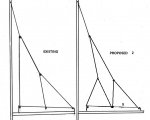
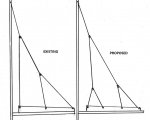
I'm considering modifying the stack pack to have four attachment points for the lazyjacks, like this
Lazyjacks.jpg

But I've doubts about how successful this would be. The existing set-up has the merit that the strongest support is given near the mast where the weight of the contained sail is greatest, with the uplift from the lazyjacks decreasing as you go aft, corresponding to the decreasing weight of the contained sail. The proposed system would divide the uplift from the lazyjacks more equally along the length of the boom, possibly leading to the front of the stack pack sagging.

Any comments or alternative ideas very welcome.
 
Your 4 point system will work - the boom is too long for a 3 point as you have found out. The final falls perhaps should be a bit longer than your sketch suggests.

Just to add, I would not worry about straining the mast end. I have had a 4 point system for over 20 years and when I set it up i adjust the final falls to ensure the support for the top of the back is equal along its length before tying off.
 
Last edited:
I put some on my boat earlier this year (see attached).

They work well and they have the benefit they can be easily tied to the mast when not in use to make hosting the sail easier.

If this looks of interest let me know and I'll send some photos. Meantime have a look at the plan attached. BTW you only need 15 rivets, not the 30 I listed.

lazy-jacks 2.jpg
 

Attachments

  • lazy-jacks.jpg
    lazy-jacks.jpg
    70.7 KB · Views: 1
.... i adjust the final falls to ensure the support for the top of the back is equal along its length before tying off.

Thanks Tranona, where the lines branch into two do you use blocks/rings/thimbles or knot the lines together. If the former I should have thought that adjusting the falls wouldn't make much difference to the distribution of forces as they would re-distribute themselves?
 
Thanks Tranona, where the lines branch into two do you use blocks/rings/thimbles or knot the lines together. If the former I should have thought that adjusting the falls wouldn't make much difference to the distribution of forces as they would re-distribute themselves?

They run through thimbles.
 
I'm considering modifying the stack pack to have four attachment points for the lazyjacks, like this

View attachment 67769

But I've doubts about how successful this would be. The existing set-up has the merit that the strongest support is given near the mast where the weight of the contained sail is greatest, with the uplift from the lazyjacks decreasing as you go aft, corresponding to the decreasing weight of the contained sail. The proposed system would divide the uplift from the lazyjacks more equally along the length of the boom, possibly leading to the front of the stack pack sagging.

Any comments or alternative ideas very welcome.

I made my lazy jacks exactly like your proposed. The connections were stainless rings.

To make raising the main easer and stop the battens catching on the lazy jacks I passed a line from the aft most lower ring through the forward lower ring on each side back to the mast to allow the lazy jacks to be pulled forward to aid raising the main.
 
I made my lazy jacks exactly like your proposed. The connections were stainless rings.

To make raising the main easer and stop the battens catching on the lazy jacks I passed a line from the aft most lower ring through the forward lower ring on each side back to the mast to allow the lazy jacks to be pulled forward to aid raising the main.

Ooh I like that a lot - I don't want the hassle of loosening lazy jack halyards then clearing them forward (they are tied at the second spreaders so no halyard anyway), but pulling a line to get them a bit forward would help a lot.
 
Ooh I like that a lot - I don't want the hassle of loosening lazy jack halyards then clearing them forward (they are tied at the second spreaders so no halyard anyway), but pulling a line to get them a bit forward would help a lot.

You could attach the top of the lazy jacks to the second spreader with some strong shock cord that would allow the lazy jacks to pull to the mast without adjustment needed.
 
You could attach the top of the lazy jacks to the second spreader with some strong shock cord that would allow the lazy jacks to pull to the mast without adjustment needed.

I think I need the lazy jacks to be as non-elastic as possible as there is already a fair bit of movement possible because of the geometry of the system, but thanks for the thought as it would be easy to experiment provided I put the shock cord at the bottom, not the top, to avoid me going up the mast more than once.
 
On my Hanse 341, the stackpack has 3 attachments points. On both the front one and the rear one, I have fastened a short length of shockcord to the lazyjack attachment point on one side with a plastic hook on the loose end. So having dropped the sail. I just attach the hook to the lazyjack on the other side. This stops it blowing out in strong winds.
 
Three or four attachment points depend upon the length of the boom. On my present boat with a short boom (IOR of 1973) I only have three as in your first diagram. However, the aftmost fixing point should not be at the very end because there is not much sail to be gathered at that point. As a crude 'rule of thumb' divide the length of the foot into four equal parts and place your three fixing points at the place where one section meets the next.(*)
I have always used nylon thimbles throughout; they are cheap and cannot harm the sail or the stitching like stainless ones can.

(*) For example, if the foot length is 12ft I would put the attachment points at 3' - 6' - 9' starting from the tack end.
 
Last edited:
It is not quite clear to me from the photo whether the battens are full length or not. My first main had rather soft full length battens and the sail tended to flop, but a change to stiffer battens has helped.
 
I would imagine that the mainsail on my 31 ft hanse is every bit as big as yours & I have a 3 point lazy jack system. I disagree with Tranona as it works perfectly. However, there is no need to take the line to the end of the stack pack as there is no sail there to gather in due to the triangular nature of the sail. The further forward the lines are the quicker the leech clears the line when hoisting so there is a trade ff between angle & sail catching. On my boat the lines catch all the sail on the drop but do tend to catch the leach on the first third of the hoist, unless dead to wind,
 
Last edited:
I'm returning to this thread to say that I did have my stackpack modified to have four attachment points on each side and this has completely cured the problem with the sail spilling out.

Sail spill.jpg
before

4 rope stackpack.jpg
after

Impact Marine of Carnforth did the mods to the stackpack, cost £30.
 
Top