Sadler 'unsinkable' question

fisherman

Well-Known Member
Joined
2 Dec 2005
Messages
19,675
Location
Far S. Cornwall
Visit site
I see these advertised, are they all double skinned? My investigations of foam indicate it has a waterproof skin when it goes off exposed to the air, but when breached it is not closed cell. So what is the filling in a Sadler? Next, how are skin fitting holes sefeguarded? Do they end up soaked, do I get one weighed to see if it's waterlogged?
 
I bought a Sadler 29 in 1987. This design had been around for a few years but was not advertised as unsinkable. The earlier 25s and 32s were conventional and not foam cored. About a year or less after we bought ours they started to say they were unsinkable, though the design and building had not changed. The later 34 and 26 were similar. I have no idea about the actual foam. In my innocence I always assumed it was closed cell but never put it to the test.
 
A friend had a 34 and it got waterlogged in the area just aft of the bow.
He had to cut all the foam out from the inside and rebuild it.
 
I see these advertised, are they all double skinned? My investigations of foam indicate it has a waterproof skin when it goes off exposed to the air, but when breached it is not closed cell. So what is the filling in a Sadler? Next, how are skin fitting holes sefeguarded? Do they end up soaked, do I get one weighed to see if it's waterlogged?

Can't speak for Sadler, but on my MGC 27 the through hulls are placed in areas that aren't double skinned, just solid laminate, same for the keel bolts.
Honestly I can see why the method of construction went out of vogue, it reduces room below considerably, especially stowage, adds weight, and you can't rely on it so still carry a liferaft when going offshore.
 
Can anyone tell me how liw in the water an "unsinkable" Sadler will float ? Seems a bit unlikey to save your life in UK waters if you are chest deep in 5° seawater...

Boo2
 
The Sadler 26 was definitely still completely sailable even if seacocks undone and opened - one of the magazines tested this. The 29 was meant to be similar. AFAIK the 34 was also unsinkable, but I don't think it was intended to be sailable flooded, just still float.

Positives for the foam construction, makes hull stiff, quiet, well insulated, thus minimal condensation. Unsinkability really not that big a plus.

Negatives very vulnerable to idiotic owners screwing or bolting fittings in and not doing a proper job (ie removing foam core and replacing with solid epoxy or other resin) which lets water slowly soak into the core. Serious impact damage can obviously do the same thing but normally the boat then pretty promptly gets lifted out, dried and repaired. The foam is nominally closed-cell but will slowly absorb some water. Also the foam reduces interior volume a bit.
 
The Sadler 26 was definitely still completely sailable even if seacocks undone and opened - one of the magazines tested this. The 29 was meant to be similar. AFAIK the 34 was also unsinkable, but I don't think it was intended to be sailable flooded, just still float.

Positives for the foam construction, makes hull stiff, quiet, well insulated, thus minimal condensation. Unsinkability really not that big a plus.

Negatives very vulnerable to idiotic owners screwing or bolting fittings in and not doing a proper job (ie removing foam core and replacing with solid epoxy or other resin) which lets water slowly soak into the core. Serious impact damage can obviously do the same thing but normally the boat then pretty promptly gets lifted out, dried and repaired. The foam is nominally closed-cell but will slowly absorb some water. Also the foam reduces interior volume a bit.

I agree with this. When I fitted my Yacht Legs I removed pieces of foam that were replaced by the backing pads (shown here http://coxeng.co.uk/cruising/installing-yacht-legs/) The foam was definitely closed cell, which I tested by immersing one weighted piece in water for about a week. At the end of that time there was no absorption of water that I could detect. I did not weigh before and after, it was just a simple check.

The double skin has huge advantages in eliminating condensation in winter. We lived on ours in winter time for up to a week at a time and only the windows created condensation, the hull was totally dry.

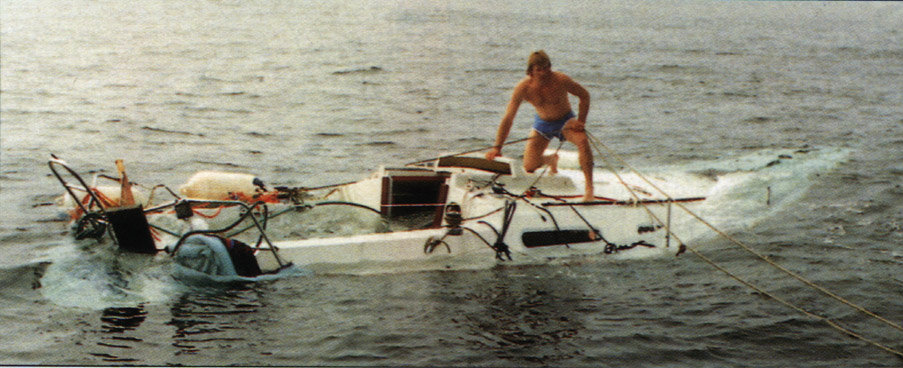
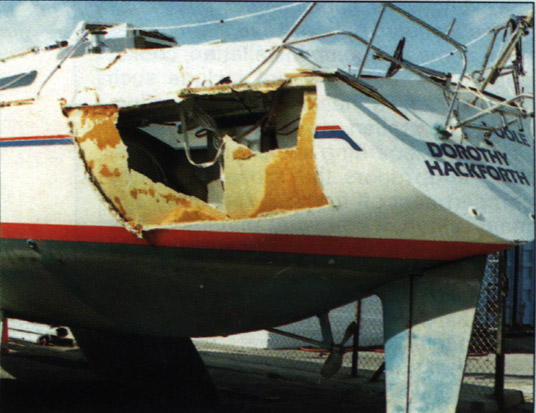
As said, the 26 can be sailed with the seacocks open as demonstrated to journalists when the boat first appeared. There is progressively less foam/displacement with the 29 and the 34, so each will float somewhat lower. The photos show the Sadler 34 Dorothy Hackforth that was in collision with a trawler, certainly not sailable but still afloat despite massive damage. The boat was salvaged, repaired, and AFAIK is still sailing.


I agree with this. When I fitted my Yacht Legs I removed pieces of foam that were replaced by the backing pads (shown here http://coxeng.co.uk/cruising/installing-yacht-legs/) The foam was definitely closed cell, which I tested by immersing one weighted piece in water for about a week. At the end of that time there was no absorption of water that I could detect. I did not weigh before and after, it was just a simple check.

The double skin has huge advantages in eliminating condensation in winter. We lived on ours in winter time for up to a week at a time and only the windows created condensation, the hull was totally dry.

As said, the 26 can be sailed with the seacocks open as demonstrated to journalists when the boat first appeared. There is progressively less foam/displacement with the 29 and the 34, so each will float somewhat lower. The photos show the Sadler 34 Dorothy Hackforth that was in collision with a trawler, certainly not sailable but still afloat despite massive damage. The boat was salvaged, repaired, and AFAIK is still sailing.


Great photo!
 
Top