Sadler 32 - amount of Kiwi Grip needed

eddystone

Well-Known Member
Joined
18 Aug 2013
Messages
1,936
Location
North West Devon
Visit site
Long shot this - anyone used Kiwi Grip on a Sadler 32? Unfortunately I have to order the stuff without having an opportunity to measure up but trying to remember where the non-slip goes on a rough plan of the deck gives me a figure of c.10-11 square metres, but I could be well out. One 4L tin covers 8 square metres so wondering whether 4L + 1L will be enough or 2 x 4L.

(Off white has to be mixed so 1 week delay between ordering and delivery)
 
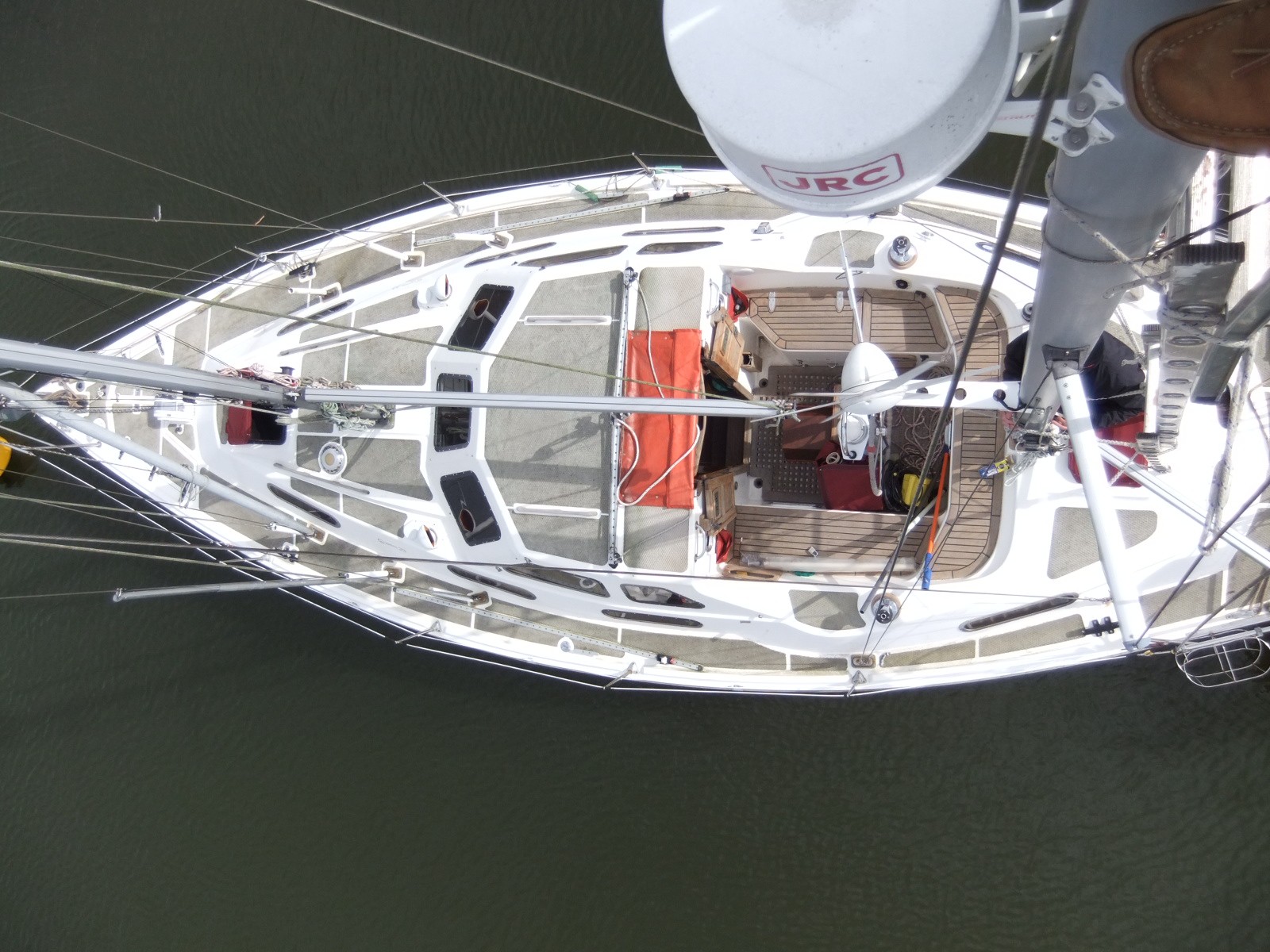
I have a similar boat although a bit narrower (Centurion 32). I use an outdoor paint with very fine sand ("Finetex") bought in a 5-litre pail. Applying two coats to the deck and the coachroof uses less than half a pail so I think that your 4L would be more than enough.
Here is a view from the masthead; perhaps it can help you to compare. That's me in the cockpit.

Ov1zH5H.jpg
 
Long shot this - anyone used Kiwi Grip on a Sadler 32? Unfortunately I have to order the stuff without having an opportunity to measure up but trying to remember where the non-slip goes on a rough plan of the deck gives me a figure of c.10-11 square metres, but I could be well out. One 4L tin covers 8 square metres so wondering whether 4L + 1L will be enough or 2 x 4L.

(Off white has to be mixed so 1 week delay between ordering and delivery)

Yes, did my S32 with off-white Kiwigrip over the summer. I used one 4 litre can but I was rather paranoid about not having enough so possibly put it on a bit thin. However it has adequate coverage and I do have some left over. If I were doing it again I would buy a 4 litre can and a 1 litre can to take off the pressure. I also made some notes of things I learned doing the job which I can post here if I can find them.
 
These are the lessons learned - some worked out myself and some gleaned elsewhere. I did it under a tent on a sunny - and therefore very hot - day.

- I bought two of the specialist texture rollers (one comes free with the can). One was used in the conventional way and one cut up to make three tools for the hard to reach areas. The tools were make by gluing the cut-up bits of roller to suitable pieces of wood using Silkaflex. My most useful one was a piece 15mm x 50mm glued to the end of a short length of plywood.

- I found a four inch brush and a 1 inch brush the best tools for applying the Kiwigrip. I did try a grouting trowel to give an even coverage but that didn’t seem to work well and was another stage which slowed things down. Two square feet at a time was the best area to cover.- I had to press harder with the texture roller and slower (to avoid splashing) than I had imagined. It took me about five minutes to get a good technique and all was well thereafter.

- After 4 hours in that heat (and dryness) I realised the gloop was getting thicker but it was easy to thin with some water.

- Masking has to be taken off with the Kiwigrip wet. The tape is best applied in 2 foot lengths starting from where you will finish with the end furthest away on each length bent over to form a pulling tab.

- An open box - say 2 foot square minimum - is better for dropping masking tape still covered with wet Kiwigrip into than a bag.

- I underestimated the amount of masking as the roller especially in the hands of a tired and over-heated operator is a very blunt instrument. 2 inches of masking as standard would be better (or two overlapping 1 inch strips).

- The sooner the stray bits of Kiwigrip are wiped off (with a water-damped cloth) the better. Immediately is best, within a few days is better, but after two weeks it is quite concrete-like. You may guess how I know this.

- After about two hours the roller began to deposit some small lumps of dried paint. It took a while to realise I should wash the whole roller clean in water, dry as best as possible, then carry on. No problems after that.

- I was a little anxious about how far my 4 litre can would spread. I estimate I had 600ml left at the end. As a result it looked rather thin in places which was discouraging. However I recoated any thin bits the following day and this worked very well indeed and there was no sign of any edges to the second coat. Because the second coat is on an already hardening texture it was not problem to match that texture. I also realised that eventually re-coating the Kiwigrip would not be too difficult.
 
I'm just in the process of stripping off the 30 year old Treadmaster from my Colvic Countess 33 to replace with Kiwigrip.
I've bought a 4 ltr can and hope it will be enough, but if not, I will buy another 4 ltr can as I believe it keeps and I'm sure it will need touching up in the not too dim distant future!

DSCF0154-e1388965909493.jpg
 
These are the lessons learned - some worked out myself and some gleaned elsewhere. I did it under a tent on a sunny - and therefore very hot - day.

- I bought two of the specialist texture rollers (one comes free with the can). One was used in the conventional way and one cut up to make three tools for the hard to reach areas. The tools were make by gluing the cut-up bits of roller to suitable pieces of wood using Silkaflex. My most useful one was a piece 15mm x 50mm glued to the end of a short length of plywood.

- I found a four inch brush and a 1 inch brush the best tools for applying the Kiwigrip. I did try a grouting trowel to give an even coverage but that didn’t seem to work well and was another stage which slowed things down. Two square feet at a time was the best area to cover.- I had to press harder with the texture roller and slower (to avoid splashing) than I had imagined. It took me about five minutes to get a good technique and all was well thereafter.

- After 4 hours in that heat (and dryness) I realised the gloop was getting thicker but it was easy to thin with some water.

- Masking has to be taken off with the Kiwigrip wet. The tape is best applied in 2 foot lengths starting from where you will finish with the end furthest away on each length bent over to form a pulling tab.

- An open box - say 2 foot square minimum - is better for dropping masking tape still covered with wet Kiwigrip into than a bag.

- I underestimated the amount of masking as the roller especially in the hands of a tired and over-heated operator is a very blunt instrument. 2 inches of masking as standard would be better (or two overlapping 1 inch strips).

- The sooner the stray bits of Kiwigrip are wiped off (with a water-damped cloth) the better. Immediately is best, within a few days is better, but after two weeks it is quite concrete-like. You may guess how I know this.

- After about two hours the roller began to deposit some small lumps of dried paint. It took a while to realise I should wash the whole roller clean in water, dry as best as possible, then carry on. No problems after that.

- I was a little anxious about how far my 4 litre can would spread. I estimate I had 600ml left at the end. As a result it looked rather thin in places which was discouraging. However I recoated any thin bits the following day and this worked very well indeed and there was no sign of any edges to the second coat. Because the second coat is on an already hardening texture it was not problem to match that texture. I also realised that eventually re-coating the Kiwigrip would not be too difficult.

wow sensational info for an OP who started with "long shot this..."
 
These are the lessons learned - some worked out myself and some gleaned elsewhere. I did it under a tent on a sunny - and therefore very hot - day.

- I bought two of the specialist texture rollers (one comes free with the can). One was used in the conventional way and one cut up to make three tools for the hard to reach areas. The tools were make by gluing the cut-up bits of roller to suitable pieces of wood using Silkaflex. My most useful one was a piece 15mm x 50mm glued to the end of a short length of plywood.

- I found a four inch brush and a 1 inch brush the best tools for applying the Kiwigrip. I did try a grouting trowel to give an even coverage but that didn’t seem to work well and was another stage which slowed things down. Two square feet at a time was the best area to cover.- I had to press harder with the texture roller and slower (to avoid splashing) than I had imagined. It took me about five minutes to get a good technique and all was well thereafter.

- After 4 hours in that heat (and dryness) I realised the gloop was getting thicker but it was easy to thin with some water.

- Masking has to be taken off with the Kiwigrip wet. The tape is best applied in 2 foot lengths starting from where you will finish with the end furthest away on each length bent over to form a pulling tab.

- An open box - say 2 foot square minimum - is better for dropping masking tape still covered with wet Kiwigrip into than a bag.

- I underestimated the amount of masking as the roller especially in the hands of a tired and over-heated operator is a very blunt instrument. 2 inches of masking as standard would be better (or two overlapping 1 inch strips).

- The sooner the stray bits of Kiwigrip are wiped off (with a water-damped cloth) the better. Immediately is best, within a few days is better, but after two weeks it is quite concrete-like. You may guess how I know this.

- After about two hours the roller began to deposit some small lumps of dried paint. It took a while to realise I should wash the whole roller clean in water, dry as best as possible, then carry on. No problems after that.

- I was a little anxious about how far my 4 litre can would spread. I estimate I had 600ml left at the end. As a result it looked rather thin in places which was discouraging. However I recoated any thin bits the following day and this worked very well indeed and there was no sign of any edges to the second coat. Because the second coat is on an already hardening texture it was not problem to match that texture. I also realised that eventually re-coating the Kiwigrip would not be too difficult.

Absolutely brilliant - thank you so much. I've been expecting to have to build a tent to do this in March but the process of fitting new engine has dragged on so should be able to get a few dry days to do it in the open.
 
Also, I would definitely buy you a drink (s) if we should meet up - boat lives at Cargreen on Tamar and I can also be found trying to get to grips with my wife's Flying Fifteen at Draycote Water
 
Absolutely brilliant - thank you so much. I've been expecting to have to build a tent to do this in March but the process of fitting new engine has dragged on so should be able to get a few dry days to do it in the open.

You're welcome.

Doing it without a tent would be preferred unless it is raining. It is nowhere near as delicate an operation as painting two-pack on 'gloss' areas.

One further tip for the S32. Being right handed I found it easier to work clockwise round the boat in two circles. The first turn was to do the coachroof (while standing on the untreated side decks) and the second circle to do the side decks.

Good luck!
 
Also, I would definitely buy you a drink (s) if we should meet up - boat lives at Cargreen on Tamar and I can also be found trying to get to grips with my wife's Flying Fifteen at Draycote Water

Ha ha ... thank you. We do seem to be living parallel lives with the S32 so meeting up will probably be an inevitability at some point!
 
Top