S/S wire: today I have been mostly making

I have made dozens of those "nappy pins" from 3mm stainless steel wire/rod.

could be used as a quick release locking pin for rigging clevis pin.

Can also be made from TIG welding wire 1.6mm dia

My life raft retaining pins are locked with 2 of those spring pins.


36086035985_e14622e7ca_c.jpg
 
Last edited by a moderator:
Nappy Pins have fallen out of favour as they are unreliable. This is because they are prone to snagging and have poor resiliance against springing open and subsequently falling out. They still get used in static situations where the risk of snagging is low but drop nose pins are even taking over from those. I have spent a lot of my career looking at pins on structural rigging where nappy pins have been used and are now missing. There are more reliable and secure solutions.
 
Prone to snag, yes, spring open, don't think so. It's very very stiff. Remember this wire is designed to pull and push engine controls.
The dimensions, length, depth of hook, can be changed to make it stiffer/easier as required.
That one is to attach the boom on a dinghy rig.
 
I have made dozens of those "nappy pins" from 3mm stainless steel wire/rod.

could be used as a quick release locking pin for rigging clevis pin.

Can also be made from TIG welding wire 1.6mm dia

My life raft retaining pins are locked with 2 of those spring pins.


36086035985_e14622e7ca_c.jpg
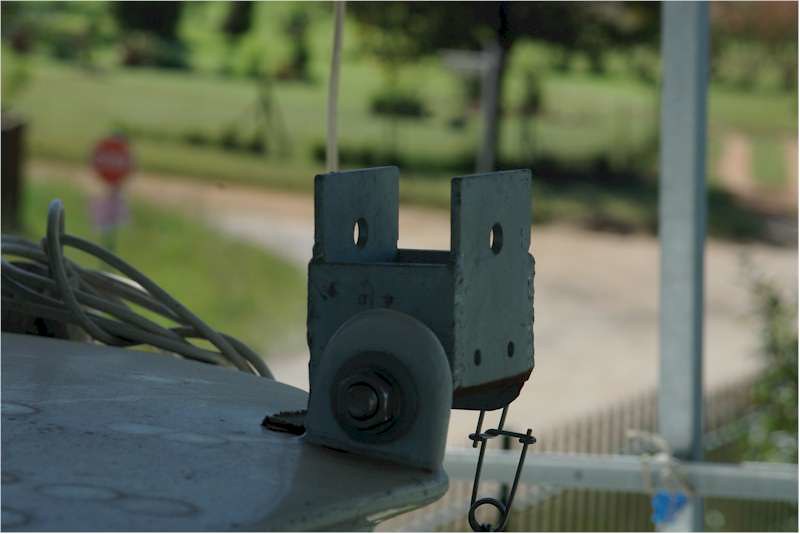
Don't want to nit pick, but a downward pull on the twine at the bottom will open one of them.....
 
Prone to snag, yes, spring open, don't think so. .............

They do when snagged, which is why they are more or less universally banned in dynamic lifting applications. Sure, they don't spring open in a static application.
 
I had an unhappy experience with a carbine hook. Attached to an eye on a steel hatch, it laid flat, then rotated so one side of the eye pushed it open. Dropped the hatch on my head......it weighed about 50kg.
My daughter did exactly the same with her (£3500) saxophone, dropped it on the floor.
 
Moving on - what is the wire in a morse cable.

I've been looking for a cheap source of a HT stainless - hard drawn.

Are the innards of a Morse cable suitable?

Jonathan
 
Don't want to nit pick, but a downward pull on the twine at the bottom will open one of them.....

The lower one is only there as a spare and has no twine on it.

This is a retainer for an mast lowering frame and will only have a small shear load on the in the pin through the pivot bar behind the pivoting bracket.
 
Moving on - what is the wire in a morse cable.

I've been looking for a cheap source of a HT stainless - hard drawn.

Are the innards of a Morse cable suitable?

Jonathan
No idea. Find a fisherman, or a fish quay skip, they break several every year. Or buy a short cable and break it. I used it to seize very big mooring shackles and no deterioration over three years and still there as far as I know, with someone else.
 
Trying to assess stiffness: I have a 1300mm length. At rest an arc of 700mm dia. I coiled it to a 150mm dia, it resumed at rest 650mm. As you'd expect, designed to be springy, they give a warning about undoing them when new.
 
I use an old Morse inner wire with a narrow loop in the end as a mouse for shoving through conduits to pull new wires through. Ideal for the job.
 
I think someone mentioned it on here and it was nice to know that I'm not the only one that retrieves the ss stiffeners from dead wiper blades. V handy stuff.
 
Top