Rydlyme application to a Volvo D4? How??

kennyh

Well-Known Member
Joined
18 Jun 2006
Messages
378
Location
Firth of Clyde / West Coast Scotland
Visit site
Hi all

I'd previously posted that my Volvo D4-260 was prone to rising operating temperature at full throttle (so time ago) but I was hoping that a good service and change of coolant may resolve the issue.

It appears that my wishes have been ignored and the engine now shows the temp rising to 93-95deg when run at max (3500rpm) for more than a few minutes. It does return to 85deg when at 3200rpm, so not a catastrophe.

I do think it is now time to do a de-scale and have been looking at using Rydlyme to do the cleaning to the heat exchangers.

So, the question is has anyone done he same procedure to a D4(260) and can offer advise on how I should do the setup for connecting the circulating pump, hoses and Rydlyme tank to circulate the cleaner through the raw water system?

Cheers
Kenny
 
I have recently carried out this work on my D6's. All i did was close raw water sea cocks, open sea water filters place funnel with hose directly into raw water feed pipe to the engines (in top of raw water filter) then got the mrs's to start that engine and I poured Rydlyme in until it starts coming out of the exhaust (approx 10 litres). Stop the engine, close up the raw water filter and leave for about 4 or 5 hours. Repeat on other engine.

then just start the engine and watch the muck come out, make sure you run the engines for a while to flush all the Rydlyme out.
 
Hi kennyh, did mine last year,remove the impellor replace back plate, replace the raw water pipe with similar pipe i reduced this pipe to fit inline pump,remove water injection pipe from exhaust outlet, extend this pipe so that it can reach a bucket.put rydlime
in the bucket with some fresh water,connect a pump to the pipe from the water pump, this will circulate the rydlime around every part left mine running about 3 hours, i also removed the exhaust elbow and placed that in the bucket, everything came out lovely and clean. my engine was 260 inboard not sterndrive hope this helps
 
I did mine ,not Volvo but principle should still be ok I would have thought, by buying 2 of these reducing hose connectors ( this link is just an example of what I mean) http://www.pondkeeper.co.uk/oase-universal-union-connector/p522?gclid=CNKMg9vX0s0CFesV0wodDXcCOw.

I took off the inlet hose after the impellor and connected a reducing connector and then disconnected the final hose leaving the system after all the heat exchangers( coolant, intercooler and oil cooler) and fitted another reducer connector to that hose too. To each reducer I connected some water pipe from ASAP http://www.asap-supplies.com/hose/bilge-pump-hose and joined the inlet one to to a 12v pump http://www.asap-supplies.com/rule-il280p-inline-transfer-pump-306555 which sat in a bucket of Rydlime and the other from the exit hose straight back into the bucket.Turned the pump on and allowed it to circulate for a few hours.Job done. Hope that helps.
 
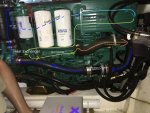
I did something similar with my D4. First I shut the raw water seacock and drained the raw water from the system. I connected my Rydlyme input by disconnecting the pipe exiting the raw water pump so by passing the impeller. The Rydlyme then circulated through the heat exchangers for fuel, freshwater coolant, oil, turbo intercooler and finally ATF. The exhaust injection was difficulty for me to access so I took the Rydlyme out of the system as it came from the ATF heat exchanger and back into my bucket.
My Rydlyme was pumped from the bucket using a 12v cheap (£9) diaphragm pump off ebay. It pumped about 3L/min. I left it circulating for three hours.
The Volvo raw water hoses are big so I made reducers with wooden bungs to fit the raw water hoses, the bungs drilled centrally to snug fit garden hose which fitted the 12v pump.
Don't forget to take out your anodes in the intercooler and main/freshwater heat exchanger . Rydlyme will dissolve them !
 
Thanks all

The one thing I've not got my head around is the raw water flow sequence in the D4. ie After the raw water pump does it flow through the inter-cooler and then on to the oil cooler / block cooler?

And has anyone got a diagram that shows the inlet/outlet hose connection for a stern drive?

Sorry if the questions make me sound like a complete novice, but the Volvo D4 is relatively new to me and I've got limited access space around the engine to get a good look at all the connections.
 
On a shaft drive D4 the raw water sequence is as in my description. From sea cock to impellor then heat exchangers for fuel, fresh water coolant, oil, intercooler, reverse gear oil (ATF) then injected into exhuast gases and expelled
 
image.jpg
On a shaft drive D4 the raw water sequence is as in my description. From sea cock to impellor then heat exchangers for fuel, fresh water coolant, oil, intercooler, reverse gear oil (ATF) then injected into exhuast gases and expelled

Well I needed to get my head round the flow and I think I've sorted it out after looking on the cooling system / parts schematics online.

On my installation D4-260A-B with DPH stern drive, I think the sequence is:

- Inlet from leg
- Hydraulic cooler
- Raw Water pump
- Strainer
- Fuel Cooler
- Intercooler
- Fresh / Raw Heat exchanger
- Oil Cooler

I was confused by the fact that both the Intercooler and Heat Exhangers have inlet/outlet on the same side/ endcap. i.e For each cooler one of the two end caps has both the inlet and outlet connections, and the water flows down half of the internal pipes of the cooler in one direction, and then returns down the other half of the internal pipe matrix.

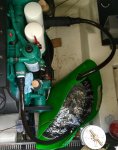
I made myself a quick (and very rough) annotated pic to show the water flow and sequence.

Please do let me know if I've got it all / slightly wrong. Happy to be corrected.
 
I don't know your engine, but if there are any anodes make sure you remove them before using Rydlyme cos it will dissolve them! It's excellent stuff btw, I've been using it for years. It's much more effective if you can keep a constant flow rather than just letting it sit in the engine.
 
Anodes out plugs ( Brass anode carriers without the anode) back in.
Remove impeller.
Use a 12v pump, possibly a diaphragm pump and a large plastic box to suck from and return to
by the seawater strainer return from by the injection bend.
You may need to restrict return to ensure the engine fills up with solution rather than not hitting the highest points of the system.
The plastic box needs to be quite big to ensure you have enough room for foam which dissipates when it returns to the box.

When it appears to be spent introduce fresh Rydlyme.

You can do two engines in series.
 
Use a 12v pump, possibly a diaphragm pump and a large plastic box to suck from and return to
by the seawater strainer return from by the injection bend.

Sorry Bandit, I don't understand what you mean in the above - which points/connections should I use as the tap in points?

I was going to use the main hose after the hydraulic cooler as the "in" point and connect a hose to the outlet from the fresh/raw heat exchanger as the "return" point and feed them both to the bucket (with the diagram pump on the "in" hose connection.
 
Use the line from the sea strainer to the coolers for your supply line

Remove the impellers.

Use the final line from one of the coolers ( oil?) that goes to the injection bend, remove that from the engine end and use another hose from the fitting back to the plastic container.
 
Use the line from the sea strainer to the coolers for your supply line

Remove the impellers.

Use the final line from one of the coolers ( oil?) that goes to the injection bend, remove that from the engine end and use another hose from the fitting back to the plastic container.

Thanks, got it now.

Andy59, thanks for the link to the vid. Very useful.

Right I just need to organise the hose reducers /connectors and then get the finger out!
 
Thanks all for your comments; job is now done.

I made up connectors with some PVC pipe, a lot of self-amalgamating tape along with some rubber hose I purchased (45mm ID hose on the return from the block).

I removed the strainer and connected into the system before the fuel cooler. That way there was no need to remove the impeller.

Now it's just down to a trial run to see if the rising temp problem has been fixed. Weather here has been very poor this weekend, so I'll have to wait until next weekend. Fingers crossed!
 

Attachments

  • image.jpg
    image.jpg
    92.8 KB · Views: 45
Top