RYA courses advice

I guess that the approach has always been to teach how to do it without data and electronic sources so that people know what to do when they fail.
When I did DS theory I never did get a sensible answer as to how I could follow a depth contour if my electronics, ergo sonar, had failed. Swinging the lead not such a good option when single handing in 100’+ of water…
 
I would sort out the VHF asap.Get your partner on it too .I understand it’s a legal requirement all over the Med .
If you are stopped it’s one of the things on officialdom s tick box list .
They might fine you without a VHF license.

A guy came round to our house 2005 and suggested the wife sit in .We both got certified about 2 hrs later .She’s never picked up a handset since but her cert is in a file on the boat for all to see .

As far as RYA stuff i future proofed my qualifications and retrained doing a French permit d Mer .I had RYA stuff .
Just thought one day ( I was right re brexit ) U.K. peeps permanently keeping a boat in the EU might require to follow local rules .
This is different to passing through on a passage in which your home RYA stuff is acceptable.
Its a grey area and the RYA ain’t gonna kill it’s cash cow of courses and obviously the vast majority of guys on here with boats permanently based in the EU don’t want to hear me making this point of order .
Nor does the marine industry of the Balearics want to see a Brits exodus if Madrid applied the letter of maritime law .

But if you have a blank canvas and speak the local language ( or find an English instructor ) then do the local qualifications.

There was a thread on here a while back from a Eng guy on a Greek island who had a rib for 20 yrs same berths etc and got fined after brexit by GR officials for not having proper GR qualifications.His ICC cut no ice .The cash strapped GR saw fining Brits with only RYA bits of paper permanently keeping a boat in there waters ,a low fruit cash generator .
 
Last edited:
This is a really helpful discussion for me. One course that would be extremely helpful would be an electronics course on the systems. Is there such a thing? There's a lot of functionality with the Raymarine systems today, and so far I've used the chart plotter and setting waypoints to follow with the auto pilot.
That's a good point that I've always made when discussing courses.
I'm a bit of a "geek" when it comes to the boat's electronics.
Even if the courses did cover the electronics, there is such a range of features within your own system that any course could not cover all the features.
That said, IMO, the most useful feature of any nav system is the ability to move the cursor on a plotter to t he place you want to go and then select "go to cursor". Then a feature to enable the autopilot to go to that same position. Like you, we have Raymarine which does just that. Our Raymarine system is a more sophisticated G series system but it is, conceptually, the same as yours. Garmin's systems have very similar functions.
Initially, I used to create waypoints and routes which worked well but after a few years cruising the Med the KISS principal seems to be the most appropriate way of using the kit.
So, to recap, just put the cursor where you want go go and press "go to cursor". Of course make sure you won't hit anything or go into too shallow water on the way but I put that down to common sense.

Finally, you need go understand how your system works whilst you are underway to your selected cursor position. Let's say a ship appears to be on a collision course with you and you need to disable the autopilot until the ship is clear. On Raymarine, you reset the cross track error and restart the autopilot. Raymarine remembers the position of your original cursor selection. However, my experience of Garmin is that you have to go through the whole process of setting your cursor again. That might have been rectified in more recent Garmin firmware upgrades.

So, that's all you ACTUALLY need for navigating around the Balearics but whilst underway, there is generally plenty of time to play with t he kit. AIS, if fitted, is a good thing to get your head around. Select a target on the AIS and work out your CPA (closest point of arrival) think of is as the "crash point" - just make sure you aren't at the crash point at the CPA time!!! Some systems are better at displaying CPA. Raymarine CPA works but I prefer to use a completely separate system for AIS - OpenCPN which is a free plotter navigator software that runs on a PC, Lzptop or Android device. I have mine on the "ships PC" and fed to my Raymarine displays but that solution is a bit extreme.

EDIT
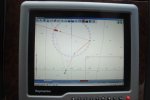
This is a pic of one of my Raymarine monitors showing an OpenCPN display.
We are the red vessel.
You can easily work out from that display that we will be past the "crash point " before the green target gets there.
If you want to know more about OpenCPN - just ask.

DSC06024().JPG
 
Last edited:
This is a really helpful discussion for me. One course that would be extremely helpful would be an electronics course on the systems. Is there such a thing? There's a lot of functionality with the Raymarine systems today, and so far I've used the chart plotter and setting waypoints to follow with the auto pilot.
The best way to learn your electronic toys is to use them every time you’re out, play with them when conditions are good so you understand what they are telling you and how to access the most useful functions. Coming back from a trip on Tuesday night I hit a real pea souper sea fog and had to navigate a tricky bit of water in less than 20 yards of visibility. Not fun but because I am used to using all the toys I made it home without incident. Was a bit like playing a video game but with more serious consequences if I got it wrong :eek:

0BA397B6-F189-4A0D-8B2B-695A0076C1C0.jpeg76111378-5B51-4812-B023-750DE9219B74.jpeg
 
Top