running engine with coolant cap loose/broken volvo MD2030

TactilePaul

Well-Known Member
Joined
18 May 2017
Messages
100
Visit site
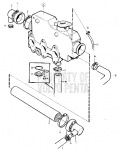
HI, so my Step Mother is in Alderney with a Volvo MD2030 loosing water, she has discoveredPHOTO-2022-06-02-13-13-55.jpg that the 'radiator cap' is corroded , or rather the metal surrounding it, it has an auxiliry expansion / filling point and of course a loop to the HW cylinder.
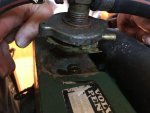
My Question, seeing as they are on a rock, is, Would it be ok to run engine like this, if someone keeps topping up through the broken cap?, or is there pressure here that will pump the water out?
They are trying to get it sorted whilst there, but also making plans for possible sail home maybe just using engine for last 5 mins, another question, how long till a diesel overheats with no coolant????

any help appreciated,
Thanks.
 
Pressure raises the boiling point basically, if a system doesn't hold Pressure it is more likely to run hot.
Alot of motors will only perge out a certain amount of water, others will keep gaining heat and force to much out.

It is far from ideal, if it was a short trip with plenty of places to stop if things go bad the trip would be low risk. Imo.

I would look at getting a new neck braised in if it were me, or if stuck out of repairs reach, i would find a way of capping the hole like strapping a rubber bung onto the radiator with the strap going from the base over the bung and down to the base again.
 
Also consider where hot coolant would go if it does boil over - the alternator is below the heat exchanger and might cause problems if drenched while running.
The bung idea as proposed by Aussie Farmer could work but might need quiet a lot of ingenuity to get it to work properly.
I had a broken pressure cap on a expansion tank on a car once and found it impossible to fashion a bung sufficient to contain the pressure, but I had limited materials and I definitely am not one of those people who are good at fixing things.
 
I had a similar issue on my MD2040 some years ago, where the filler cap neck detached from the heat exchanger housing completely as I was un screwing it to check the coolant level.
On examination it was clear that corrosion had been an issue for some time as the neck had been breached at least two thirds the circumference, before it finally gave up.

My point is that I had been using the engine for some time and frankly had not had any over heating issues or noticed any drop in the coolant level.

A VP engineer informed me that this was a common problem with this range of engines and that the engine ‘can’ run without the pressure cap in place or in our case knackered and unable to seal. Yes ideally pressure should build allowing for a lower boiling point and this is better for the engine, but without the pressure cap, the engine would run up until it reaches temperature - obviously not boiling - expanding the coolant to a certain level and provided the engine is run at lowish revs and not WOT then you could use it to get you home, within reason.

I clearly had been using the engine and for some hours with a faulty pressure cap and had not had an overheating issue, so I suppose that the VP engineer was right.

Hopefully this may offer some reassurance? Best of l
 
Why not just a normal car cap?disconnect it & use a normal cap. Blank the other return end from the hot water tank with a tapered plug & jubilee clip.It might take the side strain off the fitting.
For hot water just boil a kettle over the gas.
nothing much wrong with the cap...
 
nothing much wrong with the cap...
I take the point, but the weight of the pipe on top will be pulling sideways. Especially with engine vibration. You could bend the lugs a bit on a plain cap, perhaps by hammering them in to reduce the diameter, to get it to grip whatever is remaining & get it to hold for a short while. You might get some more rotation on the cap to grip a more solid bit of the rim. You can then get to a place where a proper fix can be sorted. A cheap cap can be bashed about for a trial & you will be little worse off (a couple of £ sobs perhaps) later down the line if it does not work. If one does not experiment one will not know. Take the hose off the cap you have, open the lugs up a bit & see if you can rotate it a bit to locate a bit of the rim where it has never engaged before. that may still be solid enough to hold
 
Last edited:
My MD 2030 blew its cap and seating right out of the heat exchanger whilst I was motoring across Lyme Bay. I realised something was wrong due to a slight hissing sound but motored at my usual 2,000 or so rpm for several hours before having the chance to properly investigate. The engine suffered no damage at all, unlike my wallet as a new heat exchanger was the best part of £2k. The engineers were sceptical about refitting the brass seating into the aluminium heat exchanger.
 
My MD 2030 blew its cap and seating right out of the heat exchanger whilst I was motoring across Lyme Bay. I realised something was wrong due to a slight hissing sound but motored at my usual 2,000 or so rpm for several hours before having the chance to properly investigate. The engine suffered no damage at all, unlike my wallet as a new heat exchanger was the best part of £2k. The engineers were sceptical about refitting the brass seating into the aluminium heat exchanger.
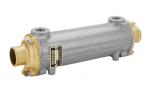
Is it not possible to junk the Volvo H/E and fit a 3rd party one?
For at least 32 years and I suspect since new in 1986 my MD17D has had a Bowman H/E bolted to the bulkhead next to the engine with a header tank ( plastic ) mounted on the bulkhead above it. I think the Bowman I have - designed for oil cooling - currently costs about £500.
Mine looks like this https://ej-bowman.com/wp-content/uploads/2020/08/MARINEOIL-EC120-890-3-scaled.jpg
 
Tried the JB weld quick fix and it just didn’t work and as mentioned by chrisD a replacement heat exchanger casing is prohibitively expensive. Ended up cleaning up the remaining aperature back to clean alloy and then affixing a machined flange around it with a gasket and sealant between. The flange had been predrilled with five holes to screw it down and I got a local garage welder to weld a new neck into the flange that would take a new pressure cap. Tapped into the alloy HE casing - carefully - then basically screwed the flange and neck down onto the gasket onto the HE casing - again carefully - until the whole fixture was rock solid.
This was about six year ago and it’s frankly a much stronger fitting than it was before. No leaks and all good.
I’ll try and take some images if I can.
 
Bowman hx is an option if you aquire or make a non marine exhaust manifold.

Never been a great fan of manicoolers where they are avoidable, the advantage is of course it reduces engine room temperature and make the machinery safer to be around especially in a cramped yacht engine space.

So technically doable but there's drawbacks.

On the other hand the bowman hx are durable well made and ubiquitous, so there's also advantages
 
Top