Rule 17 -- Vid of a close encounter....

We're trying to avoid collisions here - that's the only consideration, and AIS combined with a VHF call to the other vessel when 5NM miles away is pragmatic, prudent and safe.
Surely if you are 5NM away you don't need to call anyone on VHF you can just make an alteration of course. Or are you calling to try and influence the other vessels actions.
 
Surely if you are 5NM away you don't need to call anyone on VHF you can just make an alteration of course. Or are you calling to try and influence the other vessels actions.
As a stand on vessel it is prudent and safe to keep your course until it is clear that the other vessel is not taking the correct action as required by the Regulations and a collision is likely.

Calling the "give way" vessel up when 5NM away after an AIS CPA of <0.5nm to ensure:
1) they have seen us and
2) will take avoiding action

is not influencing other vessels' actions.

If the advice is for every vessel to alter course when on a potential collision course (at 5NM), irrespective of rights of ways is a recipe for disaster. Because then there are no rules.

It would also make crossing the shipping lanes in the English channel in a small yacht that is sailing almost impossible.
 
Last edited:
...and that MGN emphatically doesn't say "Never use VHF for collision avoidance.".

I never have, but it doesn't take much imagination to come up a scenario where it could help and couldn't possibly hurt.
I think we are agreeing! But others in this thread seem to think that the MGN is saying this, and have quoted the MGN in full to disagree with my approach which is simply:

1) If an AIS target has a CPA of <0.5NM AND is around 5NM away AND I am the stand on vessel then
2) I call up the said vessel on VHS to ask their intentions and request them to alter course.

It appears that 2) in this approach is causing difficulties to some forum members, because the MGN is implicitly critical of using VHF to avoid collisions.

On all the occasions this has happened only 1 vessel refused to take action. We altered course when we were closer (1.0NM) to avoid any risk of a collision.
 
No mention of location or context re Narrow Channel, Fairway, TSS ect. Requirement to "not impede" Well past the point off.
My suspicion would indeed be a narrow channel situation. They tend to lead to such encounters.

Some experts apparently. Don't approve of altering to Port. My opinion in this case by far the safest action to take. When confronted with a give way vessel which is apparently not giving way in sufficient time. It is much safer and a much better recommendation to turn away from the give way vessel rather than towards the giveaway vessel.

An engrained habit, from the specific cases* the Rules proscribe. Even so, here the ship altering to port would have been unwise for those very reasons: the geometry is the same as a crossing situation.

Surely if you are 5NM away you don't need to call anyone on VHF you can just make an alteration of course. Or are you calling to try and influence the other vessels actions.

In open water (i.e. not in the Solent or other confined space like a TSS), I grow concerned if a ship has not altered by that point. Being slow, my ability to open up the CPA starts to become very limited. It also becomes more disruptive if the table is set or there's a pot on the stove. Here calling the other vessel allows time to gather information whilst still preserving time to act.

In confined spaces things are quite different, and you can expect to be in much closer proximity. I think it's important to treat the two separately.

* Restricted visibility, and for the stand-on power vessel in a crossing with another power vessel.
 
...and that MGN emphatically doesn't say "Never use VHF for collision avoidance.".

. . .

I think we are agreeing! But others in this thread seem to think that the MGN is saying this, and have quoted the MGN in full to disagree with my approach which is simply:

Can you give any examples of others in the thread suggesting or implying one should never use VHF for collision avoidance?

T'was I who quoted MGN (though, contrary to your assertion, not in full). I certainly have neither said nor thought that one should never use VHF for collision avoidance. I think one should avoid using it as a matter of course - evidence shows it can lead to accidents and, as others have pointed out, in crowded waters ships' crews may already have their hands full - and that seems consistent with the Guidance.
 
... Some experts apparently. Don't approve of altering to Port. ...

Perhaps there is confusion over who should not turn to port.

The stand on power vessel should not alter course to port to avoid a collision in a crossing situation with another power vessel, which is probably the point being made by the "experts" you refer to. This is because the give way power vessel may suddenly turn to starboard to avoid a collision in preference to turning to port. Why? Because Rule 15, for motor vessels crossing, state that if the vessel is on your starboard side (tip, you see a port light, red, stop), it is the stand on vessel, and as a give way vessel should not try and cross ahead (if a risk of collision exists), which means as give way, it could turn to starboard to comply, but if the stand on, then decides to turn to port, a bad situation, that was recoverable, has just increased the odds of colliding, and might not be recoverable.

I agree that the sailing vessel tacking to port was the correct manoeuvre to avoid a collision in the context of what the video shows.

IRPCS RULE 15 CROSSING SITUATION

When two power-driven vessels are crossing so as to involve risk of collision, the vessel which has the other on her own starboard side shall keep out of the way and shall, if the circumstances of the case admit, avoid crossing ahead of the other vessel.
IRPCS RULE 17 ACTION BY STAND-ON VESSEL

(a)

(i) Where one of two vessels is to keep out of the way the other shall keep her course and speed.

(ii) The latter vessel may however take action to avoid collision by her manoeuvre alone, as soon as it becomes apparent to her that the vessel required to keep out of the way is not taking appropriate action in compliance with these Rules.

(b) When, from any cause, the vessel required to keep her course and speed finds herself so close that collision cannot be avoided by the action of the give-way vessel alone, she shall take such action as will best aid to avoid collision.

(c) A power-driven vessel which takes action in a crossing situation in accordance with sub-paragraph (a)(ii) of this Rule to avoid collision with another power-driven vessel shall, if the circumstances of the case admit, not alter course to port for a vessel on her own port side.

(d) This Rule does not relieve the give-way vessel of her obligation to keep out of the way.
 
2) I call up the said vessel on VHS to ask their intentions and request them to alter course.
An interesting suggestion (that comment is code for something!)

Personally if circumstances really dictated that it would prudent to call another vessel I would never ask them to alter course. I would be asking them what their intentions were..

PS in my 50 plus years of boating I’ve only called another vessel regarding IRPCS twice. The last time was to point out to a ship that I was motor sailing (and hence a power driven vessel) and would be altering course to avoid him. (My motor sailing cone was obscured from his view by our genoa.)
 
Oh the irony!

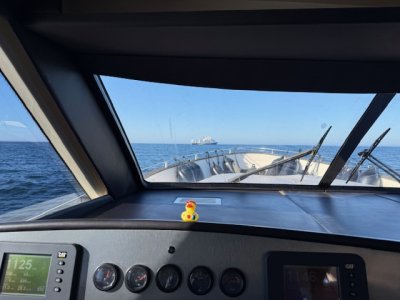
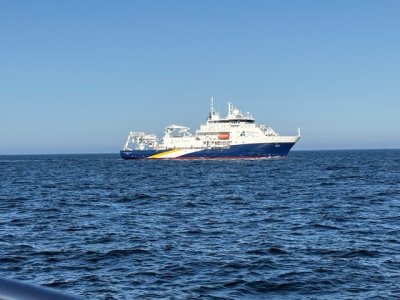
I’m currently on passage between Weymouth and Gibraltar and I’ve just passed South of Oussant. There was French ship on my port side and I wondered what he was doing as he was getting closer and showing no signs of altering and was changing course in a rather bizarre way.

Anyway, he called me up saying he was a survey vessel and if possible he would prefer not to alter course and could I help please? As it happens I spent a very happy year a little while ago working for the UK hydrographic office on their survey ships and I’ve got a slight inkling as to how complex their procedures are and of course I was very happy to oblige. I initially turned to starboard thinking we were going much faster and I’d get ahead of him, but our speeds were fairly closely matched so I did a 360 and came round behind him.

No day shapes to show that he was restricted by his surveying! Don’t you love the French…

IMG_8623.jpeg

I then went up to the fly bridge to take a better shot.
IMG_8624.jpeg

So that’s the third time I’ve used VHF. for collision avoidance.
 
An interesting suggestion (that comment is code for something!)

Personally if circumstances really dictated that it would prudent to call another vessel I would never ask them to alter course. I would be asking them what their intentions were..

PS in my 50 plus years of boating I’ve only called another vessel regarding IRPCS twice. The last time was to point out to a ship that I was motor sailing (and hence a power driven vessel) and would be altering course to avoid him. (My motor sailing cone was obscured from his view by our genoa.)

Calling to point out you were motoring.
This strikes me as a very good point. If motoring with a sail up. A vessels status re stand on or give way. Could be appear ambiguous, confusing or just plain wrong to another vessel. Clarifying your status and intentions probably appreciated.

Otherwise, I've never really felt the need to use the radio to call. Just make my actions obvious or readily apparent to the other vessel.
Although I did have an old handheld tuned to the VTS channel I often kept in the cockpit and found quite handy. Unfortunately the transmit button was NFG.
My recent sailing. Far from the maddening crowd. Only a couple of other vessels, A minke, some gannets, some porpoise and a couple of Sea Eagles. They are quite big.
 
Last edited:
... If motoring with a sail up. A vessels status re stand on or give way. Could be appear ambiguous, confusing or just plain wrong to another vessel. Clarifying your status and intentions probably appreciated.

Or displaying the cone, apex down, day shape for motor sailing would likely make matters clear for other vessels, without VHF interventions. At night, motoring lights would be shown, not sailing lights.

The IRPCS are quite simple and in my experience, actions are clear enough, in most situations, without VHF contact. Post number 250 is a good example of none compliance by the survey vessel, assuming it was restricted in manoeuvring by the survey equipment.
 
Last edited:
The IRPCS are quite simple

And that's why there is no need for court cases to determine what they mean and IRPCS questions on the Internet are quickly and succinctly settled with everyone's agreement. Nobody can ever make any money selling a book on their meaning or even sell an RYA course explaining them because they're so clear.

Contrast them to the RRS. The RRS are updated every 4 years, each time becoming clearer and clearer. (Including one complete rewrite.) Night and day difference.

The IRPCS are a bloody mess of weasel words, non existent definitions and unwritten assumptions.
 
Or displaying the cone, apex down, day shape for motor sailing would likely make matters clear for other vessels, without VHF interventions. At night, motoring lights would be shown, not sailing lights.

The IRPCS are quite simple and in my experience, actions are clear enough, in most situations, without VHF contact. Post number 250 is a good example of none compliance by the survey vessel, assuming it was restricted in manoeuvring by the survey equipment.
Yes, Sometimes these things just get forgot.
No point in getting all bent out of shape about it. Until someone loses an eye.
Some years ago I saw a ship in an unusual location, Thought I wonder what he is doing over there. For some strange reason I had the radio on.
Turns out they had just run aground. There was all sorts of fuss about it, Radio calls tugs and oil spill response vessels(fortunately not required)
They never did put the shapes up. Or turn the running lights off until the next day.
I suppose they had other things on their mind at the time.
It is also possible, It may not actually have fully qualified as restricted. Even so alteration may have messed up the run, requiring a do over. However why not cut a working boat a break? Particularly if they ask nicely.
 
However why not cut a working boat a break? Particularly if they ask nicely.
I was very happy to give the survey ship a break. However if he’d put day shapes up indicating he was surveying he wouldn’t have needed to call me up!! He was very polite though.

There must be something in the air around here as we’ve just had another incident. A moderate size tanker was coming from our port side. We were stand on vessel and the cheeky so and so called us up and asked us to get out of his way. Of course we obliged but…
 
I was very happy to give the survey ship a break. However if he’d put day shapes up indicating he was surveying he wouldn’t have needed to call me up!! He was very polite though.

There must be something in the air around here as we’ve just had another incident. A moderate size tanker was coming from our port side. We were stand on vessel and the cheeky so and so called us up and asked us to get out of his way. Of course we obliged but…
Is a survey ship entitled to "restricted in ability to manoeuvre"? Prefer not to is not the same as can't
 
I had 2 interactions today. Couldn’t be arsed to get the jib out, loads of tide propelling us to our objective, so we sailed on just the main with the engine on idle, to assist us through the tacks. Cone displayed. Crossed a Trinity House ship, properly under way, he stood on, as you’d expect. No deviating, hooting, just a straight course, we tacked behind him, no sweat. Shortly after, we were on Starboard, came across a port tacker. No jib, cone up, I am the give way vessel, no contest. I made an early, large, alteration to port, to cross behind him. He also altered course to port. I went round furtter, so did he. So I came hard on the wind and put the hammer down. Amazingly, he then altered course again, to starboard! I learned some new words from Mrs C, who can be a stickler for the rules. Without her, I certainly wouldn’t have bothered with the cone. It seems nobody takes any notice anyway. And isn’t having only the main up usually a giveaway that someone is motorsailing?
 
Oh the irony!

I’m currently on passage between Weymouth and Gibraltar and I’ve just passed South of Oussant. There was French ship on my port side and I wondered what he was doing as he was getting closer and showing no signs of altering and was changing course in a rather bizarre way.

Anyway, he called me up saying he was a survey vessel and if possible he would prefer not to alter course and could I help please? As it happens I spent a very happy year a little while ago working for the UK hydrographic office on their survey ships and I’ve got a slight inkling as to how complex their procedures are and of course I was very happy to oblige. I initially turned to starboard thinking we were going much faster and I’d get ahead of him, but our speeds were fairly closely matched so I did a 360 and came round behind him.

No day shapes to show that he was restricted by his surveying! Don’t you love the French…

View attachment 195966

I then went up to the fly bridge to take a better shot.
View attachment 195967

So that’s the third time I’ve used VHF. for collision avoidance.
In my experience survey ships never show dayshapes to indicate restricted maneuverability. There is a lot of survey activity going on off the Belgian coast for planned windfarms and powercables and the survey ships inform VTS of their intended work and safe distance off if required, but if you have missed that broadcast you are unaware. When the survey ship is a mobo coming straight at you doing 15 knots you might wonder what’s going on
 
Is a survey ship entitled to "restricted in ability to manoeuvre"? Prefer not to is not the same as can't
No reason why they shouldn’t put RAM up if they’re working? More entitled than the fishing boats entering Sullom Voe in Shetland who’ve taken to putting two red up indicating not under command to circumvent the local bylaw that they need to give away to the oil vessels. (That’s got that off my chest…!)

I honestly can’t remember what the Royal Navy survey vessels do. Despite spending a year of my life writing on them and actually driving a survey vessel gathering data of a second world War rack in the Mediterranean near Corinth.
 
In my experience survey ships never show dayshapes to indicate restricted maneuverability. There is a lot of survey activity going on off the Belgian coast for planned windfarms and powercables and the survey ships inform VTS of their intended work and safe distance off if required, but if you have missed that broadcast you are unaware. When the survey ship is a mobo coming straight at you doing 15 knots you might wonder what’s going on
Seen lots that have further south.
 
Top